- After Seasons of Letdowns, the Maple Leafs Revamped
- Stars Show Up, But It’s About More Than Shine
- Maple Leafs’ Special Teams: The Great Equalizer
- Berube’s Blueprint: Not Flashy, But Fierce
- Stolarz Isn’t Stealing Games — He’s Stabilizing the Team
- The Definition of Winning Ugly in Playoff Hockey
- Winning Ugly Is Still Winning
The Toronto Maple Leafs came into Game 1 knowing full well that, fair or not, their season would be judged by playoff success. If that’s the bar, they’ve cleared the first hurdle. A 6-2 win over the Ottawa Senators isn’t a guarantee of anything, but it’s a strong start, and in the postseason, that matters.
Related: Bill Barilko, the Tragically Hip & the Most Famous Goal in Maple Leafs History
The Maple Leafs couldn’t have asked for a better start to their playoff run, but it’s just one game in a series that promises to get tougher, chippier, and more chaotic. However, if Game 1 was any indication, the Maple Leafs are more than ready to embrace the chaos. If Toronto wants to come out on top in this Battle of Ontario, they’ve got to continue to revamp their personality. They don’t have to be perfect because they’ve learned to win ugly.
After Seasons of Letdowns, the Maple Leafs Revamped
The Maple Leafs entered these playoffs under a familiar microscope. For years, their regular-season success has been met with postseason letdowns, and the message always seemed clear: results or regret. But this regular season’s dress rehearsal was different. And, the fact was that for one game anyway, the team looked different on the ice.
In Game 1 of the Battle of Ontario, the Maple Leafs delivered something different and better. The results were evident—a gritty, composed 6–2 win. Remaining composed in the face of intense chaos could be about them finally learning to win ugly.

(Photo by Mark Blinch/NHLI via Getty Images)
The Maple Leafs are learning that playoff hockey doesn’t reward flash. It rewards execution, discipline, and timely pushback. And while the scoreline might suggest domination, Game 1 was far from perfect. Instead, it was a sign that this version of the Maple Leafs doesn’t need to dominate every minute to control a game. They need to win the right moments.
Stars Show Up, But It’s About More Than Shine
The Core Four — Mitch Marner, Auston Matthews, William Nylander, and John Tavares — did what was asked of them. They combined for nine points, factoring in on four of the five goals after the opener. Marner’s three-point night continued his climb into Maple Leafs playoff history, passing Darryl Sittler for second in all-time playoff assists and tying Syl Apps in total points. These aren’t just high-paid stars anymore — they’re building legacies.
Related: Berube’s Coaching Clinic Helps Maple Leafs Shut Down Senators
But it wasn’t effortless. This wasn’t end-to-end dominance or vintage run-and-gun. It was a game carved through composure, smart decisions, and a collective understanding that flash alone won’t win in April and May. The Maple Leafs have been here before. This time, they looked like they’d learned from it.
Maple Leafs’ Special Teams: The Great Equalizer
At 5-on-5, Toronto wasn’t the better team. In fact, according to Natural Stat Trick, Ottawa held the edge in shot attempts (68%), expected goals (65%), and high-danger scoring chances (55%). But playoff games often turn on special teams, and the Maple Leafs owned that area. A 3-for-6 performance on the power play and a perfect penalty kill erased any even-strength concerns.

(Amy Irvin / The Hockey Writers)
That’s what good playoff teams do. They don’t panic when they’re not dominating — they find other ways to win. Until Toronto finds its footing at even strength, its special teams must keep stealing minutes and momentum. In Game 1, they did both.
Berube’s Blueprint: Not Flashy, But Fierce
Head coach Craig Berube might be new to Toronto, but his Game 1 bench work was playoff-tested. He trusted Matthews’ line in a tough matchup against Ottawa’s top trio — Brady Tkachuk, Tim Stützle, and Claude Giroux — and while that line won the analytics battle, they were invisible on the scoreboard. That’s scoreboard coaching.
Related: 2 Takeaways From the Maple Leafs’ 6-2 Win Over the Senators
Berube didn’t overthink it. He didn’t try to shelter his stars or hide flaws. He went strength vs. strength, and Toronto didn’t blink. That mental toughness felt like a new chapter for a team that had often wavered under pressure.
Stolarz Isn’t Stealing Games — He’s Stabilizing the Team
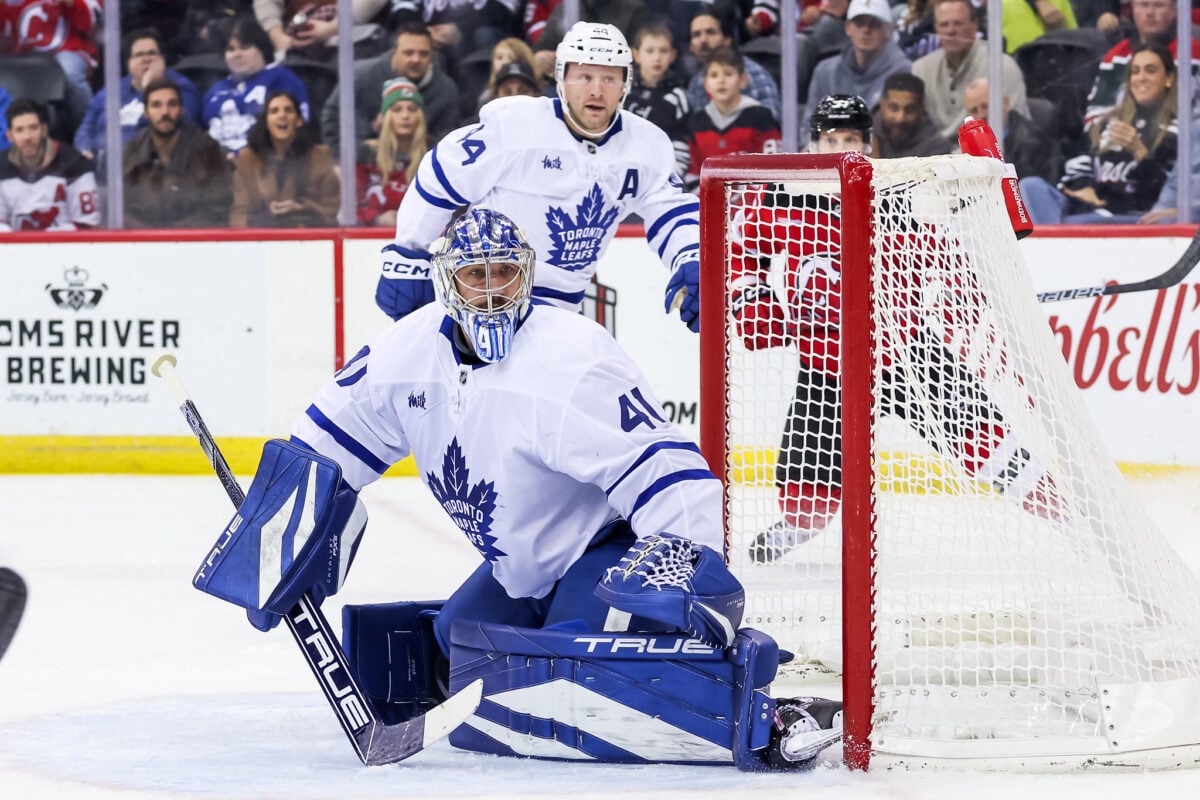
Goaltending is always the X-factor in the playoffs, and the Maple Leafs made an under-the-radar offseason bet by turning to Anthony Stolarz. So far, it looks like a wise one. Despite early questions and criticism on the first goal, Stolarz responded with a calm, technically sound game, making timely saves and exuding quiet (although he does yell directions a lot on the ice) confidence.
He doesn’t need to be a superstar. He needs to give his team a chance to win. On a night when Linus Ullmark struggled again in playoff action, Stolarz looked like the more composed option—not on paper, but where it matters most: in the crease.
The Definition of Winning Ugly in Playoff Hockey
Winning ugly in the NHL playoffs means grinding out victories through discipline, stability, and timely execution—even when the play isn’t clean, dominant, or pretty. It’s about surviving, embracing the chaos, capitalizing on key moments, and finding ways to win when the stat sheet and advanced analytics say you shouldn’t.
(Jess Starr/The Hockey Writers)
To keep winning ugly, the Maple Leafs must stay composed under pressure, lean on special teams, and trust their depth and goaltending to steal moments.
Winning Ugly Is Still Winning
Game 1 wasn’t a masterpiece. It didn’t have to be. The Maple Leafs sometimes bent, gave up too much at even strength, and still walked away with a four-goal win. That’s what winning ugly looks like — and that’s what playoff hockey often requires.
It’s one win. But if the Maple Leafs can repeat the formula — execution, discipline, special teams, timely goaltending — this series won’t be about how perfect they were. It’ll be about how tough they made it for Ottawa to play their game.
Ugly wins count too. And finally, the Maple Leafs seem built to earn them.
[Note: I want to thank long-time Maple Leafs fan Stan Smith for collaborating with me on this post. Stan’s Facebook profile can be found here.]

Free Newsletter
Get Editor's Choice coverage delivered to your inbox
In-depth analysis, breaking news, and insider takes - free.
Subscribe Free →