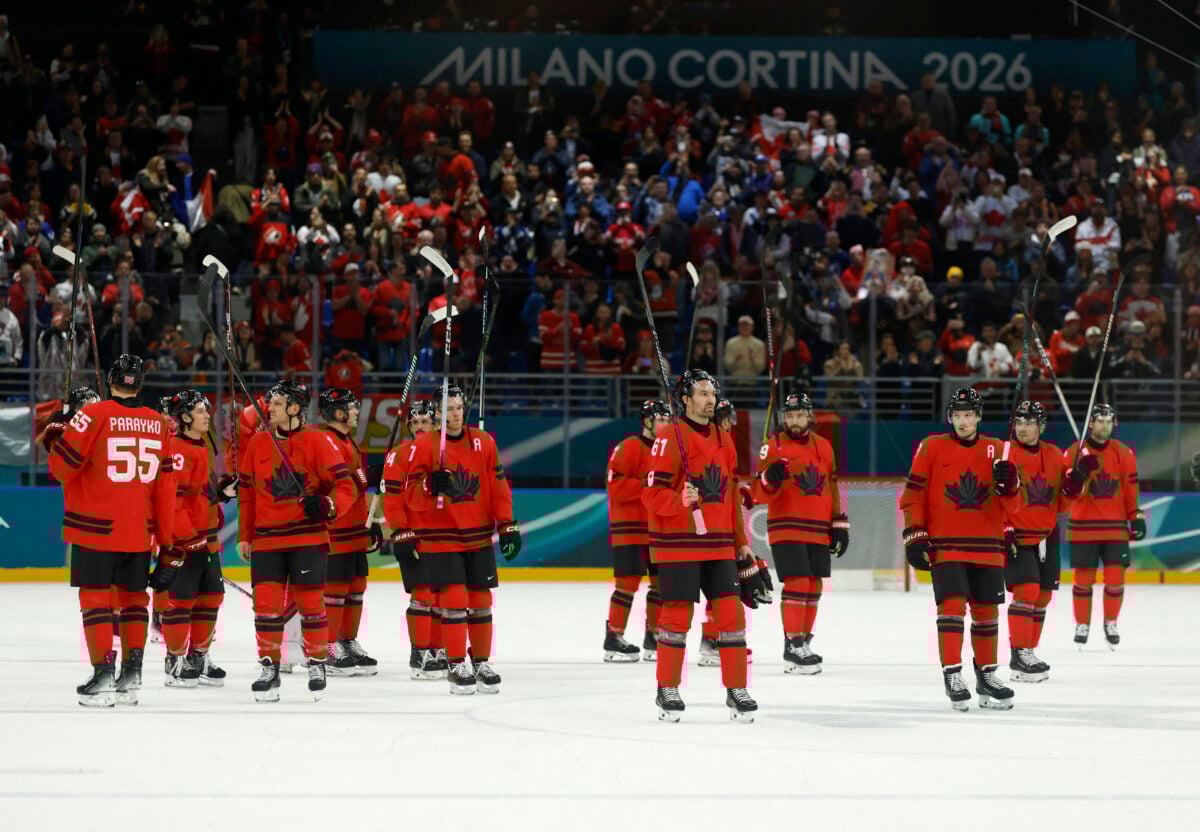
With the 2026 Olympic Games in the rearview mirror, the next Olympic showcase on the NHL’s calendar will take place in 2030 in the French Alps. And when the Winter Olympics head to France, Team Canada will have the opportunity for redemption.
The 2026 silver medalists could look a lot different in 2030. Here’s an early look at the team Canada could ice at the next Winter Games.
Projected Roster for 2030 Canadian Hockey Team
| LW | C | RW |
| Brayden Point | Connor McDavid | Mitch Marner |
| Macklin Celebrini | Nathan MacKinnon | Connor Bedard |
| Brandon Hagel | Nick Suzuki | Seth Jarvis |
| Adam Fantilli | Robert Thomas | Wyatt Johnston |
| Gavin McKenna | Dylan Cozens |
| LD | RD | G |
| Thomas Harley | Cale Makar | Mackenzie Blackwood |
| Matthew Schaefer | Travis Sanheim | Logan Thompson |
| Josh Morrissey | Evan Bouchard | Joel Hofer |
| Jakob Chychrun | Shea Theodore |
- 2026 Olympic participants: 13
- First-time Olympians: 12
It feels as if there’s going to be a changing of the guard for Team Canada. No more Drew Doughty, Mark Stone, Brad Marchand, or Jordan Binnington. The same goes for Sidney Crosby, who will be 42 in 2030 and likely retired from the NHL.
With 13 returning players and 12 newcomers, the 2030 Canadian Olympic team could be a nice blend of new and old, and able to play with pace and tempo.
Apart from Crosby, Canada’s top offensive players will be back and leading the charge – Connor McDavid, Mitch Marner, Nathan MacKinnon, and Macklin Celebrini. We could see the “nuclear line” of McDavid, MacKinnon, and Celebrini reunited at some point, too.
We could see an infusion of youth as well. Adam Fantilli, Gavin McKenna, and Wyatt Johnston bring plenty of offense and should thrive in depth roles for Canada.
Defensively, we could see a similar group as 2026, but with a couple tweaks. Devon Toews and Colton Parayko will likely be a step slower in 2030 and could be on the outside looking in. In their place, we could see Evan Bouchard and Matthew Schaefer step in and bring their top-tier puck-moving abilities to the international stage. Schaefer, in particular, could play a huge role for Canada as a 22-year-old.
Along with Schaefer, expect a heavy dose of Cale Makar and Thomas Harley. Travis Sanheim and Josh Morrissey return to provide stability in the defensive zone.
Related: Team USA’s Projected Roster for the 2030 Winter Olympics
Goaltending once again will be a true wild card for Canada. Jordan Binnington and Darcy Kuemper likely won’t be back, as they’ll be 36 and 39, respectively. Logan Thompson should return given his age and talent level.
Otherwise, it’s anyone’s guess. Mackenzie Blackwood and Joel Hofer should be playing at a high level in 2030. And it’s possible Tristan Jarry, Stuart Skinner, or Samuel Montembault reach a new level by then. Canada could also go young and bring in one of Sebastian Cossa, Jet Greaves, or Devon Levi.
Final Word
After trotting out a veteran-heavy team in 2026, Canada could opt to go younger in 2030. Either way, they should challenge for gold once again. They just might enter the tournament as underdogs – a rarity for Team Canada.
Missed the Cut
Mathew Barzal, Anthony Cirelli, Dylan Guenther, Bo Horvat, Brad Marchand, Michael Misa, Sam Reinhart, Tom Wilson, Bowen Byram, Colton Parayko, Owen Power, Devon Toews, Sebastian Cossa, Jet Greaves, Tristan Jarry, Devon Levi, Samuel Montembault, Stuart Skinner.