When the Detroit Red Wings acquired David Perron at the trade deadline, they not only brought back a familiar face, but a central figure in team culture as well. The fact that it only cost them a conditional fourth-round pick was an added bonus.
So now that Perron is back in the fold, how do the Red Wings deploy him? Where does he slot in almost two years after his last game with the organization? Here’s how I would approach his return.
Red Wings Reintegration Plan for David Perron
First off, the Red Wings need to give Perron time to ramp up. Not only is he joining a new team, but he’s also coming back from hernia surgery and hasn’t played since Jan. 20. He’ll likely need a couple games to get up to speed.
Given this, it makes sense to start Perron out in the bottom six where he can play 10-12 minutes per game initially. Beyond that, the Red Wings should let his play dictate his place in the lineup. Perron’s big-game ability, strong board play, and knack infiltrating high-danger areas would be of value anywhere in the lineup.
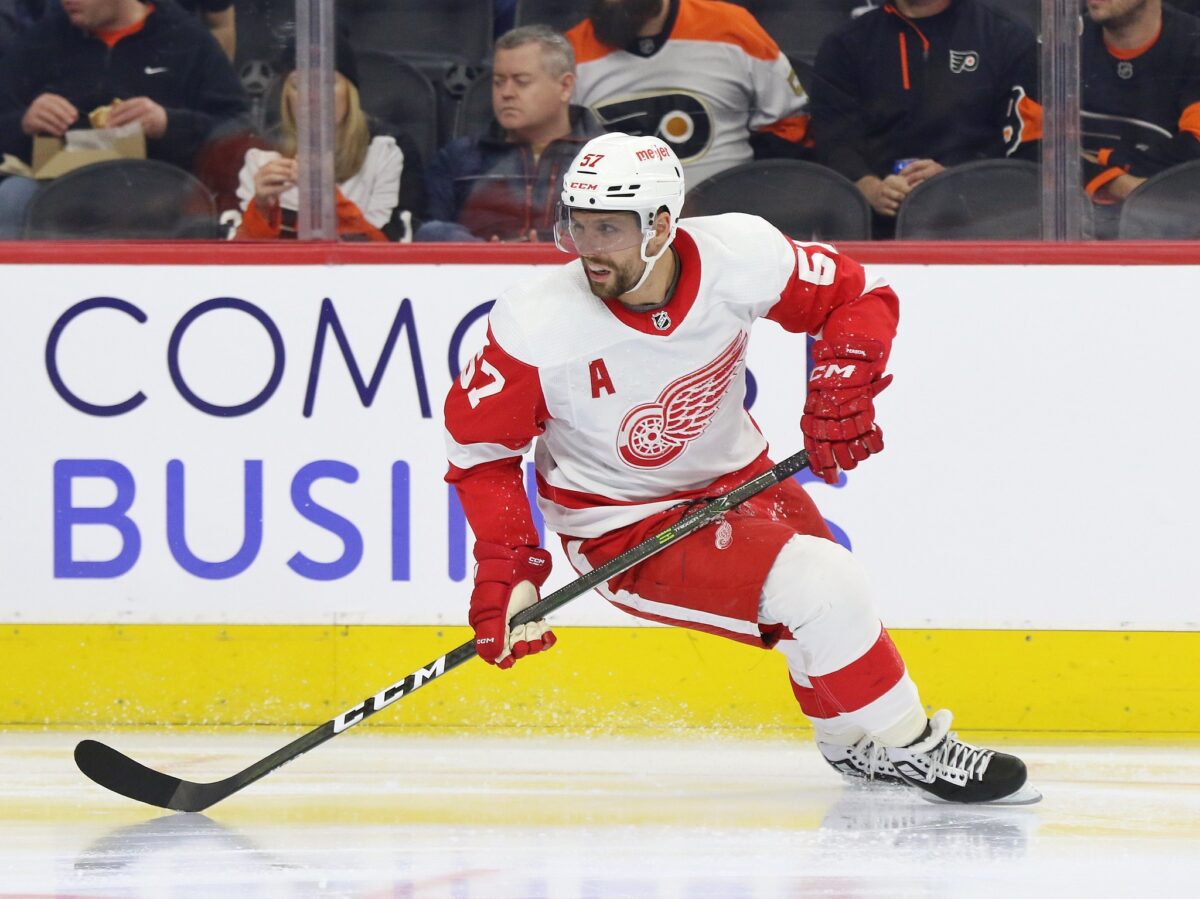
Ideally, Perron should start out on Michael Rasmussen’s wing. Between Rasmussen and J.T. Compher, Perron has much better numbers with the former:
- Perron/Rasmussen: 54.84 GF% and 12.58 HDCF/60 in 334 minutes together
- Perron/Compher: 45.16 GF% and 7.45 HDCF/60 in 274 minutes together
As for the other wing, Emmitt Finnie and Mason Appleton are the best options. Both bring speed and energy, whereas James van Riemsdyk’s slower foot speed could be a concern if paired with the equally sluggish Perron. This also assumes Michael Brandsegg-Nygard and John Leonard are reassigned to the AHL when the Red Wings are fully healthy. If he’s kept around, though, Brandsegg-Nygard would be the perfect complement for Perron.
But, for now, here’s what Detroit’s lineup could look like with Perron, Dylan Larkin, and Andrew Copp back:
| LW | C | RW |
| Marco Kasper | Dylan Larkin | Lucas Raymond |
| Alex DeBrincat | Andrew Copp | Patrick Kane |
| Emmitt Finnie | J.T. Compher | James van Riemsdyk |
| David Perron | Michael Rasmussen | Mason Appleton |
Perron should have a role on Detroit’s power play as well. Ideally, he’s on PP2 and lining up in the “net front” role that Alex DeBrincat mans on PP1, with Axel Sandin-Pellikka (left flank), Justin Faulk (quarterback), Marco Kasper or Andrew Copp (right flank), and van Riemsdyk (bumper) occupying the other spots.
Related: Red Wings’ Trade Deadline Moves Foreshadow Forward Pursuit In Offseason
In this setup, the veteran could leverage his above-average vision to find seams to teammates from near the goal line and would be strong on the puck when cycling down low. Plus, Sandin-Pellikka could walk the line and allow Perron to rotate up to the left flank where he could either shoot or distribute the puck – similar to what Lucas Raymond and DeBrincat do on PP1.
In time, Perron could be ready for a larger role – potentially in the top six. But, again, he needs to earn more responsibility with quality play first.
Final Word
After the trade deadline wrapped up, the Red Wings shared that Perron was about two weeks away from game action, meaning his return to the lineup would likely be March 19 against Montreal or March 21 versus Boston. That said, the veteran is no longer sporting a non-contact jersey at practice – he could be back sooner.
Regardless of when he puts on the Winged Wheel again, the Red Wings will need Perron to be a key contributor. He’ll need a game or two to ramp up, of course. But, otherwise, the team needs to be firing on all cylinders to preserve their playoff position – Perron included.
Data courtesy of Natural Stat Trick.
