Finland won the bronze medal in the 2026 Winter Olympic men’s hockey tournament, and it was another reminder of what works about best-on-best hockey. In the bronze-medal game, Finland scored four goals in the final period to solidify a 6–1 win over Team Slovakia.
Related: 3 Takeaways From Finland’s 6-1 Bronze Medal Win Over Slovakia at the 2026 Olympics
The medal matters. Finland can still build a national roster that wins. The harder question is whether management is built for the next cycle, with the 2028 World Cup of Hockey now locked into the NHL calendar and best-on-best events set to return regularly.
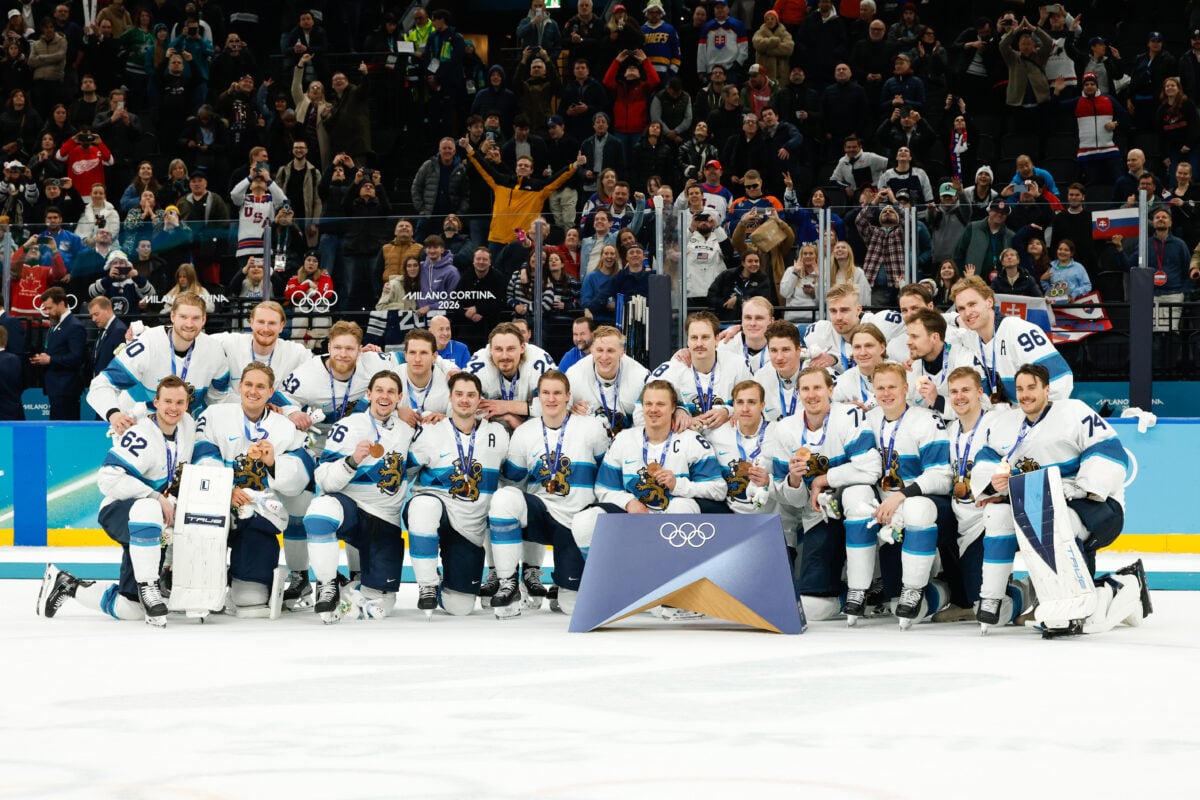
Finland Team Construction: Grade B+
Finland’s roster strategy was clear months before puck drop. They did not have the NHL depth of the top nations, but the federation selected 24 NHL players and one skater from Switzerland’s top league, leaning into experience and familiar roles.
Head coach Antti Pennanen sold it as a group ready to contend. Canada and the United States can leave legitimate NHL first-line talent at home and still dress a fourth line that plays like a third. Finland cannot.
What Worked:
- Role Fit Was Clean. Finland brought a defence-first backend and enough scoring touch to finish chances without needing track meet hockey. In the bronze-medal game, Finland’s core produced offense while the group stayed composed until the third period broke open.
- Experience Was A Feature, Not A Slogan. The roster was built around players with deep NHL mileage, and NHL.com’s Finland roster breakdown stressed how much history and NHL hardware were in the room.
What Didn’t:
- Thin Margin At The Edges. Finland’s one non-NHLer, defenseman Mikko Lehtonen, made clear that the roster did not have room for pace mismatches when the game tightened against top opponents. It showed how much a successful roster construction depends on NHL Depth. Not that Finland was far out of contention with their NHL stars, but they were the defending gold-medalists from the last Olympics when NHLers didn’t participate.
- Top End Depth Gap Still Exists. Finland can win medals with their structure, but it has less surplus star power than the North American giants. When the opponent’s fourth-best forward is still a top-line threat, Finland’s roster has to be nearly perfect.
Finland achieved what it was designed to acheive: a medal and a chance in the semifinal.
Finland Coaching Staff: Grade C+
This grade is not only about systems. Finland’s structure held up to reach the medal round. The issue was bench management under pressure and decisions that turned into tournament turning points.
Canada vs. Finland Semifinal: The Decisions
Canada beat Finland 3–2 in the semifinal on Nathan MacKinnon’s power-play winner with 35 seconds left in the game after overcoming a two-goal deficit. Finland was unable to close after going up 2–0 because of Canada’s late rally against the defending champions.
That late offside challenge was not the issue. It was a logical swing and the only option in the final seconds. The more questionable coaching decision happened earlier in the third period, when chaos in the crease led to Canada’s tying goal, and Finland did request a goaltender interference review.
Finland’s staff chose the conservative path, in part because a failed challenge means a penalty. It’s a defendable decision, but it was also the defining choice in a best-of-best semifinal. The coaches did not need to be reckless, but they needed to be decisive in key moments like this one.
Usage And Communication: The Pennanen Theme In Milan
Yle’s on-site reporting during the tournament showed how quickly bench decisions became public talking points. The discussion around Mikko Rantanen’s ice time came down to Pennanen, who cited internal analytics that differed from IIHF numbers. That kind of dispute is minor, but it underscores how much Finland’s decisions were being dissected in real time.
That matters when you are evaluating staff performance. Finland’s players were not only playing for medals. They were playing inside a constant feedback loop of questions about usage, line combinations and trust.
Finland’s Off-Ice Issue: Confidence In The Staff
Finland’s most damaging storyline was not tactical; it was the players’ lack of confidence in their head coach. Ilta-Sanomat said Finnish NHL players approached management about replacing Pennanen after a poor 4 Nations showing and suggested Florida Panthers head coach Paul Maurice as a preferred option. That is second-hand reporting through a tabloid outlet, but it matches the broader public debate that surfaced in Finnish coverage during the Olympics.
Even if we remove Maurice from the discussion, the storyline is still important. Finland’s NHLers are openly considering what an NHL bench looks like and whether Finland’s national team should mirror it more closely.
What This Means For The Next Best-on-Best Tournament
The NHL and NHLPA have already announced the World Cup of Hockey will return in February 2028 and framed it as part of a regular rotation that includes Milano Cortina 2026 and the 2030 Olympics.
Finland’s roster approach and structure will not change much. The player pool depends on what’s available. The edge is in management and coaching staff structure and operational speed. Finland proved in Milan that its roster construction still produces medals. The next step is getting the bench to the same standard, because Canada and the United States are not slowing down.
