The Colorado Avalanche’s chances of getting their captain back increase daily, and those odds significantly improved on Wednesday morning (April 9). The organization announced that Gabriel Landeskog has been loaned to the Colorado Eagles of the American Hockey League (AHL) for a conditioning stint. Under the current collective bargaining agreement, Landeskog can play up to three games with the Eagles without needing to be activated from long-term injury reserve, meaning his cap hit will not affect the Avalanche’s salary cap.
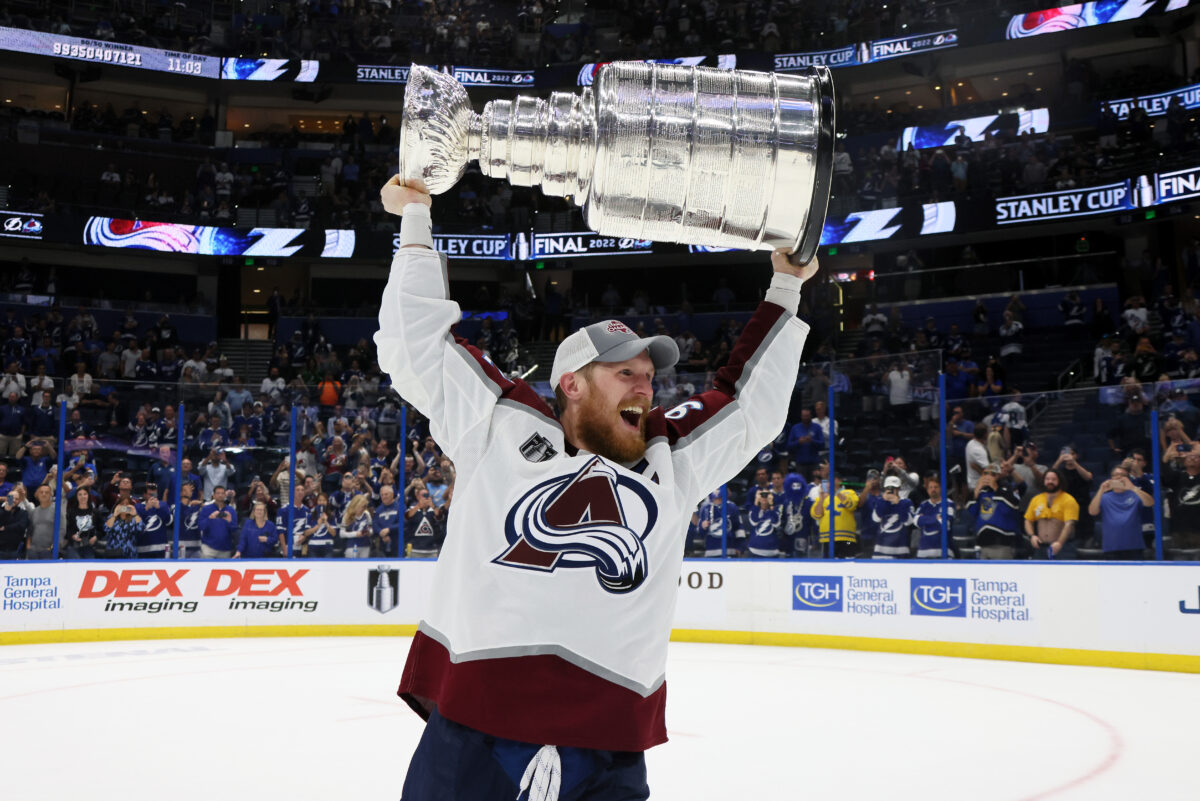
Landeskog practiced with the Eagles on Wednesday, and the team will provide further updates on his status in the coming days. After Tuesday’s game against the Vegas Golden Knights, Avalanche coach Jared Bednar shared some encouraging comments about his captain and the challenges Landeskog has faced in his return attempt. His last NHL game was Game 6 of the Stanley Cup Final against the Tampa Bay Lightning on June 26, 2022.
Since then, Landeskog has undergone multiple surgeries on his knee, including cartilage transplant surgery in May 2023. In recent weeks, he has been practicing more with the Avalanche, and the next step is for him to take on some real contact. With there being more footage of him skating, practicing, and now potentially playing hockey again, what could he look like on this new Avalanche team, and where could he fit in the lineup if the team sees him ready to go, potentially for Game 1 of the Stanley Cup Playoffs?
Where Could He Fit In the Lineup?
Integrating Landeskog into the lineup will be challenging for Bednar. He hasn’t dealt with a typical injury; he was sidelined for three years, significantly longer than the usual season-long recovery. Landeskog will likely need several games to regain his game speed and additional time to find his role within the system. Before his injury, he was a key player in the top six, frequently playing alongside Nathan MacKinnon and Mikko Rantanen. I don’t expect him to start in the top-six for Game 1, as the Avalanche will probably ease him back into play.
To include Landeskog in my Game 1 lineup, I would give him Miles Wood‘s spot on the third line. A line featuring Landeskog, Charlie Coyle, and Ross Colton could be quite strong. While placing him on the fourth line might seem practical, I would prefer not to disrupt the chemistry of the Parker Kelly-Jack Drury-Logan O’Connor line. Another possible combination could place him on the second line alongside Brock Nelson and Marty Necas. Nelson hasn’t been as effective as a net-front presence as I had hoped, but Landeskog has a history of excelling in that role. The crucial question remains: Can he handle the physicality required at the front of the net?
In the last line pairing, I would place Landeskog on the fourth line, which contradicts my earlier statement about not wanting to break up the line. Reluctantly, I’ll be dropping Kelly to make room for Landeskog. Drury and O’Connor’s excellent hustle will help support Landeskog as he gets back into the swing of things. Landeskog is a solid defensive forward, and I think he can handle taking on a bit of a shutdown role while being able to give him solid minutes per game, around 13-15 minutes, instead of placing heavy top-line minutes on someone who hasn’t played professional hockey in two years.
Remembering What Landeskog Can Bring to the Lineup
Since it has been a while, many people understandably forget that Landeskog can bring nearly everything to the Avalanche. He is like a Swiss Army knife; although he is Swedish, the comparison still fits. When he was healthy during the 2021-22 Stanley Cup run, he played as a top-six winger, averaging over 20 minutes of ice time per game while contributing on both the power play and penalty kill.
You can consider him a jack of all trades but a master of none. He didn’t have a shot like Rantanen, but he could deliver an impressive shot. While he may not have MacKinnon’s playmaking ability, he was always reliable when making that crucial pass to set up a play. Landeskog excelled in doing the “dirty” work that made the top line shine—showing physicality, grit, and a net-front presence, all while possessing a solid skill set.
Related: Avalanche Prospect Report: Curran, Nabokov, Humphreys & More
It’s difficult to expect Landeskog to perform at the same level he did before his injury, especially when it comes to logging significant minutes after serious rehab. The team will likely want to ease him back into play. We recently saw this approach with Wood, who returned to the lineup against the Los Angeles Kings on March 27 and played just under 10 minutes.
Expectations Need to Be Set On His Return
Landeskog’s potential return has been a significant focus for the Avalanche over the past two seasons. Despite recent news, there have been very few updates about his progress. Information regarding his skating, practice sessions, or any timeline for returning to the Avalanche or the Eagles has been scarce. The past two playoffs have not been what fans or the team expected and having your captain on the sidelines who desperately wants to play and knows how much of a difference he can make on the ice is rough to see, especially with his cap against the team and how they need to manage contracts around it and his potential return.
With Landeskog’s potential return either this postseason or the start of next season, fans will need to know that we might not see the same level of play from him that we saw before and need to be aware of that if he ends up looking a bit “rusty” when making his return. The most important aspect of the captain’s return is his leadership. I have long believed there has been a leadership issue in his absence. Even if he only plays six minutes, his presence in the locker room and on the bench is invaluable, especially with the return of “Condor” Erik Johnson. That makes his return so valuable—the hard work and effort his teammates recognize in him as he returns from an injury that rarely affects NHL players, especially at 32 years of age.
