It’s a saying as old as time in the NHL: you’re not in trouble in a playoff series until you lose on home ice. For the Philadelphia Flyers, that had to bring some comfort after they dropped the first two games of their Eastern Conference semifinal series on the road against the Carolina Hurricanes.
But like many clichés, they’re not 100 percent true. The Flyers were in trouble from the start of this series, heavy underdogs on paper and blitzed to open Game 1. A better performance in Game 2 restored some optimism, only for Noah Cates’ series-ending injury and Owen Tippett‘s lingering absence to keep the gap between them and the Hurricanes even wider than it could’ve been.
That gap stretched to its breaking point on Thursday night, as the Hurricanes moved within one win of consecutive sweeps and a third Eastern Conference Final in four seasons. Two early third-period goals allowed Carolina to pull away en route to a 4-1 victory, putting the Flyers on the brink of elimination for the first time in these playoffs.
Fight to Finish
Just like in overtime in Game 2, the Flyers had an excellent first 15 minutes of Game 3’s opening period. Just like in overtime in Game 2, the only goal that came of it went in the back of their net.
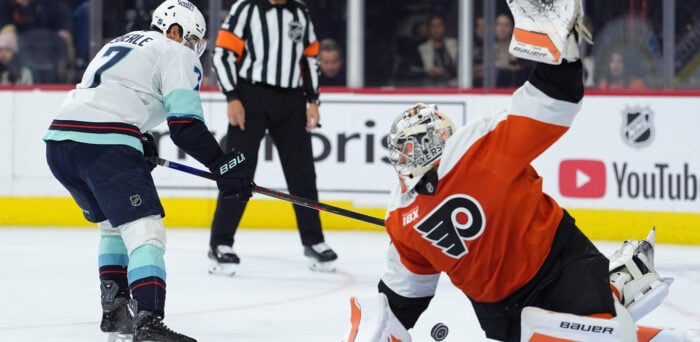
The deja vu was at its strongest early, with Travis Konecny getting a chance to right the wrong of his breakaway miss, only to hit the post 1-on-1 with Frederik Andersen a minute into the game. Porter Martone did the same, cutting down the middle (like with Konecny in Game 2, a tremendous Trevor Zegras feed found him) just a few minutes later.
Martone nearly had an assist later, as his backdoor feed to Alex Bump was read perfectly by Andersen, who kicked the puck away. But the real gut punch came late, moments after Jordan Staal opened the scoring. A hard rebound blast by Rasmus Ristolainen appeared heading in after bouncing off Andersen’s shoulder, only for the ever-aware Jaccob Slavin to sweep it off the goal line.
Fortunately, the Flyers would strike early in the second period. On a delayed Carolina penalty, Zegras capitalized on a fortunate bounce to bury a rebound goal, his first tally since Game 3 of the first round. It was a positive moment for the Flyers up a man, something that would very much prove to be an outlier as the night progressed.
For the series, the Flyers are shooting just 4.5% (three goals on 74 shots), way below their 10.32% rate from the first round and 11.49% mark in the regular season. Ironically, the Hurricanes are beating the Flyers somewhat similarly to the way teams usually beat them, with the Canes unable to finish on chances due to a lack of players who are highly talented but not true gamebreakers. Still, their roster betters the Flyers’ on paper, and it’s shown across the first three games of this series.
Up a Man, Down a Goal
It’s no secret that the Flyers’ power play isn’t a strength. That was on display in Carolina, when the Flyers went oh-fer in Game 1 and only managed three combined shots on seven tries in Game 2. The first of those went in the net, and Philadelphia applied pressure on an opportunity in overtime, but their work still left a lot to be desired.
That only grew on home ice in Game 3. The Flyers’ first chance was boring enough, but it would be a highlight compared to what came next. On both their second and fourth chances, Jamie Drysdale took a penalty while the Flyers were on the PP.
But the huge blemish was Drysdale failing to get the puck in deep after a faceoff win late in the second. That led to a Carolina rush the other way, and Drysdale and Zegras’ attempt to switch coverages to avoid a 2-on-1 only opened up Jalen Chatfield to wire in an agonizing one-timer.
Somehow, the Flyers still had a golden chance to turn things around shortly after. Drysdale’s second power-play penalty (third overall) looked like it would result in 4-on-4, but Seth Jarvis was called for high-sticking Travis Konecny as the play ended. Then, an unsportsmanlike conduct on the Carolina bench opened it up for a 75-second 5-on-3.
Even switching to a five-forward unit, which produced Martone’s first career goal in the same scenario late in the regular season, couldn’t solve the issues. Entries were a huge issue all night (Drysdale’s first penalty was for interference while trying to set up a blue line pick, although it wasn’t an egregious play), and even when the Flyers did get set up, their shots were from only okay areas and their passing plays were a tick off.
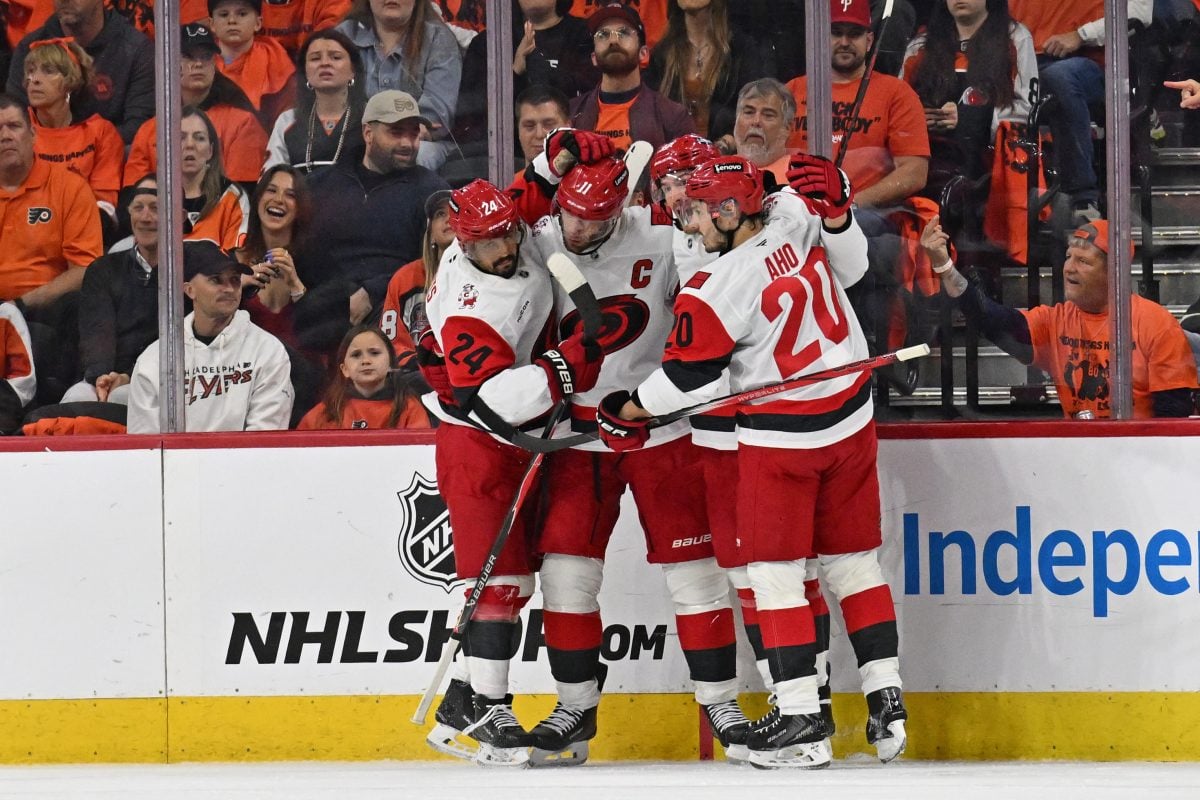
Fans were upset that the original power play Carolina scored shorthanded on was only a minor, as Taylor Hall’s dangerous hit on a kneeling Travis Sanheim along the wall was a dangerous check. But even if it had been ruled a five-minute call, there’s little evidence to suggest the Flyers would’ve capitalized. Carolina scoring two power-play goals, including the playoff rarity 4-on-3 goal from Andrei Svechnikov, only added more salt to the wound.
Stay Even to Stay In It
If you’re looking for one tiny piece of optimism for the Flyers, their 5-on-5 play in the last two games has been fairly sound. There just hasn’t been enough of it for it to matter as much as it usually does in the playoffs.
Philadelphia was shorthanded eight times on Thursday, its most in a playoff game since the infamous bracelet disaster in Game 3 of the 2016 Eastern Conference quarterfinals. Somehow, bracelets were also handed out for this Game 3, which also put the Flyers in a 3-0 series hole, although they mercifully stayed in the stands this time around.
Over the last two games combined, the Flyers have a 5-on-5 expected goal (xG) share of 45.75% (per Natural Stat Trick). That’s a marked improvement over their 38.42% mark in Game 1 and slightly better than their 44.44% mark in the regular season when they avoided a regulation loss across four meetings.
Some of the calls were debatable – they always are in the playoffs – but post-whistle penalties like Christian Dvorak’s late second-period roughing minor can’t happen. Otherwise, the Flyers will only play four playoff games against the Canes, too.
What’s Next
It feels weird that one Eastern Conference semifinal series has barely begun while another already feels over. But that’s where things stand right now, with the Buffalo Sabres up 1-0 over the Montréal Canadiens, while the Hurricanes could close out this series Saturday at 6 p.m. before that series even shifts venues.
You could argue about whether it would be a good thing if Carolina pulls off back-to-back sweeps. If the Sabres-Canadiens series goes the distance, the earliest the Eastern Conference Final could start would be May 20. That would be an 11-day break for Carolina if they finish things off in Game 4.
The Flyers will try their hardest to avoid that. The last time the franchise was swept in the playoffs was the 1997 Stanley Cup Final by the Detroit Red Wings. They’ve played well enough at times the last two games to believe they can at least keep that footnote intact. But a Flyers team that has prided itself on defying the odds over the last two months seems to have finally met a mountain too steep to climb.
Free Newsletter
Get Philadelphia Flyers coverage delivered to your inbox
In-depth analysis, breaking news, and insider takes - free.
Subscribe Free →