


When Craig Berube was hired as the head coach of the Toronto Maple Leafs, there was an undercurrent of anxiety in Toronto. Known for his hard-nosed coaching style and no-nonsense demeanour, many fans braced for an autocratic approach that might not mesh with the skill-heavy roster. But what unfolded throughout the season was something far more nuanced and far more effective.
Here are four things Berube got right in his first season as head coach of the Maple Leafs.
1. Berube Built a System—and Got Buy-In
The most critical thing Berube did was implement a clear, structured system that players actually embraced. Unlike in years past, where structure often collapsed under pressure or was loosely followed depending on the opponent, this season’s Maple Leafs stuck to their blueprint.

You saw it in their play without the puck. The Maple Leafs developed a real defensive identity—limiting chaos in the crease, defending the slot, and consistently clearing traffic from the front of the net. That structure led to fewer second-chance opportunities for opponents and created the kind of environment where both Anthony Stolarz and Joseph Woll could thrive.
Related: Craig Berube Could Be Toronto Maple Leafs’ Missing Piece
This wasn’t just a defensive overhaul. It was a culture shift. For a coach with a reputation for rigidity, Berube managed to teach his system without alienating the core. The result? He created a disciplined, confident, and cohesive team down the stretch.
2. Berube Let the Stars Be Stars—Without Letting Them Off the Hook
One of the early concerns about Berube’s hiring was whether his coaching style would clash with Toronto’s high-end talent, especially players like Auston Matthews, Mitch Marner, and William Nylander. But instead of stifling them, he found a way to hold them accountable while empowering them.
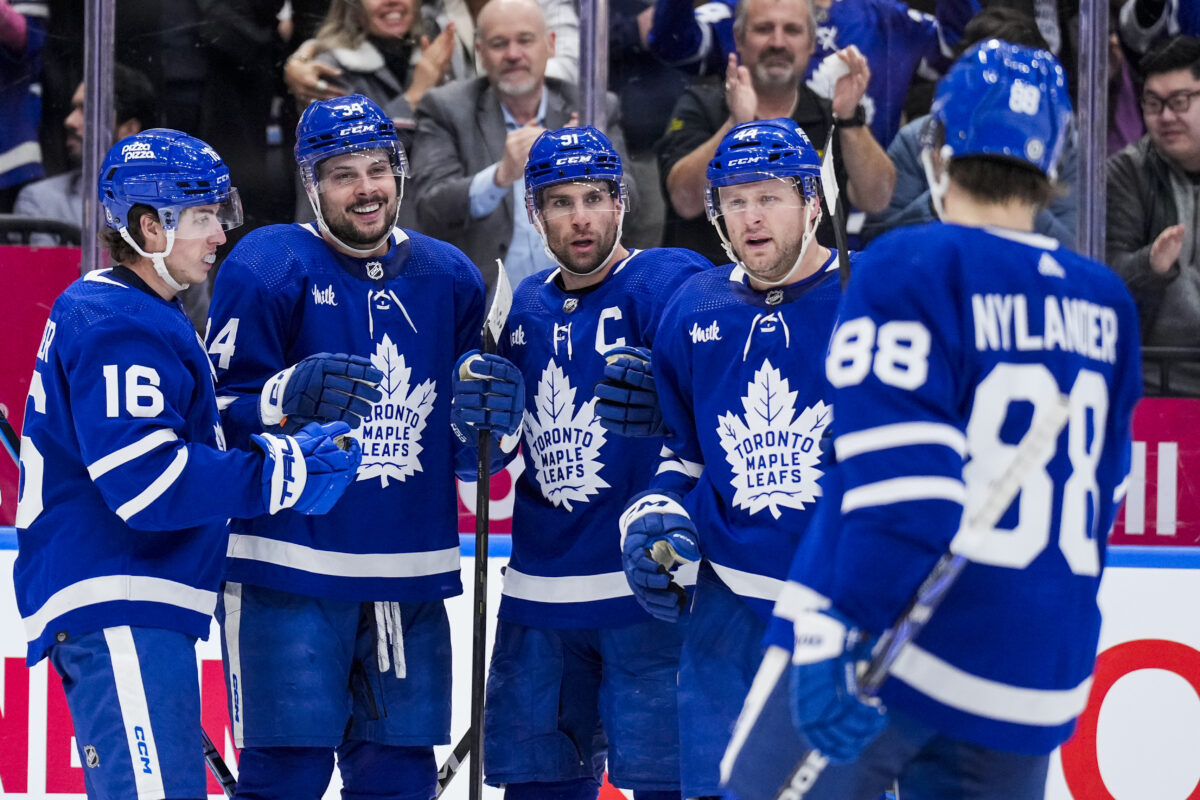
(Photo by Kevin Sousa/NHLI via Getty Images)
Marner and Matthews hit significant milestones—100 points and 400 goals, respectively. But more importantly, they did it while buying into both sides of the puck. Matthews evolved into a more complete playmaker. His helper on Marner’s goal last night was a thing of beauty. Marner played some of the best two-way hockey of his career. That doesn’t happen without trust from the coach and clarity in the system.
Berube struck a delicate balance: he gave the stars the space to shine while making sure they knew they were part of a bigger structure. That kind of duality—freedom and accountability—isn’t easy to achieve, but he did it.

Get your Maple Leafs fan gear from NHLShop.com NOW with FREE SHIPPING (with minimum purchase). Check out all the great team stuff HERE.
3. Berube Adapted—and Didn’t Force Roles That Didn’t Fit
For a coach with a reputation for rigidity, Berube showed a surprising level of adaptability. He didn’t arrive with a fixed lineup in his mind. Instead, he tinkered. He tested. He figured out who fit where in real time and wasn’t afraid to make adjustments.
Related: Reviewing the Maple Leafs’ Strong 2024 Free Agent Class
Look no further than the emergence of Stephen Lorentz and the bottom six. Lorentz signed after a professional tryout (PTO) and became a key depth contributor. The line of Lorentz, Scott Laughton, and Calle Järnkrok found chemistry late in the season and added a physical, responsible edge to the Maple Leafs’ game. Those aren’t just lucky accidents—they result from a coach willing to adjust and reward performance over pedigree.

The same goes for his handling of Max Domi. After an up-and-down start, Berube slotted Domi onto a second line with Tavares and Nylander, where his playmaking started to click. Domi recorded two assists in a recent win over the Carolina Hurricanes and has played some of his best hockey in the season’s final stretch. That’s good coaching: recognizing when a player is surging and putting him in a position to succeed.
4. Berube Didn’t Micromanage in the Final Stretch
As the Maple Leafs went 8-1-1 down the stretch and clinched the Atlantic Division with a statement win over the Buffalo Sabres, Berube could’ve tightened the screws. Instead, he trusted his group.
He expected Tavares to deliver, leaving him in his crucial place on the team. As a result, Tavares found his rhythm after the 4 Nations snub, putting up 17 goals in the final two months. He allowed the goaltending tandem to rotate naturally, rather than declaring a premature No. 1. He didn’t overwork his stars, and now he’s in position to rest them with the division locked up.
Related: NHL Rumors: Nurse, Oilers, Landeskog, Avalanche, Couture, Sharks
That kind of composed leadership—trusting the system and the room—is exactly what this team needed. Berube was never guilty of overthinking or overreacting.
Berube: A Coach Who Met the Moment
Berube came into the season with a reputation. He leaves the regular season with something far better: results. The Maple Leafs didn’t just win the division—they evolved. And that evolution started behind the bench, with a coach who taught a system, trusted his players, and proved he could adapt to the moment.
With the playoffs looming and a Battle of Ontario ahead, Berube faces his most significant test. But if the regular season was any indication, the Maple Leafs are in good hands.

