How many times will the Los Angeles Kings make the same mistake? How many times will they actively kill themselves and give away games? How many more games will it take before they realize that sitting back and being complacent against an offensive powerhouse doesn’t work?
These are questions everyone’s asking because multiple head-scratching decisions over the past two games have cost this team big time. It’s been four straight seasons, and still, it doesn’t seem like they have figured it out, and once again, another third period of sitting back and allowing the Edmonton Oilers to take it to them shift after shift proved disastrous.
For a team that looked to have grabbed this opportunity by the throat early on in the series to finally slay their demons and get over the hump, has now quickly turned into a team that has allowed the Oilers to make this series interesting.
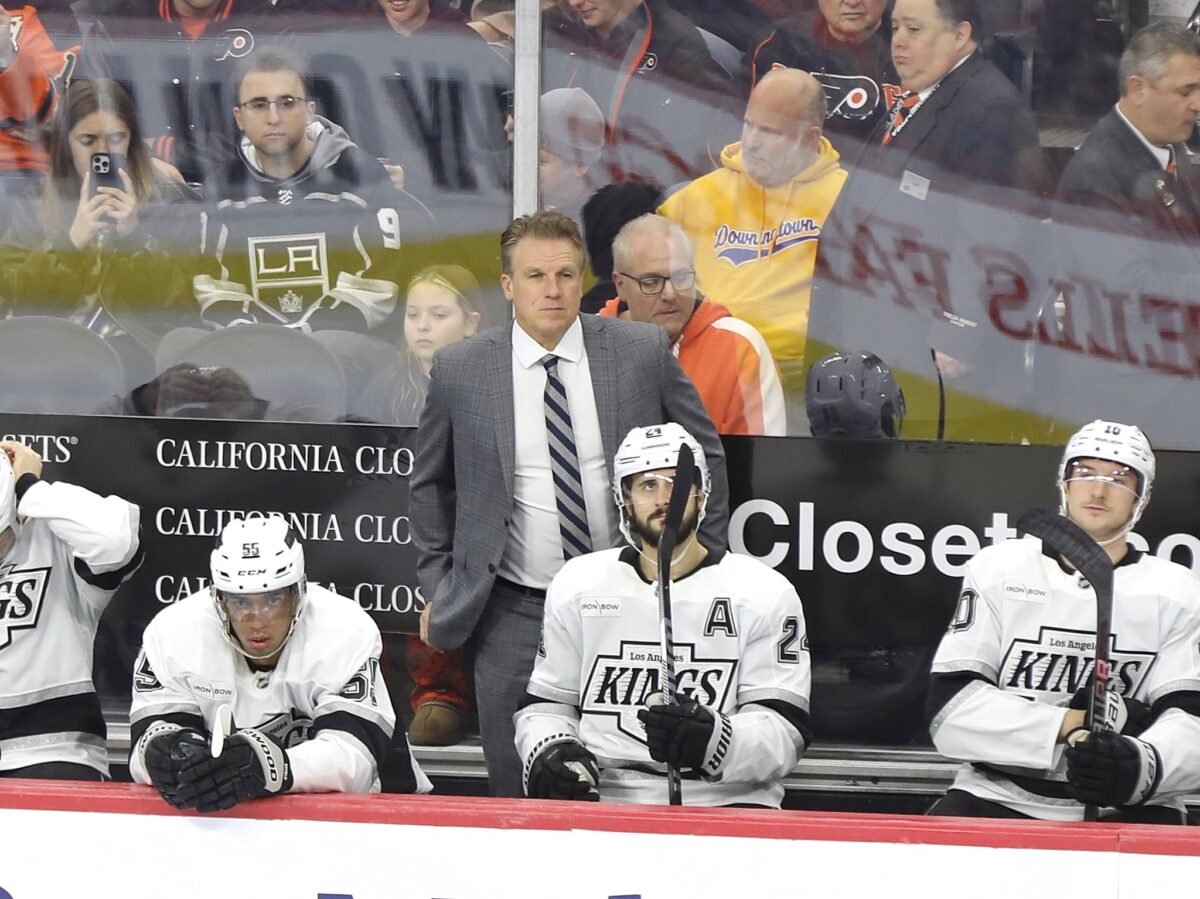
With 29 seconds left in regulation, Evan Bouchard found the back of the net from the point after Quinton Byfield could not get the puck out of the zone. Instead of a quick and simple chip off the boards, he tried to skate around Bouchard and wasn’t successful.
“How do I change it?” head coach Jim Hiller questioned with displeasure when asked how his team needs to change their approach in the third period. “Next question, please, we’re (not) that far away on the empty net. Q (Byfield) chips that one out, Bouchard makes a good play, (and) we’re not even talking about this, so how about that.”
Not a great response to a completely warranted question, and based on the continued lack of accountability, it doesn’t look like this group plans on changing anything anytime soon.
Sure, if Byfield was able to get the puck out of the zone on that play, he most likely would have gone down the length of the ice and sealed the deal. The problem is, it never should have gotten to that point in the first place. That play should never have been the game-deciding play, and it wouldn’t have been if the Kings did anything other than dump and change, refuse to forecheck, and try and sit back and neutral zone trap their way to a win for the entire third period.
The momentum the Oilers gained in that third period was so strong that it didn’t matter how the Kings came out in overtime. It was too late, the Kings gave the Oilers life, and they ran away with it. If you watched any of that overtime period, you knew that it wasn’t a matter of if, but when, the Oilers were going to end it.
The only reason it took almost an entire period for the Oilers to put this one to bed was because Darcy Kuemper wouldn’t let them. He stopped 16 shots in overtime, a few of which were spectacular. Kuemper, whose numbers throughout these four games haven’t looked the greatest, looked a lot more like the Kuemper who put up Vezina-caliber numbers this season, stopping 44 of 48 shots for a .917 save percentage.
“Darce was outstanding,” said Phillip Danault postgame. “We got to find a way to win there, but some big saves from him there, so we’ll take the positive out of this.”
Aside from Kuemper, Danualt’s performance was one for the ages. He seemed to be all over the ice, making a constant positive impact both offensively and defensively. Danault, who finished with the second-most time-on-ice out of any Kings forward, collected two primary assists, setting up both Trevor Moore and Warren Foegele.
“Best hockey I’ve seen him play,” said Hiller. “Blocking shots, winning faceoffs, killing penalties. He’s been really, really good, and that’s what you need at this time of the year. It’s always great to see players rise above, and he’s one of those guys that have done that so far.”
Kings Continue to Stray Away From What Works
Through 40 minutes of play in each of the four games, the Kings have had a lead. When they are skating, applying pressure on the Oilers, and trying to create plays, it hasn’t even been close. In Game 1, they had a 4-1 lead after two. The Oilers came back with a massive third period where they dictated the pace of play, and if it wasn’t for a lucky bounce with 41 seconds left to play, they would have fumbled that one as well. In Game 2, they had a 3-1 lead, Game 3 they had a 4-3 lead, and Game 4 had another 3-1 lead. The Kings were in a terrific position in each game to do something they were so good at all season long: holding onto third-period leads and finishing strong. Well, that hasn’t been the case for three of the four playoff games.
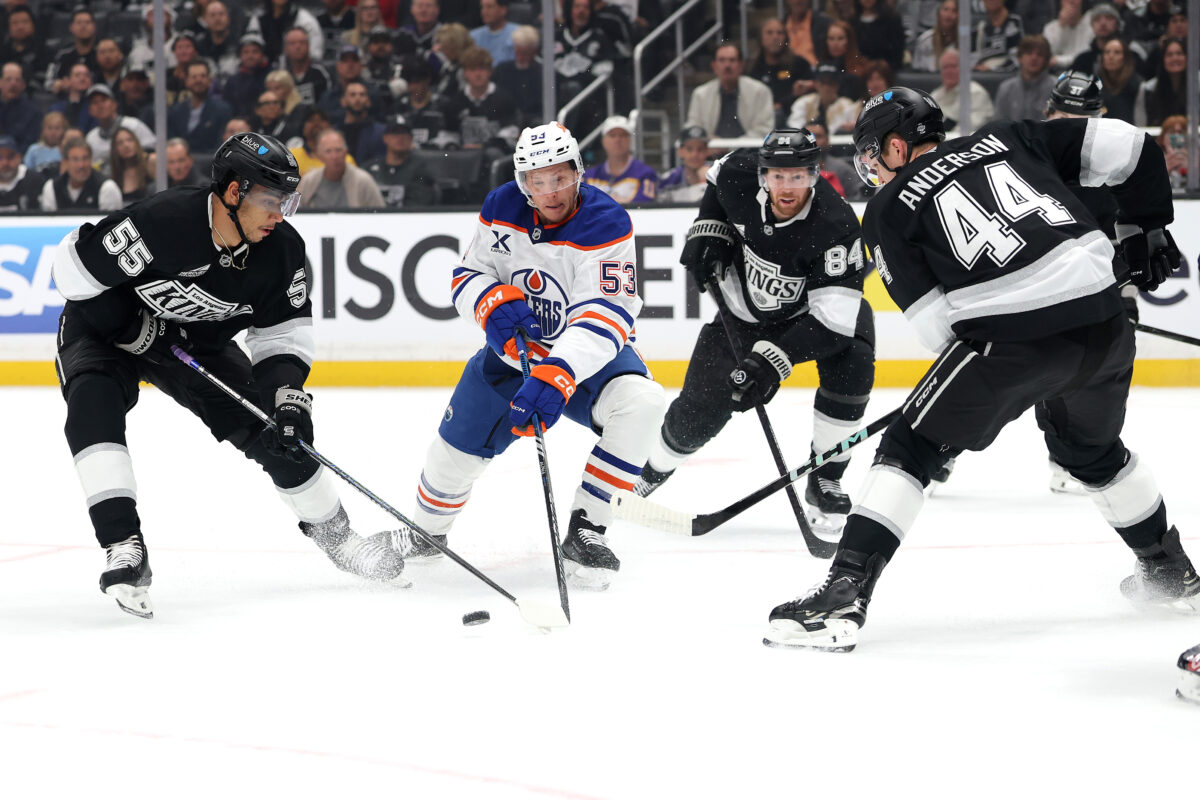
The Kings outshot the Oilers 17-10 throughout the first two periods of last night’s game, which propelled them to a 3-1 lead heading into the third. The Kings then took the foot off the gas, were outshot 16-6, and the Oilers scored twice to tie it. The Kings had just three scoring chances in the third period compared to the 24 chances they generated throughout the first two. Their Corsi for percentage (CF%), scoring chance for percentage (SCF%), and expected goals-for percentage (xGF%) in the third period were all lower than they were for the first two. In overtime, the Oilers outshot the Kings 17-7 and outchanced them 17-5, ultimately winning the game on the power play with less than two minutes remaining. Just a complete shift from the first and second periods to the third in the way the Kings tackled the game, and they suffered because of it.
In Game 3, the Kings did the same thing, sitting back and relying on structure with just a one-goal lead, and they ended up falling 7-4. After seeing this approach fail in Game 3, the Kings went ahead with it again, only to be met with the same ending.
Related: Kings Make Game-Deciding Mistake, Give Oilers Life In Game 3 Loss
Defense and goaltending are by far the Oilers’ weakest points, and the Kings have exploited that in every game. Forcing the Oilers to play defense has done nothing but prove their inability to do so. So why, after seeing a strong forecheck and willingness to play in the offensive zone, continue to work against the Oilers, does that style completely vanish in the most important period of the game? The one time the Kings kept pushing, forechecked hard, and played in the area of the ice where the Oilers are the weakest was in Game 2, when they potted three goals in a row in the third and ran over the Oilers 6-2.
For the past three seasons, you could say that the Oilers were by far the better team, and that’s why the Kings were unable to get past them each time, but what will be the excuse this time if they manage to lose this series? Because, for the first time in the past four seasons, the Kings can’t use that excuse.
If they lose this series, it’s not because they weren’t the better team; it will be because they gave it away for no reason. This has been their series to lose, and after taking a 2-0 series lead, they have been actively killing themselves. The Kings could have 100% swept the Oilers with ease, and they were in the perfect position to do so, being in control through 40 minutes in each game.
Top Players Are Being Overplayed
Aside from the terrible systematic approach, rotating just nine forwards and four defensemen isn’t sustainable either. Combine the willingness to allow the Oilers to continuously attack, while the same 13 players play is undoubtedly going to cause fatigue. By the time this game got to overtime, the Kings were out of gas. The same four defensemen kept being rolled out against a relentless Oilers forecheck that saw way too many extended shifts for multiple Kings. Fatigue transforms into laziness, and laziness transforms into taking penalties, which is exactly what happened in overtime when Vladislav Gavrikov tripped Connor McDavid. Whether or not that should have been called or not, the Kings were tired and were unable to get the puck out of the zone, which would have led to another penalty if that one hadn’t been called.
The Kings have had success running three defensive pairs all season, and all six/seven regular defensemen played well on most nights. So why all of a sudden the lack of trust in players like Brandt Clarke, who only saw 11:58 of ice time, Moverare, who only had three shifts and spent a total of 2:26 on the ice, or Jordan Spence, who was a healthy scratch in Game 4? The fourth forward line of Samuel Helenius, Jeff Mallot, and Alex Turcotte proved reliable to end the regular season, but they have barely played in this series. Turcotte has sat for three of the four games, Helenius has played less than 12 minutes in four games, and Mallot has played 16:43 in four games. There’s not much to judge and analyze from these players’ games because the trust in them to play in these important games is clearly not there.
It’s not to say that the top three lines and top four defensemen aren’t capable of playing those minutes, it just logically doesn’t seem like the best approach when thinking about long-term fatigue levels in a lengthy series, or possibly what I would assume the Kings hope, is a lengthy playoff run.
To this point, the Kings have no one to blame but themselves as to why this series is tied at two apiece instead of them already moving on to the second round. They don’t need any more evidence to know that this is not going to be the way they beat the Oilers, and if they continue to sit back and play conservatively in the third period, they will waste the best opportunity they have had in four seasons to finally beat this team and move on to the second round.
