The draft lottery didn’t go the Vancouver Canucks’ way this year, but picking at third overall in the 2026 NHL Draft is far from a consolation prize. While the sting of a last-place finish remains, the draft board has gifted the front office a franchise-altering dilemma.
The debate in local circles has narrowed down to a classic hockey crossroads: do you take the polished, detail-oriented centre in Caleb Malhotra, or do you swing for the fences with a dynamic, right-shot pillar on defence? If you ask those who have spent the winter in Sault Ste. Marie, the answer is increasingly clear. Chase Reid isn’t just a consolation prize; he might be the best player in this class when we look back in a decade.
Scouting Report
Standing 6-foot-2 and weighing in at 190 pounds, Reid is the physical embodiment of the modern NHL defenceman. In an era where mobility and puck transition are the primary currencies of the blue line, Reid is wealthy.
His season with the Soo Greyhounds was a masterclass in efficiency. Despite missing time due to injury, he put up 48 points in just 45 games — production that would be impressive for a veteran winger, let alone an 18-year-old defenceman. But the stats only tell half the story. Reid’s game is built on elite edgework and a high-end hockey IQ that allows him to solve forechecks before they even arrive.
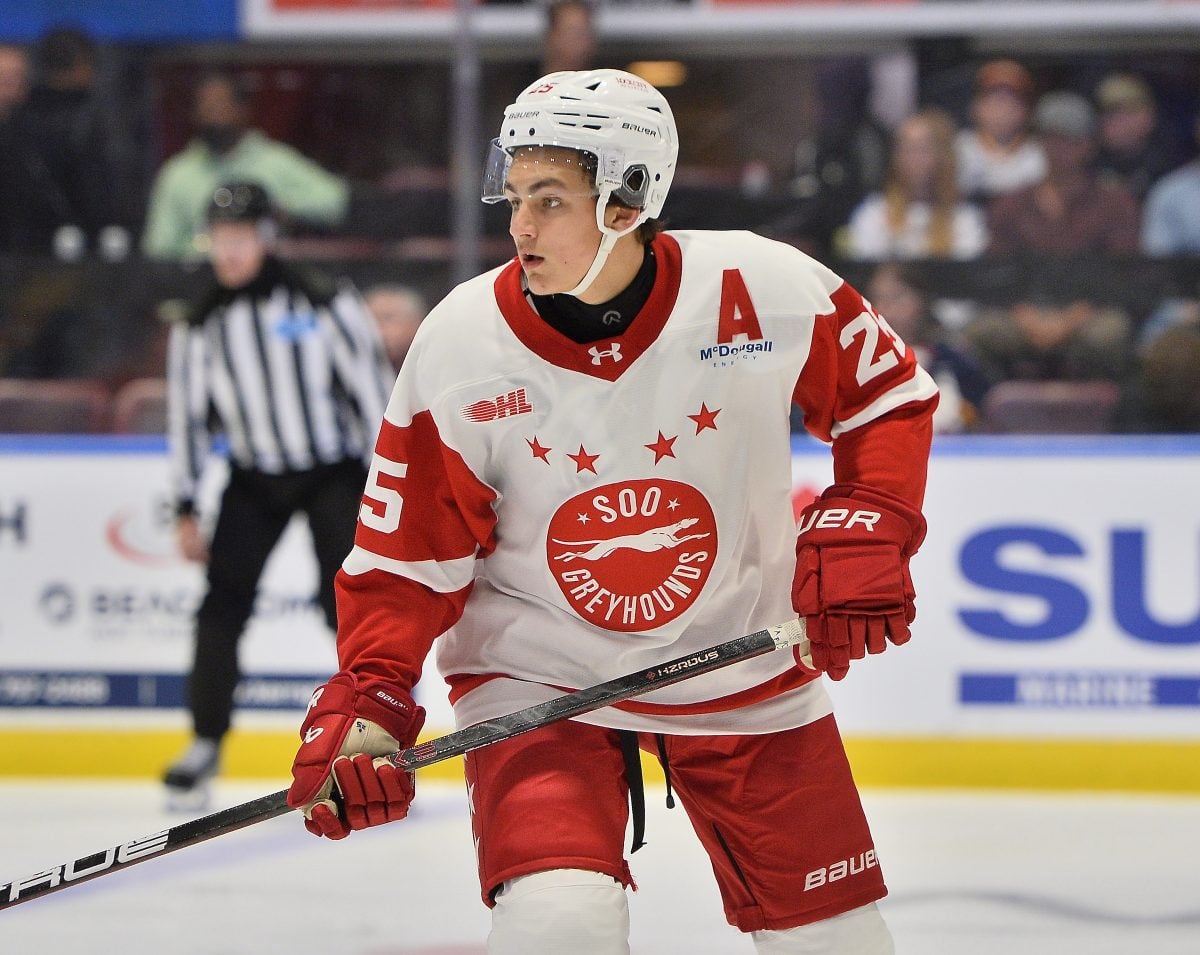
He is arguably the best puck retriever in this draft class. When the puck goes into the corner, Reid doesn’t just win the race; he exits the zone with a level of composure that settled the entire Greyhounds bench this season. Offensively, he functions as a dual threat. He possesses a heavy, deceptive shot that can beat goalies from the point, but his primary weapon is his vision. He quarterbacks a power play with a calm, predatory instinct, waiting for lanes to open rather than forcing plays that aren’t there.
While some scouts initially worried about his physical engagement, he has quelled those concerns by using his frame to seal off attackers and showing a willingness to push back in high-traffic areas. He isn’t a “bruiser” in the 1990s sense, but he is a dominant defensive presence through positioning and stick-work.
What Others Are Saying
The industry consensus on Reid has shifted from top-ten talent to franchise cornerstone over the last six months. Coaches and scouts alike have been enamoured with his ability to log heavy minutes without his play degrading.
“Reid is arguably the Greyhounds’ most valuable player and one of the most impactful defencemen in the entire OHL,” says Jason Bukala of Sportsnet. “In his last 10 games, he averaged nearly 26 minutes of ice time per game… Reid has top-pairing NHL upside.”
His performance on the international stage further cemented his status. As one of the youngest defenders on a stacked Team USA at the World Juniors, he didn’t just tread water — he thrived.
Adam Kierszenblat of The Hockey News noted: “Despite being the youngest defenceman, he played over 19 minutes every night… Reid’s ability to stand out on a stacked American team not only shows how skilled he is, but also that he plays a mature game and was trusted by the coaching staff.”
Even the opposition’s coaching staffs have taken notice. In the OHL Western Conference coaches poll, Reid was voted the Best Offensive Defenceman and finished as the runner-up for Best Defensive Defenceman, a rare double-nod that speaks to his complete 200-foot utility.
Fit in the Canucks’ Prospect Pool
The Canucks’ prospect cupboard isn’t bare, but it is lopsided. With Zeev Buium already establishing himself as a foundational left-shot piece at the NHL level — winning Most Exciting Player honours in his rookie year — the vision for the future defence is starting to take shape.
Drafting Reid would potentially create a dream scenario. A future top pairing featuring the left-shot Buium and the right-shot Reid would give the Canucks two elite, puck-moving defenders who can each play 25 minutes a night. In a league where right-shot defencemen are treated like gold, Reid fills the single most glaring hole in the organization’s depth chart.
Furthermore, there is a built-in developmental bridge. Reid is committed to Michigan State University for 2027, where he could suit up alongside current Canucks prospect Anthony Romani. For a front office that prioritizes chemistry and culture, having two of your top prospects marinating in the same elite college program is an added bonus.
Should the Canucks Draft Him?
This is the franchise-defining question. Selecting Malhotra — the son of former Canuck Manny Malhotra — would provide the team with a reliable, two-way centre who could stabilize the top six for years. It is the safe pick, and a sentimental one for a market that loves a legacy story.
However, the upside of Reid is simply too high to ignore. Elite right-shot defencemen with Reid’s skating ability and offensive ceiling don’t hit the trade market, and they rarely fall past the top three in the draft. If the San Jose Sharks opt for a forward at second overall, the Canucks should not hesitate.
Building from the back end out is the proven blueprint for modern NHL success. With Buium already in the fold, adding Reid would give Vancouver a defensive core that isn’t just good, but potentially dominant for a decade. The Canucks need a player who can dictate the pace of a game and turn defence into offence in the blink of an eye. Reid is that player.
If his name is still on the board at three, the choice isn’t just about filling a roster spot — it’s about changing the trajectory of the franchise.
AI tools were used to support the creation or distribution of this content, however, it has been carefully edited and fact-checked by a member of The Hockey Writers editorial team. For more information on our use of AI, please visit our Editorial Standards page.
Free Newsletter
Get Vancouver Canucks coverage delivered to your inbox
In-depth analysis, breaking news, and insider takes - free.
Subscribe Free →