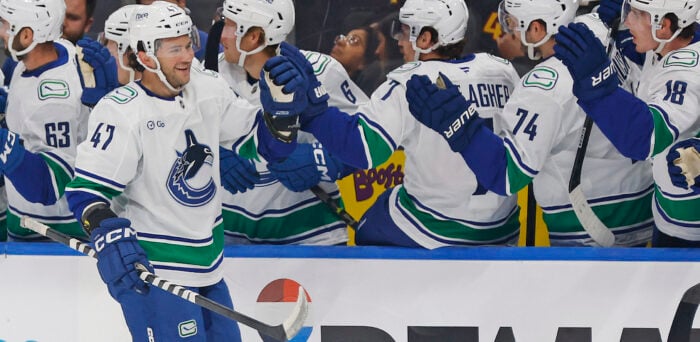
Looking solely at the standings, it’s difficult to find any sort of bright spot or positive for the 2025-26 Vancouver Canucks. They sit firmly at the bottom with a 21-40-8 record and are on pace to have one of their worst seasons in franchise history. But as it is with anything, when you look close enough, you can find a silver lining in even the darkest of clouds. Let’s take a look at a few of them.
The BRO Line: Brock Boeser, Marco Rossi & Liam Ohgren
Chemistry in the NHL is often manufactured by a coach’s blender during a losing streak, but the trio of Marco Rossi, Brock Boeser, and Liam Ohgren — the “BRO” line — has evolved into something special.
The dynamic works because the skill sets are perfectly tiered. At the centre, Marco Rossi has found the platform to showcase the elite vision that made him a top-tier prospect, racking up five goals and 10 assists in his relatively short tenure here. His ability to manage the puck has breathed new life into Brock Boeser, who remains the team’s primary offensive threat with 16 goals and 36 points in 62 games.

Adding Liam Ohgren to this mix was the masterstroke. Every scoring line needs a “motor” to win races to loose pucks, and Ohgren’s relentless work rate has provided a safety net for his linemates. With seven goals and 14 points in 38 games since he got here from Minnesota, Ohgren isn’t just a passenger; he is a legitimate dual-threat rookie who has solidified his spot in the top six.
Filip Hronek
While the headlines often gravitate toward flashy newcomers, Filip Hronek has solidified his status as the structural pillar of the defence. Leading the team with 31 assists in 69 games, Hronek has seen his responsibilities skyrocket. He is the team’s primary workhorse, often logging north of 24 minutes a night against the opposition’s elite.
What is most impressive is his composure; he plays a “high-floor” game and triggers the breakout with a crisp first pass. Beyond the numbers, Hronek has emerged as the frontrunner to be named the next captain of the Canucks. In a locker room that has lacked a singular voice since the trade of Hughes, Hronek’s “lead by example” style has resonated with the coaching staff. Management has already suggested he is on the short list for the vacancy, citing his accountability and his mentorship of the younger blueliners.
Zeev Buium
Stepping into a hockey-mad market as a young defenceman is difficult. Stepping into the shoes of a departed captain is almost impossible. Yet, Zeev Buium has handled the transition with a maturity that belies his age.

What stands out with Buium isn’t just the 22 points in 63 games or his smooth skating. It is the leadership he has shown during the team’s toughest stretches. Recently, Buium has been vocal about the need for a culture shift, emphasizing that the “human nature” of feeling down during a losing streak must be fought with a winning mindset. Despite being a rookie, he has reportedly been one of the most communicative players on the bench and in the room, drawing on his championship experience from the NCAA and World Juniors to help keep his teammates “connected.” He isn’t just a prospect; he is a core piece of the leadership group beginning to take shape.
Tom Willander
If Buium is the vocal young leader, Tom Willander is the prototype for the modern NHL defenceman. Since joining the big club full-time, Willander has demonstrated why the organization was so high on his mobility. With four goals and 18 points in 57 games, he has thrived in a top-four role, but his impact goes far beyond the scoresheet.
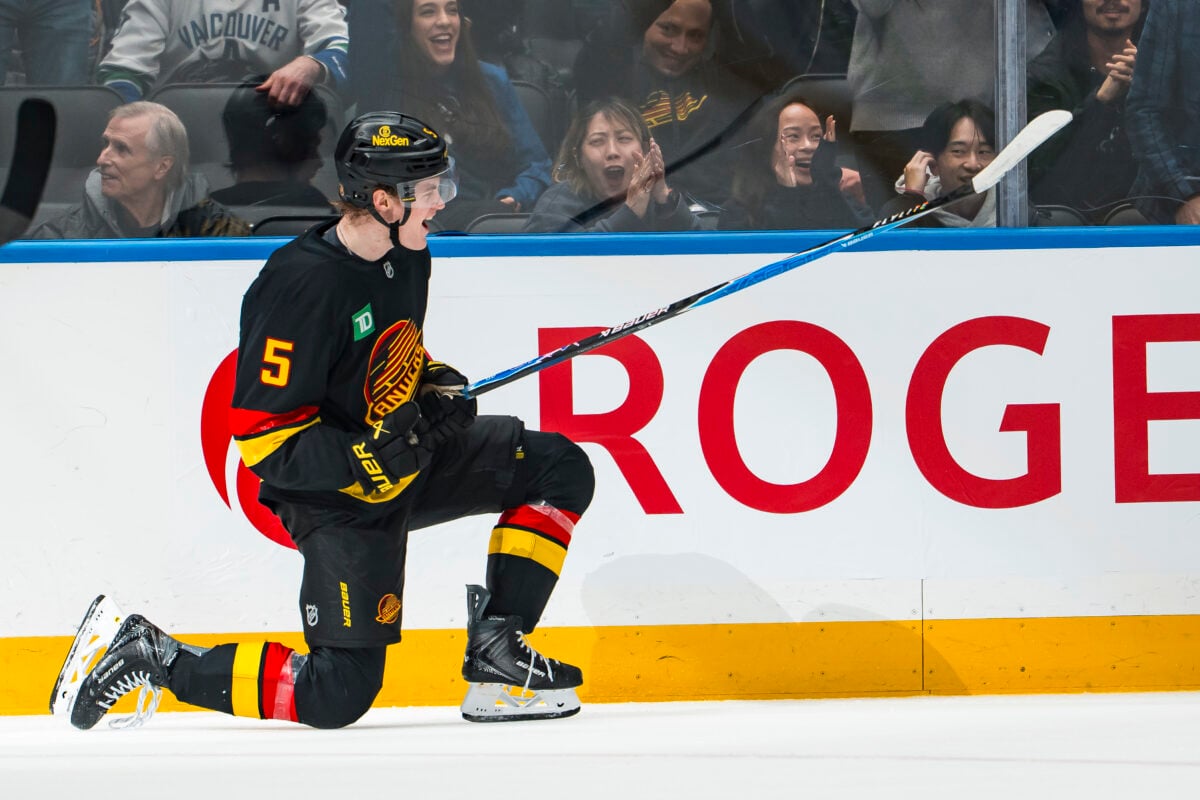
Willander’s game is predicated on closing gaps and using his elite skating to eliminate options for opposing forwards. Beyond the physical tools, he has displayed a remarkable level of professional maturity and commitment to his development. This was most evident during the recent Olympic break; while many players opted for tropical vacations, he returned to Sweden to work with his skills coaches on defensive transitions.
Critically, Willander has also formed a deep bond with Buium. Fans and insiders alike have noted a burgeoning brotherhood between the two 20-year-olds. Following a particularly difficult home loss against the Tampa Bay Lightning, the two were spotted sitting side-by-side on the bench long after the final buzzer, staring at the empty ice in silent frustration — a moment that quickly went viral as a symbol of their shared commitment to turning the franchise around.
Elias Pettersson
It can be confusing for casual observers, but the “other” Elias Pettersson — the 6-foot-3 left-shot defenceman — has carved out a vital niche on this blue line. While he shares a name with the team’s first-line centre, his game is built on a completely different set of principles. Pettersson is the physical conscience of the Canucks’ defence.

In 59 games this season, he has recorded nine points, but his value is measured in the hard minutes he provides. Pettersson has become a staple on the penalty kill, using his massive reach and aggressive stick to disrupt passing lanes. Unlike many young defenders who prioritize the rush, Pettersson has embraced the stay-at-home role, providing the necessary grit to balance out a mobile defensive corps. His willingness to clear the crease and play a heavy, physical game has made him an unsung hero during a season of transition.
Max Sasson and Linus Karlsson’s Breakout Seasons
Finally, we have to look at the internal growth of Max Sasson and Linus Karlsson. For years, the Canucks struggled to find reliable depth that could contribute more than just energy shifts.
Max Sasson has emerged as a solid bottom-six forward. With 11 goals and 15 points in 58 games, he is smart, positionally sound, and has developed a scoring touch that makes the third line a threat. Similarly, Linus Karlsson has shown that his game translates to the professional level well. Putting up 13 goals and 30 points in 66 games, he plays a heavy, intelligent brand of hockey. Having players like Sasson and Karlsson step up allows management to allocate resources elsewhere.
The Ultimate Prize: A Guaranteed Top Three Pick
Of course, the most significant bright spot of a difficult season is the draft capital it generates. By sitting at the bottom of the league with 50 points in 69 games, Vancouver has virtually guaranteed themselves a top-three selection in the upcoming 2026 NHL Entry Draft.
The Canucks currently hold a 43.7% chance of landing one of the top two selections, where franchise-altering talents like Gavin McKenna or Ivar Stenberg await. Even if they slide to the third spot — a 56.3% probability — the draft remains loaded with high-end prospects. Adding a talent of that magnitude to a core that already includes Hronek, Buium, Willander, Pettersson, and the BRO line changes the timeline of this rebuild significantly.

The 2025-26 season won’t end with a parade, but the blueprint is finally clear. While the standings suggest a team in decline, the emergence of a disciplined, homegrown core indicates that this isn’t just a period of losing, but a necessary shedding of skin to make room for a sustainable, high-ceiling contender.
AI tools were used to support the creation or distribution of this content, however, it has been carefully edited and fact-checked by a member of The Hockey Writers editorial team. For more information on our use of AI, please visit our Editorial Standards page.
Free Newsletter
Get Vancouver Canucks coverage delivered to your inbox
In-depth analysis, breaking news, and insider takes - free.
Subscribe Free →