There are two ways to look at the Vancouver Canucks right now, and they don’t exactly line up neatly. On one hand, this is a team coming off a brutally poor season, the kind that normally puts you firmly in the “rebuild” conversation without much debate.
On the other hand, the Pacific Division doesn’t look locked down the way it usually does. That creates a sliver of opportunity—small but real—if the Canucks can stabilize their game and the leadership group manages to clean up some of the issues that surfaced last season.
A Weak Pacific Division: Can the Canucks Sneak In?
Is there any chance the Canucks could push into the postseason? The Pacific Division looks iffy at best, and that opens the door to a question that wouldn’t normally apply to a rebuilding team.
Start at the top, where the Edmonton Oilers and the Vegas Golden Knights are still treated as the standard-bearers. The Oilers remain dangerous because of their core, but they haven’t dramatically reshaped their roster in a way that screams clear improvement. Vegas, meanwhile, is still Vegas. The roster is structured, experienced, and hard to play against. But cap pressures have a way of slowly trimming depth, and that can show over time.

After those two, the division starts to flatten quickly. The Los Angeles Kings feel like a team adjusting to a new stage without Anze Kopitar driving the identity. The Anaheim Ducks are young, skilled, and unpredictable in equal measure. They might be without Leo Carlsson, depending on how the offer sheet situation plays out.
The Calgary Flames look like a group still trying to find its direction, and the San Jose Sharks are improving but probably not quite ready to control games over a full season. That middle tier is exactly where playoff races get messy—and where openings appear.
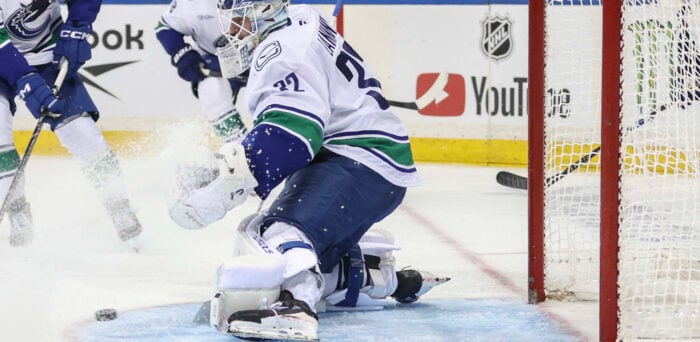
For Vancouver, the path isn’t complicated but is demanding. They need steady goaltending, a step forward from core forwards like Elias Pettersson and Brock Boeser, and continued growth from younger players pushing into bigger roles. If Thatcher Demko and Kevin Lankinen provide stability, the Canucks don’t have to be dominant—they just have to avoid sliding in a division that may not separate itself the way it normally does.
What Blueger’s Comments Say About the Bigger Picture
Teddy Blueger’s reflection on last season adds another layer to how Vancouver’s 2025-26 campaign is being viewed in hindsight. A last-place finish doesn’t usually come down to one issue—it tends to reflect something deeper, whether that’s consistency, structure, or the day-to-day rhythm of how a team operates over time.
Blueger highlights three specific takeaways from his time in Vancouver. First, there were inconsistent leadership habits and daily standards across the group. Blueger contrasts this with Sidney Crosby-driven structure around discipline and professionalism.
Second, last season was marked by instability and constant change, described as “very challenging” with “ups and downs” and little consistency.
Finally, there were struggles with team cohesion and overall culture, with Blueger stressing the importance of players coming together and sacrificing for one another.

What stands out in his comments isn’t frustration, but perspective. Blueger talks about culture, cohesion, and the habits that allow a team to hold together when things get difficult. His reference to his time with the Penguins and Crosby highlights the difference between having talent and maintaining sustained professional standards every day.
That’s really the subtext here. Talent gets you competitive. Habits keep you stable. When those habits slip, even briefly, the standings can punish you quickly.
What’s Next for the Canucks?
So when you put it all together, the Canucks aren’t suddenly being projected as contenders—but the door in front of them might not be as closed as it looks on paper. A softer middle of the Pacific creates opportunity, even for teams still sorting themselves out.
But opportunity only matters if the internal structure holds. That’s where Blueger’s comments quietly land. This isn’t about rewriting the roster overnight—it’s about tightening the foundation so the roster can actually sustain itself through an 84-game season. If that happens, Vancouver doesn’t need perfection to stay in the conversation. In a division like this, they might just need enough steadiness to let everyone else wobble first.
Free Newsletter
Get Vancouver Canucks coverage delivered to your inbox
In-depth analysis, breaking news, and insider takes - free.
Subscribe Free →