Entering December, the New Jersey Devils find themselves at a pivotal crossroads of their season, one defined not by talent or potential but by their inability to assert themselves within the Metropolitan Division. Monday night’s loss to the Columbus Blue Jackets dropped New Jersey to a concerning 3-4-1 record against divisional opponents. And while that number may not look catastrophic at first glance, the details tell a more troubling story.
Only one of those three wins came in regulation, all the way back on Oct. 13, also against Columbus. Their other two victories required shootouts to edge past the Pittsburgh Penguins and Washington Capitals, hardly the kind of convincing performances expected from a team with playoff aspirations. On paper, 3-4-1 isn’t a season-defining failure. But when those struggles are concentrated entirely within your own division, the stakes rise dramatically.
The Tightest Metro Race in Years
Urgency is heightened by the Metropolitan Division’s current landscape. With only six points separating the first and last-place teams, the margins are razor-thin. This isn’t a division where a single losing streak can be shrugged off or where head-to-head games fade into the background over the course of 82 games. In the Metro, every mistake is magnified, every slump is costly, and every divisional matchup shapes the standings in real time.
Every Metro game is effectively a four-point swing, and each missed opportunity carries consequences that stretch far beyond one night. The Devils’ inability to bank early wins against familiar rivals has already put them at a disadvantage, forcing them to chase momentum rather than build on it.
For the Devils, continuing to let these opportunities slip away risks burying them in a division where no one is slowing down, and where even the teams hovering near the bottom remain within striking distance of a playoff spot.
If New Jersey wants to establish itself as a true contender, rekindling its spark in these high-leverage divisional battles is no longer optional; it’s essential. These games aren’t just tests of talent; they’re tests of identity, resilience, and urgency. And until the Devils prove they can consistently rise to the moment against the teams they see most often, their path to the postseason will remain far steeper than it needs to be.
How the Devils Are Losing, and Why It Matters
The biggest issue isn’t simply that the Devils are losing divisional games — it’s how they’re losing them. In divisional matchups, New Jersey has repeatedly struggled to play to its strengths, often allowing opponents to dictate the tempo and style of the game. Last season, the Devils thrived in transition, turning defensive stops into quick-strike offense with fluid puck movement and relentless pace. This season, that rhythm has frequently vanished against Metro rivals.
Rather than controlling possession and using their pace to stretch opposing defenses, the Devils have been bogged down by disjointed shifts, neutral-zone turnovers, questionable goaltending reads and extended stretches pinned in their own end. When the structure breaks down, the game turns chaotic, and without key players like Jack Hughes, Brett Pesce, and Johnathan Kovacevic, who typically help stabilize play and dictate tempo, those chaotic moments have been costly.
These issues become even more pronounced during critical, late-game situations. Whether entering the third period with a tied score or mounting a late push to stay alive, New Jersey has struggled to show the composure needed to close out tight divisional contests.
Ultimately, how the Devils are losing these games matters because it reveals deeper flaws that become magnified in high-pressure moments. The Metropolitan is unforgiving, and if New Jersey continues to fall short in the finer details — defensive structure, puck management, and late-game discipline — those problems will only grow. For a team with legitimate aspirations, the path forward begins with understanding not just that they’re losing these matchups, but why — and addressing those underlying issues before they shape the trajectory of the season.
Offensive Inconsistencies
With Jack Hughes sidelined for at least another month due to a hand injury, the Devils’ offense has been forced to adapt on the fly. Early on, that adjustment was anything but smooth. New Jersey struggled to generate much of anything, often limping to one or two goals per game and looking noticeably disjointed without their offensive catalyst.
Since then, the group has managed to steady itself, rediscovering a bit of rhythm and scoring at least three goals in each of their last five games. Nico Hischier and Timo Meier have led that push, combining for 16 points during that stretch and setting the tone with consistent, determined play. Young contributors like Simon Nemec and Arseni Gritsyuk have also chipped in, giving the lineup occasional sparks in much-needed moments.

But beyond those few bright spots, the production has been thin. Jesper Bratt hasn’t scored since November 6 — and while he remains an essential playmaker whose vision still drives the offense, his lack of finishing touch has been noticeable during a stretch where New Jersey desperately needs him to elevate. Players such as Stefan Noesen and Ondrej Palat have been quiet as well, and Dawson Mercer’s recent slump has only compounded the inconsistency.
The Devils don’t just need isolated performances — they need a collective surge. With their top play-driver unavailable, secondary scoring can’t remain optional. Players up and down the lineup must find ways to contribute, generate pressure, and finish chances. Until that happens, the offense will continue to lean too heavily on a small handful of contributors, and that’s not a sustainable formula with one of the league’s best scorers watching from the press box.
Defensive Issues
The Devils’ blue line has certainly faced its share of turbulence this season. Injuries, constant lineup shuffling, and the heavy burden placed on young defensemen have all fueled the inconsistency in their own end. The challenges were on full display in the loss to Columbus, where chaos struck early and never really subsided. Jonas Siegenthaler was assessed a game misconduct, and Brenden Dillon — after absorbing multiple cheap shots to the head — was removed from the game out of precaution. Suddenly, New Jersey was down to just four defensemen, forcing them into a taxing rotation of Dennis Cholowski–Dougie Hamilton and Luke Hughes–Nemec for the remainder of the night.
Related: Monahan Scores Twice as Blue Jackets Defeat Devils 5-3
As expected, the defensive structure began to fray. With every man overworked and running on fumes, mistakes became more frequent and desperation shifts piled up. Nemec logged an astonishing six consecutive minutes to close out the game, finishing with 30:52 of ice time, a career high and an overwhelming workload for a young blueliner still settling into the league. Luke Hughes wasn’t far behind, skating 26:29 and being thrust into situations most rookies aren’t asked to shoulder.
Despite these difficult circumstances, there have still been flashes of promise within New Jersey’s defensive group. Nemec has taken visible strides, Hamilton has regained some stability in his game, and Luke Hughes continues to grow more confident with the puck. But the positives don’t erase the recurring issues. Costly turnovers, misreads in coverage, and botched breakouts continue to plague the unit, often undoing stretches of solid play. These mistakes aren’t merely growing pains anymore; they’re directly contributing to losses and placing even more pressure on a team already fighting uphill.
Goaltending Problems Arising
While the Devils have received stretches of strong goaltending, they haven’t consistently made the timely saves or shown the steadiness required to stabilize a team already dealing with injuries and defensive lapses. Jacob Markstrom has delivered some highlight-reel moments and a handful of genuinely impressive outings, but he has struggled to establish any real rhythm. His current numbers — an .874 save percentage (SV%) and a 3.60 goals-against average (GAA) — reflect both his inconsistencies and the team’s broader defensive issues, but they also underscore a simple truth: New Jersey needs more from its starting goalie.
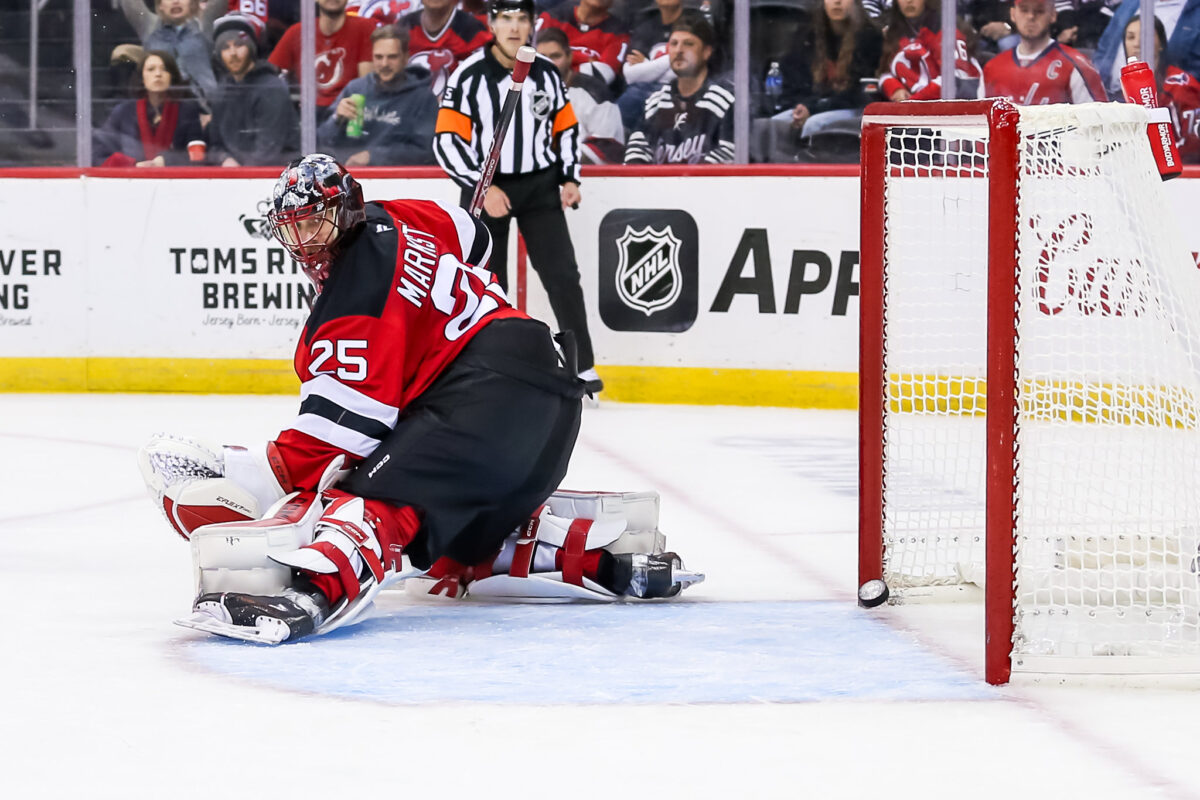
Jake Allen, meanwhile, began the season on a high note, winning five straight and giving the Devils a much-needed backbone when Markstrom was sidelined with an injury. But that early-season stability has faded. In the loss to Columbus, Allen finished with a .792 SV% and had notable issues with puck handling, including a misplay behind the net that directly led to a Miles Wood goal. Since that hot start, Allen has dropped five of his last eight games, and the cracks in his game have become more visible as the workload has increased.
Between inconsistent goaltending performances, mounting injuries on the blue line, and the offense’s uneven contributions, the Devils aren’t getting the margin for error they need. For a team trying to stay afloat in the tightest division in the league, their goaltenders play an outsized role in whether they can weather this storm. The Devils don’t need perfection, but they do need reliability.
Looking Ahead
Right now, the Devils sit in a space between who they are and who they’re trying to become. The talent is undeniable, the potential is real, and even with key injuries, their competitive window remains wide open. But in the Metropolitan Division, potential doesn’t win games; execution does.
The coming weeks could shape the trajectory of their entire season. The schedule tightens, the opponents get tougher, and the margin for error shrinks even further. If the Devils can settle their game, regain their rhythm, and approach every shift with the urgency the moment demands, they absolutely have the firepower to climb back into the race. It’s still early, and this team has both the heart and the capability to push through adversity, but the time to prove it starts now.
