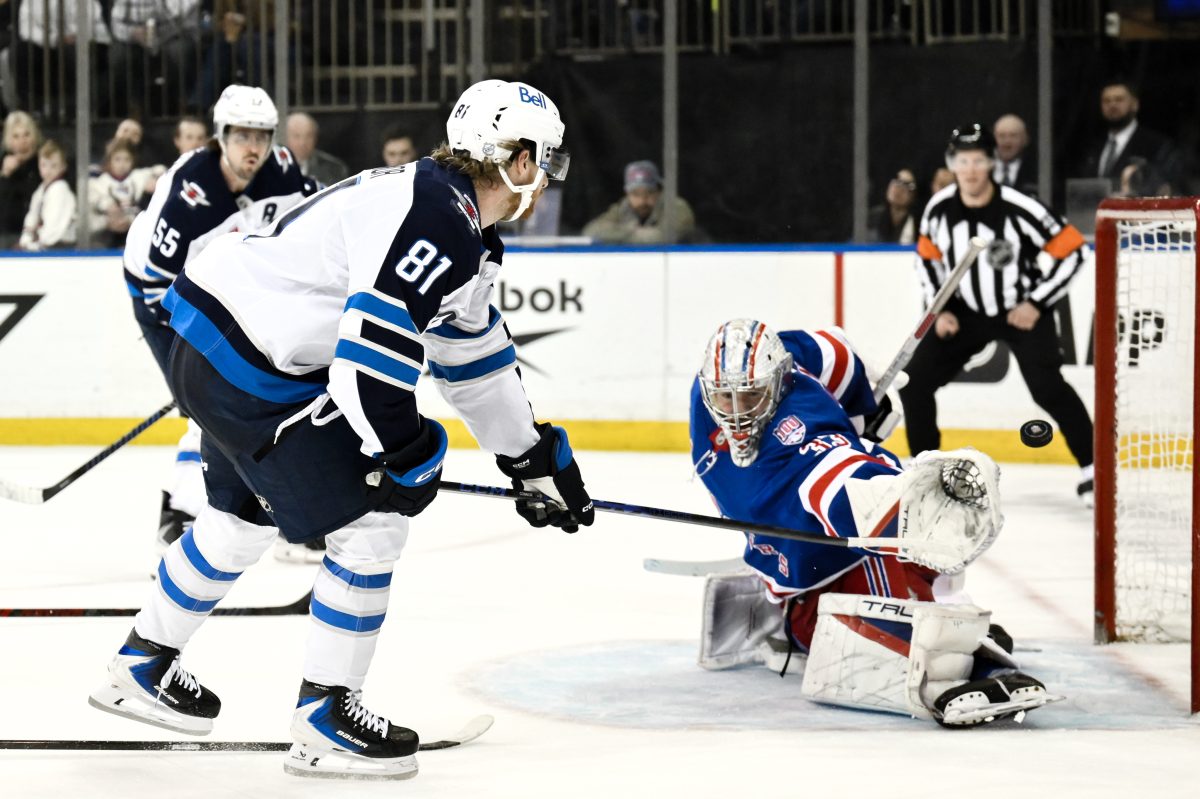
It’s been a long time coming for the New York Rangers’ top goaltending prospect, Dylan Garand, to get a shot at the NHL. Sunday’s welcome to the big leagues performance against the Winnipeg Jets, where he stopped 35 of 38 shots, reinforces that he should at least stick around at the NHL level a little bit longer.
Related: J.T. Miller Is Becoming a Liability for the Rangers
Add that to the fact that the season is almost over and the Rangers have nothing to play for besides spoiling other teams’ playoff dreams and developing younger players. By all means, Garand should split the rest of the way with Igor Shesterkin so the front office can best see where the rookie goaltender is in his development.
Potential Goalie of the Future
The timing for the Rangers now couldn’t be better, as the organization needs to find out at some point whether Garand is a capable goaltender of the future.
To be clear, when I say goaltender of the future, I don’t mean Shesterkin’s successor. The future Hall of Fame Russian netminder is in the first season of his eight-year $92 million contract, which features a full no-move clause and a $11.5 million average annual value, according to PuckPedia. So, unless Shesterkin demands a trade, the Blueshirts are married to him for a while.
However, that’s not to say Garand can’t develop into a full-time backup and potentially a trade asset down the line; if he can become the Blueshirts’ full-time backup, that will save the team the headache of finding someone in the market that fits the Rangers’ budget.
Plus, it would help to find some stability. While it’s far from Jonathan Quick’s fault that he plays on a dreadful team, the two-time Stanley Cup champion hasn’t been particularly stellar recently between the pipes. In the past two seasons, the 40-year-old has produced sub-.900 save percentage (SV%) play. Simply, better play is needed from the backup position to sustain success over an 82-game season.
Another thing to consider: Playing Garand 50 percent the rest of the way allows the Rangers to preserve Shesterkin’s longevity in the net. The Rangers need Shesterkin healthy and fresh to have any chance of completing their so-called “retool.”
Past Success
Leading up to the call-up, Garand was a streaky goaltender during his pro hockey career. Interestingly, in his first two seasons with the Hartford Wolf Pack, the 2020 fourth-round pick saved his best moments for the postseason.
For example, in the 2023 Calder Cup Playoffs, he posted a .935 SV% in eight games, followed by a .922 SV% in nine games a year later. Both of those runs helped the Wolf Pack go deep in the playoffs.
Yet, Garand’s regular season leaves more to be desired. In three out of his four American Hockey League (AHL) seasons, his SV% has been under .900, which is less than ideal.
Going forward, you’ll want to see him play more consistently. And he should get that opportunity with less than a dozen games left in the season.
Garand is considered small at 6-foot, but he makes up for it with his lateral movement and athleticism. And who better in the game to learn from than the 6-foot-1 frame of Shesterkin?
So far, Garand is off to a solid start in the NHL, owning a .946 SV% and a goals-against average of 1.85. As of now, there’s no risk to playing him and potentially finding a long-term backup between the pipes.
Quick is near the end of his career and doesn’t have much of a future with the Rangers beyond 2025-26, if any at all. Overall, the goaltending position can be a volatile one and something the Rangers might have to live with, and they can afford to do so at this point in the season. It makes sense to play Garand 50 percent the rest of the way.
