


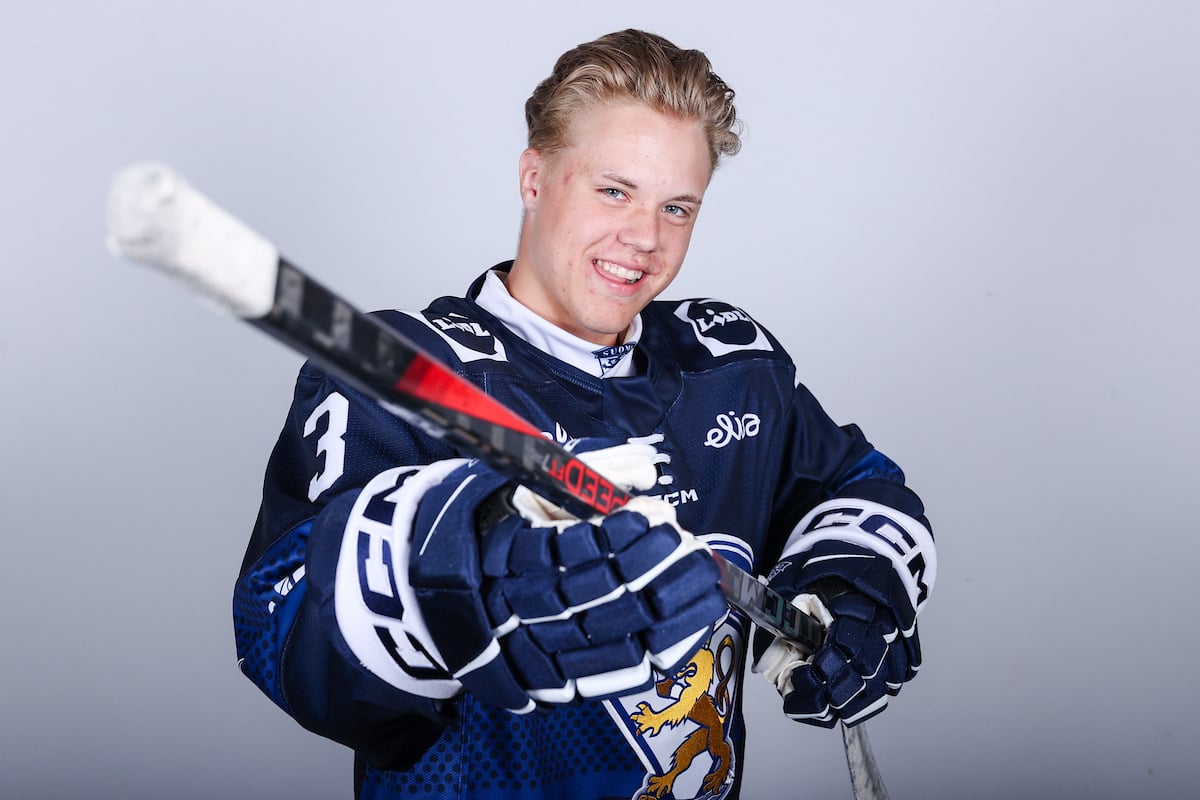
Samu Alalauri was an honorable mention on Scott Wheeler’s draft board last August. By January, he sat 52nd. This week, he moved to 48th. That trajectory, quiet and linear, tells you something about what the Pelicans defenseman is doing in Finland’s U20 SM-sarja: earning trust game by game, 20-plus minutes at a time. With the U20 playoffs now underway, the 17-year-old right-shot blueliner has a chance to make his case even louder before June.
Alalauri has been a staple of Finland’s ’08 age group from the Youth Olympics into U17s, U18 worlds (one of two underagers on the team), Hlinka and their international schedule throughout this year (which he has played very well in). A UMass commit, he has played big minutes in all situations and driven play for the Pelicans’ U20 team this season.
2026 NHL draft ranking: Gavin McKenna, Ivar Stenberg Top Wheeler’s March top 64 list – Scott Wheeler, The Athletic.
The Production Spike Is Real
Alalauri’s regular season numbers nearly quadrupled year over year. After posting six points in 35 games as a 16-year-old in 2024-25, he finished the 2025-26 U20 regular season with six goals, 19 assists, and 25 points in 40 games (0.63 points per game). He earned a spot on the league’s First All-Star Team alongside Pelicans teammate Arttu Paqvalin, who took home the best defenseman award. For a player who moved up from the U18 level to take on a top-pair, all-situations role at U20, those minutes and that recognition carry real weight.
Related: THW’s 2026 NHL Draft Guide
Internationally, the production was even louder. Alalauri put up seven goals and eight assists in 12 games across Finland’s U18 schedule this season, including four points in five Hlinka Gretzky Cup appearances where he averaged 22 to 23 minutes per game and finished tops among defensemen in scoring. Elite Prospects named him the best player at the U18 Five Nations tournament in January, writing that he was the most consistent performer in all three zones.
That international pedigree stretches back further: Alalauri was one of two underagers on Finland’s U18 Worlds roster, represented the country at the Youth Olympics, and captured attention at the U17 World Hockey Challenge before that. Finland has leaned on him at every age level, and he has answered each time.
The rankings landscape reflects the momentum. NHL Central Scouting has him 19th among European skaters. The Hockey News’ Tony Ferrari slots him 50th. Gabriel Foley’s midseason list put him 33rd. Peter Baracchini’s Top 96 March Rankings for The Hockey Writers placed him 75th, his first appearance on a THW board after falling outside Baracchini’s earlier Top 64 in January. McKeen’s ranked him 62nd after an October deep dive that praised his composure and puck-moving efficiency. The consolidated ranking on Elite Prospects sits at 70, but that aggregation lags behind the more recent individual evaluations. The general direction is up, and the pace has accelerated since the calendar turned to 2026.
Why He Projects
At 6-foot-3, 205 pounds, Alalauri is a right-shot defenseman with a mature two-way game and the skating to support it. His footwork is smooth rather than explosive, but it is good enough to close gaps early, handle retrievals under pressure, and transition pucks cleanly out of traffic. He reads the defensive zone well, uses his reach and positioning to cut off the middle of the ice, and rarely panics with the puck on his stick. When the lane opens, he can carry through the neutral zone and attack off the blue line. Neutral Zone’s November game report noted his ability to create space along the boards, escape pressure from tight areas, and generate time for outlet passes. He finished the U20 regular season logging heavy minutes in all situations, including the power play and overtime.
The inconsistency that Wheeler and others have noted is worth acknowledging. There are games where Alalauri drives play at both ends, and others where the effort and decision-making drop off. Wheeler compared him to 2025’s Logan Hensler as a player whose tools and track record suggest a higher floor than his tape sometimes shows. That variance is the gap between a first-round pick and a second-rounder, and it is the primary reason he grades out closer to a steady middle-pair projection than a top-pair ceiling. The physical tools and the international resume point up. The night-to-night consistency has to follow.
Who Benefits From a Player Like This
Right-shot defensemen with pro size, defensive competence, and a clean development runway do not last long on draft day. This class has Keaton Verhoeff, Daxon Rudolph, and Juho Piiparinen ahead of Alalauri among right-shot options, but after that group, the supply thins quickly. The profile that fits Alalauri best is a team picking in the 35-to-60 range that already has top-pair defensemen in place (or arriving soon) and needs a reliable right-side complement who can handle penalty kill minutes and contribute on the second power play within three to four years.
The Calgary Flames stand out. The Flames stockpiled three second-round picks in the MacKenzie Weegar trade alone and are building a young defensive core from the ground up. A patient, two-way right-shot defender headed to UMass fits their rebuild timeline. The Edmonton Oilers, which sent their first-rounder to the San Jose Sharks and still have a glaring need for right-shot depth behind Evan Bouchard, could target Alalauri in the second round as a long-term investment. The Pittsburgh Penguins, holding the Winnipeg Jets’ second-rounder, profiles similarly: a team entering transition that needs cost-controlled defensive depth on the right side.
The U20 Playoffs Are the Next Checkpoint
The Pelicans opened their U20 SM-sarja playoff run against KalPa on March 17 and lost 5-1. Alalauri played on the Pelicans’ second line and had 15:54 of ice time with only four shots on goal. Alalauri’s usage in future games, particularly whether he maintains his 20-plus minute workload and his composure under playoff pressure, will tell scouts more than the regular season awards did. Playoff hockey at this level compresses time and space in ways the regular season does not, and how a 17-year-old defenseman handles that compression is one of the better pre-draft stress tests available in Finnish hockey. A strong postseason showing could push him into the first-round conversation before June.
The UMass commitment (confirmed September 2025, earliest arrival 2026-27) gives drafting teams a clear development map: one more year of Finnish hockey at the U20 or Liiga level, then the NCAA transition. That pathway, from Finnish junior hockey to American college hockey, has worked for right-shot defensemen before. The team that calls his name on Day 2 will be betting that the tools and the trajectory outweigh the inconsistency, and right now the odds on that bet are improving.

