The Utah Mammoth’s 2025-26 season is officially over. The team finished with a 43-33-6 record, good enough to clinch the first wild card spot in the Western Conference. Despite a strong series, the Mammoth lost to the Vegas Golden Knights in Round 1 in six games. Meanwhile, their American Hockey League (AHL) affiliate, the Tucson Roadrunners, finished with a 34-28-10 record, placing seventh in the Pacific Division, outside of a playoff spot.
With the season in the books, it’s time to look at the 49 players under an NHL contract and grade their 2025-26 season. Over the course of this summer, we’ll take a look at their season, their future, and give them an overall grade. We’re going alphabetically by first name. Next up is JJ Peterka.
Player Info
Age: 24
2025-26 NHL Stats: 25 goals, 22 assists, 47 points in 82 games
2025-26 Postseason Stats: Zero goals, zero assists, zero points in six games
Originally Acquired: Acquired in a trade with the Buffalo Sabres for Josh Doan and Michael Kesselring on June 25, 2025
Contract Status: In the first year of a five-year deal with a $7.70 million annual average value (AAV). Unrestricted free agent (UFA) in 2030
Season Overview
Peterka and the Mammoth seemed like the perfect fit when general manager Bill Armstrong traded for the German forward last summer. Fresh off a career-high 68-point season with the Sabres, Peterka thrived on speed and skill, something the Mammoth were built around. Paired alongside someone like Dylan Guenther or Logan Cooley, it seemed like the best was yet to come from the former second-round pick.
A solid preseason saw Peterka’s assist game pick up right where he left off with the Sabres. However, preseason is completely different from the regular season. Peterka made his Mammoth debut in the team’s first game of the season against the Colorado Avalanche. He produced his first point with the team in the very next game against the Nashville Predators, an assist on Cooley’s goal.
The game against the Predators kicked off a stretch of five games where Peterka produced four points. That included scoring his first goal as a member of the Mammoth against the Chicago Blackhawks. Peterka had his first multi-point game of the season later in October against the St. Louis Blues, putting up three assists.
October was a fantastic month for the forward. He produced 10 points in 11 games, performing well on the second line with Guenther and Cooley. Despite the hot start, November started cold for Peterka. He went pointless in his next five games and was a minus player in four of them, including in his return to Buffalo, where he was booed.
He broke his pointless streak with a two-point game against the Sabres when they visited the Mammoth in Salt Lake City. Peterka followed up the game with a two-goal game against the San Jose Sharks. Yet, November wasn’t as good as the forward’s October. He had six points in 15 games across the month and finished out November on a four-game point drought.
Peterka was moved up to the top line with Clayton Keller and Nick Schmaltz during the Mammoth’s last game of the month. It seemed to work, with the forward producing seven points in the first five games of December. Peterka produced five points in the next nine games to round out the month and 2025.
To begin 2026, Peterka was placed back on a line alongside Guenther, switching places with Lawson Crouse. Just like last time, though, the German struggled to produce consistently. He put up nine points in 15 games throughout January and recorded a single goal in his four games in February.
Unlike most of the Mammoth players, Peterka had a very busy February. Ahead of the Winter Olympics, he was named to Team Germany for his very first Olympic Games. Placed on a line with Tim Stützle, Peterka played some of his best hockey of the season. He produced four points in five games despite Germany struggling as a whole. Slovakia curb stomped the country in the quarterfinals 6-2, ending the forward’s Olympic tournament.
Unfortunately for Peterka, his near point per game production rate in the Olympics did not carry over to the Mammoth’s return to the regular season. In his eight games following the conclusion of the Olympics, he only produced one point, despite being reunited with Cooley and Guenther. In his following eight games, Peterka once again failed to do much, producing three points in that span.
With the entire line struggling, head coach André Tourigny decided to make a change. Peterka was placed on the third line alongside Jack McBain and Michael Carcone, while Kailer Yamamoto was eventually put on the Cooley and Guenther line. The change seemed to work as Peterka put up four points in his first five games on the line and produced five points in the final 10 games of the season.
John 👏 Jason 👏 Peterka!
— Utah Mammoth (@utahmammoth) April 15, 2026
4-1, Utah! pic.twitter.com/nAobHRkE4i
Peterka finished the season with 47 points in 82 games, the lowest total in his career since his rookie season. The forward ended up in the team’s top five in points and fourth in goals with 25.
Despite the glaring decrease in most of his stats, there was a major improvement in Peterka’s play: his defense. During his time with the Sabres, the forward was consistently criticized for his defensive play. Yet, in his first season with the Mammoth, it was noticeably better. He finished as a plus player in the plus-minus stat line for only the second time in his entire pro career.
“I think I played more like a complete player,” Peterka said. “I tried a lot playing both sides of the ice, working on awareness and stuff. Looking back, I just tried to be a complete player on both sides.”
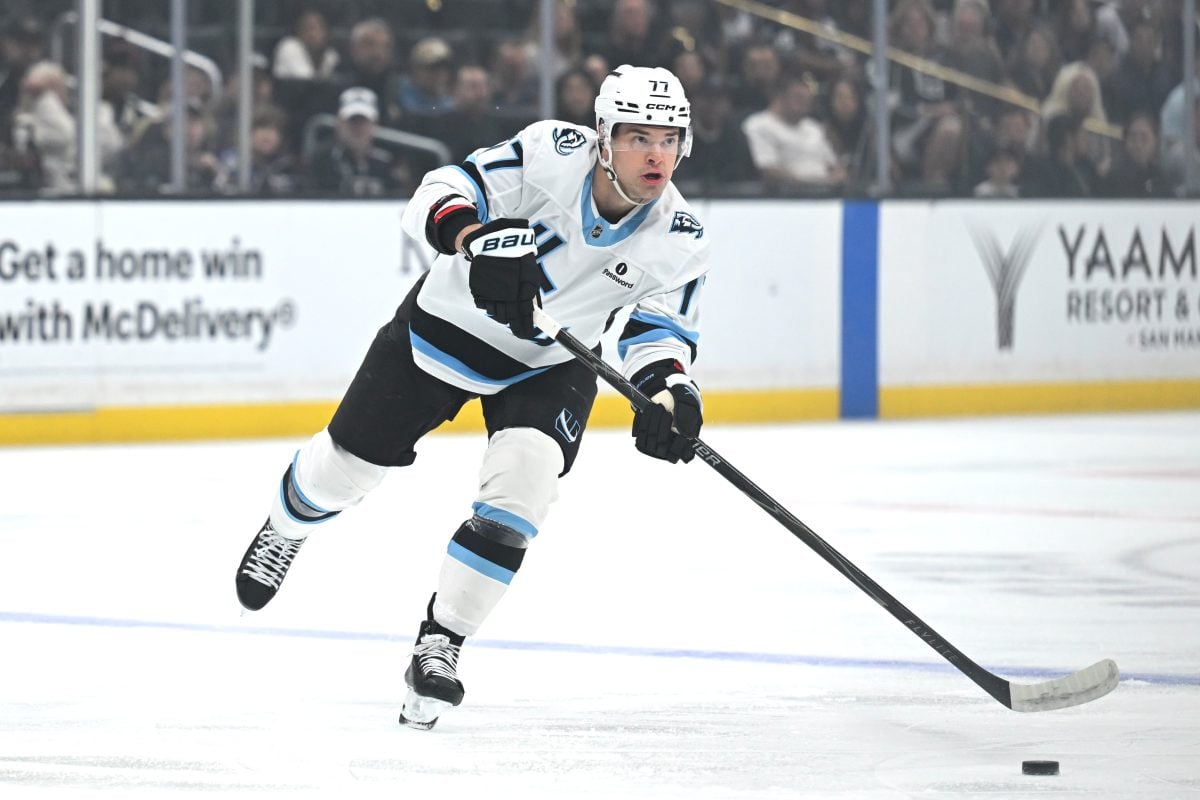
Unfortunately, Peterka’s play further declined in the playoffs. He went pointless in the first four games, resulting in Tourigny benching him in the latter half of Game 4. He was moved to the fourth line for Game 5, almost getting an assist on Carcone’s goal. Peterka was put back on the third line for Game 6, but once again, failed to put up any points as the Mammoth were eliminated by the Golden Knights.
Despite being benched in Game 4 and failing to produce any points in the postseason, Peterka thinks he responded well afterward. Just looking at his ice time, the game he played the most in was Game 6. Game 5 was arguably his best game, where he had the most chances to break through and get his first postseason point. Personally, Peterka just wanted to do whatever he could to help the Mammoth win.
“The main goal is always to win,” Peterka said. “As a player, you try your best to contribute to that. Whenever I’m out there on the ice, I try to do my best. Whenever I get the chance to be out there, I just try to focus on my play, what I can do, and try to be the best version I can be.”
The Future
For the rest of his time with the Mammoth, Peterka will always be compared to Doan. It doesn’t matter what he does because the trade that sent him to Utah is looking more and more like a comparable swap every day. Both players are speedy young players, and both have signed long-term extensions with their new teams.
However, both came from two different backgrounds. Doan struggled to get ice time and a top role with the Mammoth. That changed the second he joined the Sabres, and finally, the production we saw in the AHL translated over to the NHL with 52 points in 82 games.
With Peterka, it was the reverse situation. He was coming off a season with his highest ice time and an unreal shooting percentage. Everyone knew that his offense was most likely going to take a dip. Yet, it’s hard to argue that 47 points was less than what everyone was expecting.
You have to acknowledge that Peterka became an overall better player with the Mammoth. He became defensively reliable, something that could never be said during his time with the Sabres. Some of his offense was probably sacrificed, with the focus being shifted to improving his overall game.
“When the focus shifts a little bit more to the defensive sides, standing back sometimes, staying under the play, you get a few fewer points,” Peterka said. “But you give up way fewer goals at the end of the day. I think that was the result.”
To play in Tourigny’s system, you have to know how to play a solid two-way game. If you look at almost every forward in the Mammoth’s system, they know how to play defense well. Taking the growth in Peterka’s defensive game, 47 points in 82 games isn’t horrible.
However, what isn’t great is zero points in six playoff games. When everyone was talking about the lack of experience on the Mammoth, one player that wasn’t brought up enough was Peterka. Despite being a tad bit older than Cooley and Guenther, who were the main subjects in that conversation, Peterka hadn’t even played competitive regular-season NHL hockey outside of his rookie season.
It showed. The third line was the worst line for the Mammoth throughout the postseason. Peterka was benched, the line was broken up, and the trio combined for three points in six games. Depth scoring wasn’t good enough, and part of that blame has to be placed on Peterka.
Yet, the problem is, Peterka is not a depth forward. He is a top-six player who thrives on high ice time. Towards the end of the season, the Mammoth gave up on trying to get him adjusted to playing in their top six because guys like Crouse and Yamamoto played way better in that role. Maybe it was because Peterka didn’t connect well with the players in the top six. Maybe it’s all because he focused more on the defensive side of his game. Whatever it is, the forward needs to play better next season.
Going into next season, the goal for Peterka is to get back in the 60-point range and closer to the 30-goal mark. Ultimately, he needs to have better chemistry alongside either Guenther and Cooley or Keller and Schmaltz if given that opportunity. Unlike last summer, he will have all the time in the world to train and improve in the offseason with his future secured in Utah. If he can find a way to get back to his production from his Sabres days while maintaining the solid defense he brought last season, a bounce-back season could very well happen for Peterka.
Overall Grade
While 47 points weren’t horrible, it was expected that Peterka would flourish with the Mammoth. It just seemed like such a great fit. However, it ended up being a mediocre season for the forward, which saw him grow tremendously defensively but take a step or two backwards offensively.
It’s not rare to see a player struggle when they go to a new team. Some of those players bounce back, and others continue struggling, which eventually prompts another change. Peterka’s second season with the Mammoth will ultimately tell us which type of player he’s going to be.
Overall, Peterka is getting a C for his season. It was simply a mediocre and unimpressive season for the forward when you’re looking at the offensive stats alone, but there’s a lot to like about his improvements defensively. Going into next season, if he can focus on producing more while staying defensively consistent with the willingness to learn he showed this season, it wouldn’t be surprising to see Peterka go back to being a 60-plus point player.
The Mammoth have seen players within their system have bad seasons and bounce back. A prime example was when Crouse had a bad season last year but came back and was a top-six forward once again this year. This very well could be a fluke season for Peterka, where his focus on improving his defense resulted in decreased production. However, just like Crouse did, he’ll have to prove that he can get back to the impressive production next season and that he can be a good fit for the Mammoth moving forward.
Free Newsletter
Get Utah Mammoth coverage delivered to your inbox
In-depth analysis, breaking news, and insider takes - free.
Subscribe Free →