It’s been three years since I started my journey through the Western Hockey League (WHL), and over that time, I’ve been trying to figure out how to see the Brandon Wheat Kings. Since the beginning, I was interested in checking out the league’s most Eastern team, but the trip was far from convenient, especially after the Winnipeg Ice’s departure in 2023, and I always found an excuse to go somewhere else. After all, it was just Brandon; when I asked a friend who grew up nearby what there was to do, she gave me a dead stare and said, “Nothing.”
However, if I were serious about continuing my Great WHL Journey, I needed to check off the Wheat Kings eventually. That time finally came in February 2026, after I had seen every other team in the WHL’s Eastern Conference. I had no more excuses. So, I buckled down, bought the tickets, booked the hotel, and braced myself for a 12-hour round-trip with a hockey game tucked in the middle.
But this trip wasn’t just another stop on my adventure. This was a new chapter, one where I would be venturing to increasingly unfamiliar places which required more research, time, and resources. The Wheat Kings were the biggest step into the unknown yet, and for the first time in three years of travelling around the Canadian prairies, my little idea to showcase small-town junior hockey felt bigger than it ever had.
Wheat Kings History
The 1907 Stanley Cup challenge between the Kenora Thistles and the Montreal Wanderers has gone down in history as one of the most impressive feats in the trophy’s history. Kenora, a small town of over 5,000 people, defeated the powerful Wanderers to become the smallest team to win the Cup. However, the challenge two months later would define not only two franchises, but also shape the history of junior hockey in the prairies.
In March 1907, the Brandon Wheat Kings earned a chance to challenge for the Stanley Cup in Kenora, and the team was optimistic. Stars Art Ross and Joe Hall had returned to Brandon after helping the Thistles claim the Cup in January and were ready to bring the Cup to the 10,000-person city. But Kenora brought in some new ringers in Harry “Rat” Westwick and Alf Smith, former Ottawa Senators who were part of the famed Silver Seven teams from 1903-06. Unfortunately, that was enough for the Thistles to keep the Cup; after two games, Kenora outscored Brandon 12-7, sending the Wheat Kings home empty-handed.

Five days after beating Brandon, the Wanderers asked Kenora for a rematch. This time, Montreal came out victorious, and Kenora’s three-month reign as Cup champs was over.
With hockey becoming increasingly professionalized and new leagues popping up everywhere, smaller markets like Kenora and Brandon needed to adapt. Unfortunately, the Thistles weren’t able to do it quickly enough, and by 1908, the team ceased operations, unable to compete with rising costs and a waning pool of local talent.
Brandon, on the other hand, fully left the professional scene, which allowed them to focus on developing the game at the local level. Junior teams had already been operating for many years in Brandon, and with the Wheat Kings now an amateur senior club, those players could retain their amateur status and continue to play in their hometown. Soon, Manitoba had a thriving junior hockey scene, leading the Wheat Kings to officially join the Manitoba Junior Hockey League (MJHL) in 1936. The Stanley Cup dream was dead; it was time to focus on winning the Memorial Cup.
The West Needs a Junior League
From 1918 to 1946, the MJHL sent 10 different teams to the Memorial Cup tournament, eight of which won the trophy, while the rest of the Western provinces saw just six teams combined in those 28 years. Brandon quickly rose to the top of Manitoba’s junior scene, winning seven championships from 1946-64, including a stretch where they appeared in six consecutive MJHL Finals and a three-peat from 1962-64, but only appeared in the 1949 Memorial Cup.
The primary problem was the lack of competition. Although there were several junior leagues across the prairies, the Regina Pats and Edmonton Oil Kings dominated interprovincial matchups. Then, when they reached the Memorial Cup, they often struggled to replicate the success they had out West. There just weren’t enough top junior clubs to push them, leaving the better-organized Eastern leagues to remain dominant in national competitions. If they wanted to compete with the East, the West needed a top interprovincial junior league, and Brandon was more than happy to get in on the ground floor.
The Wheat Kings joined the Saskatchewan Junior Hockey League (SJHL) in 1964, looking for better competition. It just so happened that the rest of the SJHL was also looking at improving their league, so when several of the best teams in the league, including the Pats, decided to join up with Edmonton, Calgary, and Winnipeg, Brandon was happy to put their name in the mix. Spearheaded by Bill Hunter in Edmonton, Estevan’s Scotty Munro, and Winnipeg’s Bill Hatskin, several teams came together to orchestrate a brand new league – the Canadian Major Junior Hockey League (CMJHL).
However, the plan might have been a bit hurried. With six of the eight SJHL teams planning to leave and join the new CMJHL, they voted to fold their former league. That didn’t sit well with the Flin Flon Bombers or the Melville Millionaires, the two remaining SJHL teams, who were so ticked they weren’t included in the new league that they initiated a lawsuit against the CMJHL’s organizers. Not all the provinces were on board with the new league, either, with Manitoba the primary holdout.
You can’t okay something you don’t know anything about…What can this league offer Brandon that they didn’t have last year? The answer might not be competition.
Manitoba Hockey president Ted Lozanski (from ‘Question Marks Dot Super League,’ Winnipeg Free Press – 08/07/1966).
That left the Wheat Kings in a difficult position. While the team saw the need for a new league, there was a lot that was still unknown. Was it going to be better than what the SJHL or MJHL offered? Lozanski didn’t think so, and without Manitoba’s buy-in, travel and scheduling were going to be much more difficult for Brandon.
On Aug. 2, 1966, the Wheat Kings formally withdrew from the CMJHL, citing financial concerns. The city of Brandon begged them to stay and even organized a public protest, but the team believed it was much safer to return to the MJHL. Winnipeg soon followed, leaving during the middle of a league meeting and later stating, “Winnipeg citizens are entitled to a high calibre of hockey which, we believe, the proposed revised plans could not produce.” (from ‘Winnipeg Still in Super Circuit,’ Brandon Sun, p.6 – 03/08/1966).
Setbacks began to snowball for the CMJHL. The Amateur Hockey Association of Canada (AHAC) fully rejected the new CMJHL, partly due to Manitoba’s concerns and rejection, and suspended all participants from all AHAC-sanctioned events, including the Memorial Cup. That scared off the NHL, which was beginning to transition away from the old sponsorship program, and they signed an exclusive deal with the AHAC.
Despite the setbacks, the CMJHL went ahead with the 1966-67 season, but returned with a more thorough plan for 1967-68, as well as a new name – the Western Canada Junior Hockey League (WCJHL). That satisfied Brandon and Winnipeg, and Flin Flon was also granted a spot after the team was initially rejected from joining in 1966. Not long after, the AHAC relented and allowed the WCJHL to compete in the Memorial Cup. Finally, the West had its junior league.
Manitoba Hockey’s Decline
The early years of the WCJHL were fraught with instability, and the easternmost teams seemed to bear the worst of it. After winning league titles in 1969 and 1970 with Bobby Clarke, Reggie Leach, and Ray Martyniuk, the Bombers regressed after their stars graduated. By 1978, they were out of money and looking for a new home. Edmonton, which lost its team two years earlier thanks to the arrival of the Edmonton Oilers, took in the Bombers and made them the new Oil Kings for a single season before they left for the United States, and finally folded in 1982.
Over in Winnipeg, the newly minted Jets were abysmal in their first several seasons, winning just two playoff series. That led Hatskin to look elsewhere for income, so he joined Hunter in the new World Hockey Association (WHA) in 1972, giving his new professional team the same name as his junior squad. Just like in Edmonton, the junior Jets couldn’t compete with the new show in town, forcing them to move to Calgary four years later after several attempts at generating fan interest. Winnipeg got other chances in 1980 and 2019, but both teams survived just four years before also moving for greener pastures.
That just left Brandon. It’s tough to say definitively why the Wheat Kings survived while the rest of Manitoba struggled. Maybe they were just close enough to Saskatchewan to prevent exorbitant travel costs. Maybe it was better management, better fans, a lack of competition, or they managed to peak at the perfect time. Whatever the case, Brandon has remained the lone pillar for the once-great Manitoba hockey scene, and with titles in 1996 and 2015, it has remained a powerhouse despite their isolation.
Franchise Leaders
- Most Points (Total): Brian Propp (1976-79) – 511
- Most Points (Season): Brian Propp (1978-79) – 194
- Most Goals (Season): Ray Ferraro (1983-84) – 108
- Most Games Played: Dwayne Gylywoychuk (1989-194) – 323
- Most Wins (Total): Jordan Papirny (2012-17) – 11
- Most Wins (Season): Jordan Papirny (2014-15) – 44
- Retired Numbers: #4 Brad McCrimmon
- Highest Drafted Players: Nolan Patrick, 2nd (Philadelphia, 2017); Wade Redden, 2nd (NY Islanders, 1995); Bill Derlago, 4th (Vancouver, 1978); Brayden Schenn, 5th (Los Angeles, 2009); Ivan Provorov, 7th (Philadelphia, 2015)
Assiniboine Credit Union (ACU) Place
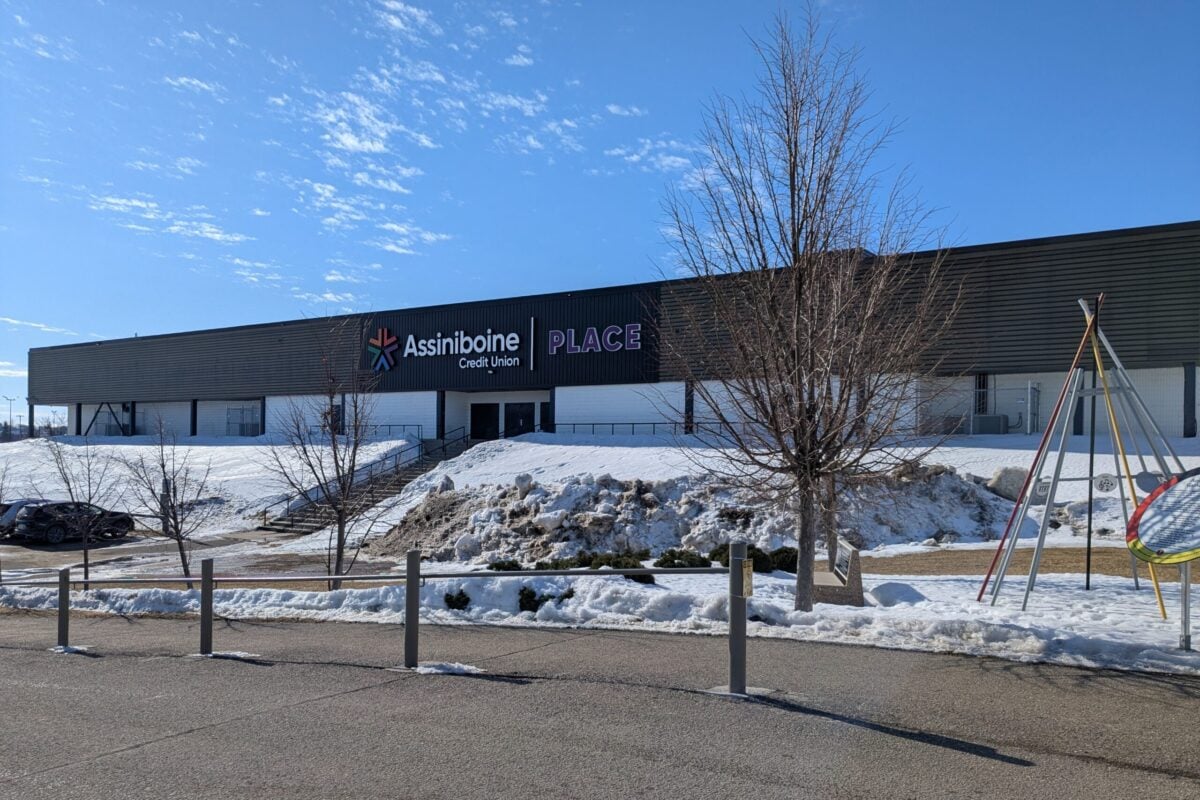
The Wheat Kings play in Assiniboine Credit Union Place, part of the larger Keystone Centre. It’s Brandon’s one-stop shop for events, including rodeos, curling, and the Manitoba Winter Fair, and it’s been the Wheat Kings’ home since 1973. Although it’s one of the older arenas in the WHL, it doesn’t feel that way inside. New seats were installed in 2024, which boosted the total capacity to 5,531, and fan comfort was a top priority. We had a great view from our seats in row 13, as well as plenty of leg room, even with the cup holders in front of us, and the padded upholstery. Part of the remodel also included adding a ‘Seat of Truth,’ an orange seat meant to serve as a reminder of the commitment to truth and reconciliation.
One of the best features of ACU Place is the tunnels connecting it to the rest of Keystone Centre. We stayed at the Canad Inn Hotel, and it wasn’t until we arrived that I realized that guests don’t have to leave the complex to get to the game. Keystone Centre also houses two smaller rinks, several exhibition halls, a curling rink, and the Wheat Kings souvenir store, all of which we passed by on our way to the arena. Unfortunately, there’s not a ton of signage, and we got turned around and ended up exiting the building. Thankfully, it was a pretty temperate day for February, and I got my shot of the arena before re-entering.
This level of integration is far from a new concept for Brandon. The team’s first home was the old Wheat City Arena, an old, towering structure originally built in 1913 and used by the Royal Canadian Air Force in World War II until it was recommissioned as a hockey rink in 1947. It also contained a curling rink and a roller rink on the upper floor, plus barns that were used for the famous Manitoba Winter Fairs. But none of that detracted from the hockey.
“It was a great place for us to play,” said Bob Wilson, who played with the Wheat Kings in 1959-60. “We had no other arena in the area like it. It held 4,500 people and had the bench-type seats with the seat number on the back. There were no individual seats. It had a huge canteen area where people would go between periods.” Adding to the uniqueness was the lack of glass around the boards; instead, it had a chain-link fence to protect fans from flying pucks. Getting hit into that “wasn’t good,” according to Wilson.
In November 1969, the Wheat Kings were suddenly evicted from their arena after a developer bought the property, leaving them homeless. A new arena was already in the works, but the city hadn’t yet broken ground on the project, so ManEx Arena, usually used for curling, was hastily transformed into a hockey rink. With a maximum of 1400 people, it was far from ideal, but the Wheat Kings didn’t have to stay there long, moving next door to the new Keystone Centre in 1973. ManEx Arena was demolished in 2004, but you can still see the foundation in one of the restaurants at the Canad Inn.
Food and Extras
Summary
- Tickets – $29.25
- Hat – $36
- Jersey – $150
- Puck – $5.99
I love finding the things that set an arena apart from the rest of the league. Brandon already earned plenty of points thanks to the tunnels connecting the hotel and arena, but I was also impressed with what they offered at the game. We first passed by the team store, so we popped in to see what they had. I’ve started picking up keychains at the arenas I visit because they’re usually available, inexpensive, and easy to transport. I like the idea of getting a jersey or a shirt, but those costs add up quickly and will eventually deteriorate.
However, if I wanted to change things up, Brandon would have been a good place to start. The store offered several great logo designs in a wide selection of styles. The colours were muted, but still clearly representing the Wheat Kings. My wife even commented on the quality of their designs, and she’s never once shown interest in sporting a hockey logo.
While looking for a keychain, I also found that the Wheat Kings sold autographed goal pucks. I have only seen this once before, and I love it; even though I wasn’t there to see the game, I got a souvenir that can only be purchased in person. That makes it that much more special, in my opinion, so I grabbed one from Jaxon Jacobson, the Wheat Kings’ 17-year-old phenom who will almost certainly be a high pick at the 2027 NHL Draft.
Once inside the arena, I also found the food selection to be unique. There were the traditional stands offering burgers and fries, but my wife and I were more interested in the pierogi and sausage stand, which offered a dinner platter for just $10.50. Then, during intermission, we grabbed a hot drink at Forbidden Flavours, a local coffee shop that has a stall set up in ACU Place and serves specialty coffees and teas. That actually may have been the best spot in the arena. More hockey games should have a coffee shop.
As for the in-arena entertainment, everything was fairly typical aside from the intermission karaoke, which fans could vote on. Somehow, Temperature by Sean Paul was the winner, and it went about as well as you think it would go for a small-town Manitoba crowd singing along to a Jamaican rap song.
The Game: Brandon vs. Saskatoon, Feb. 16, 2026
A big part of going to a hockey game is being able to share it with someone. It’s why I started this journey in 2023, and I’ve had the privilege of hearing my friends, family, media members and even a local celebrity share their unique perspective on what junior hockey means to them. For a hockey traveller like myself, connecting with people more familiar with the local team gives me a perspective I could never get through just research.
However, Brandon proved to be a bit of a challenge, as I didn’t have any family or friends who could tell me about watching the team growing up, and I couldn’t connect with anyone related to the team. For the first time in 11 teams, I was going in completely blind.
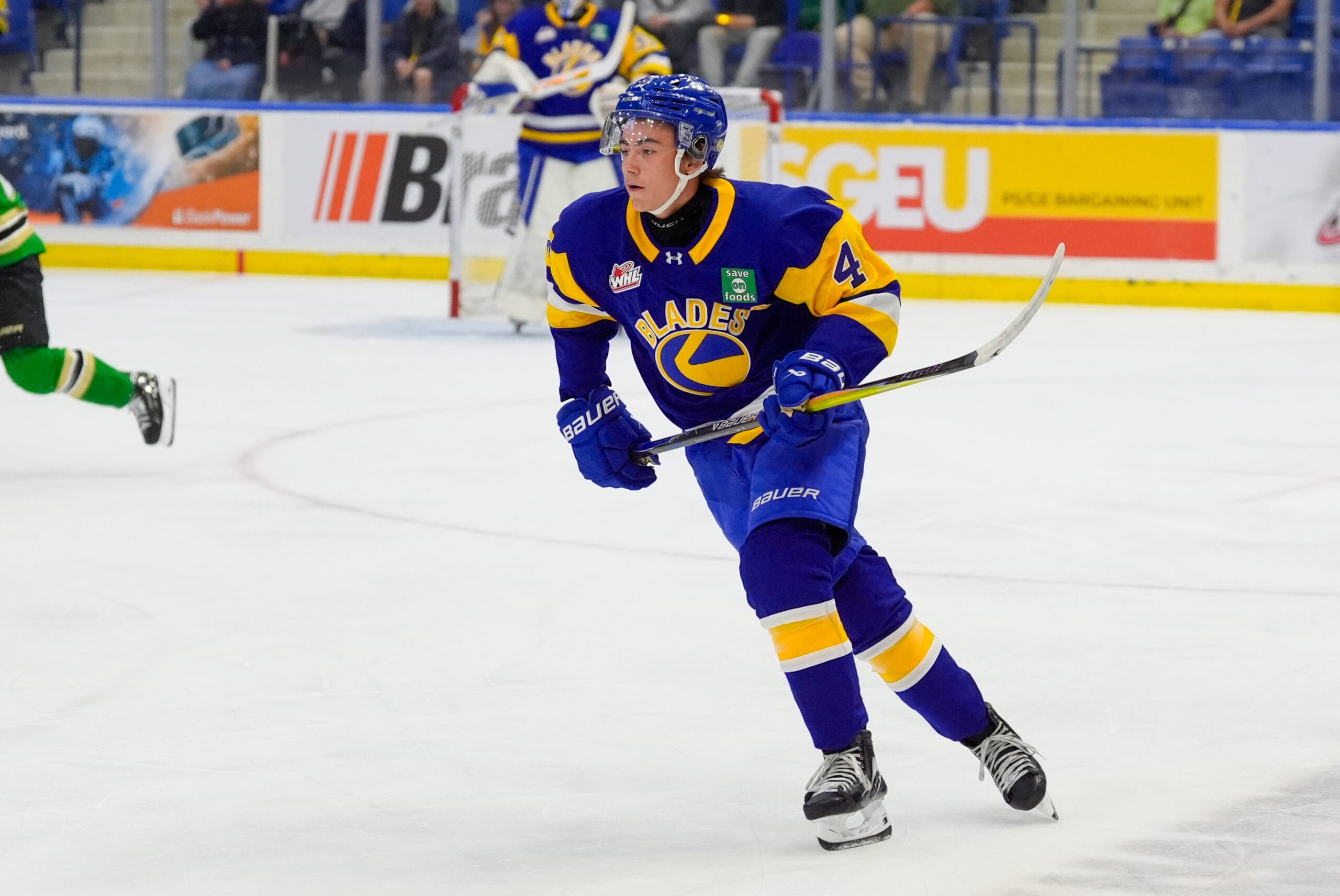
Yet, as I made my way to my seat, I spotted several Blades jerseys in our row. Initially, I was nervous; junior hockey is very local, which is why I try to cheer for the home team at each of my stops, even if my hometown Blades are playing. Opposing fans are the enemy. But, as I got closer, I noticed that the backs read “Allan,” and I was relieved. It looked like they were all here to support Blades’ defenceman Kaden Allan, who was acquired following a trade with the Spokane Chiefs in December. He must be a local, which meant that I had my Brandon connection sitting directly beside
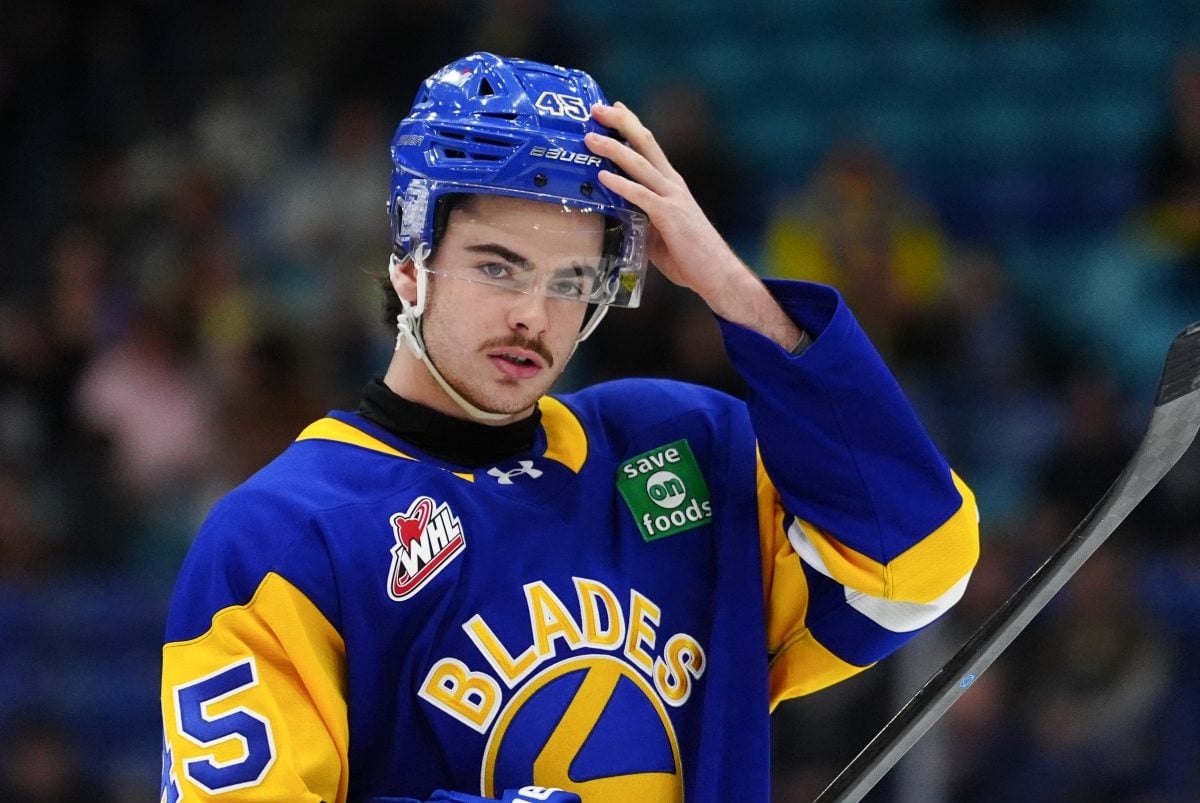
Almost as soon as we sat down, Brian, Kaden’s dad, introduced himself and his family to us and confirmed everything I suspected. The Allans all grew up in the small Manitoba town of Hamiota, about 45 minutes northwest of Brandon, and this game was the first time since October 2024 that Kaden was playing in his home province. His family still live and works on the farm, but has made it out to a lot of Kaden’s games over the years.
The whole interaction felt a bit like fate; nearly a month ago, I phoned the Wheat Kings’ box office to purchase tickets, and after dialling the wrong number and getting the coach’s office, I asked the attendant on the other end which section he would recommend for a first-time traveller. He asked if I liked sitting higher or lower, to which I responded higher, and he put us right beside the Allans, who no doubt had purchased their tickets long in advance.
Like so many hockey families across the prairies, the Allans made regular trips to the city to take their hockey-playing kids to see junior hockey games, and all grew up cheering for the Wheat Kings. But as Kaden began to get better and better, he quickly outgrew the Yellowhead Chiefs program based out of Shoal Lake and moved to the big city of Winnipeg before heading off to Spokane, Washington.
Supporting Kaden wasn’t easy anymore, but Brian was committed to supporting his son, so he travelled around the league. He recalled seeing Kaden play in Spokane, Wenatchee, Kelowna, Penticton, Prince Albert, Medicine Hat, and Saskatoon before seeing him play at home with the Blades. As his journey following his son somewhat mirrored my own, I asked him which city was the best, to which Brian noted the Okanagan Valley teams in Kelowna and Penticton as a trip that stood out for him.
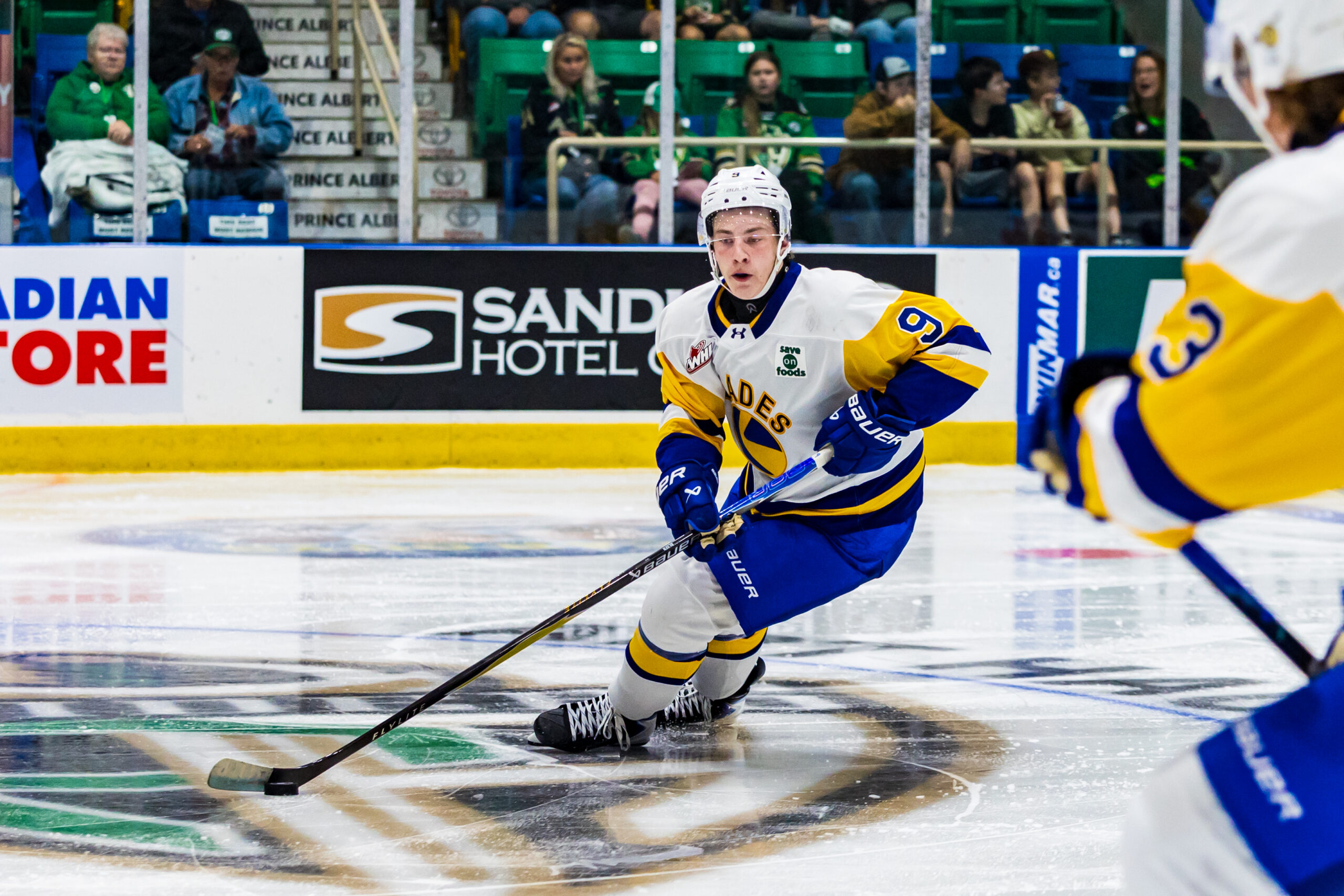
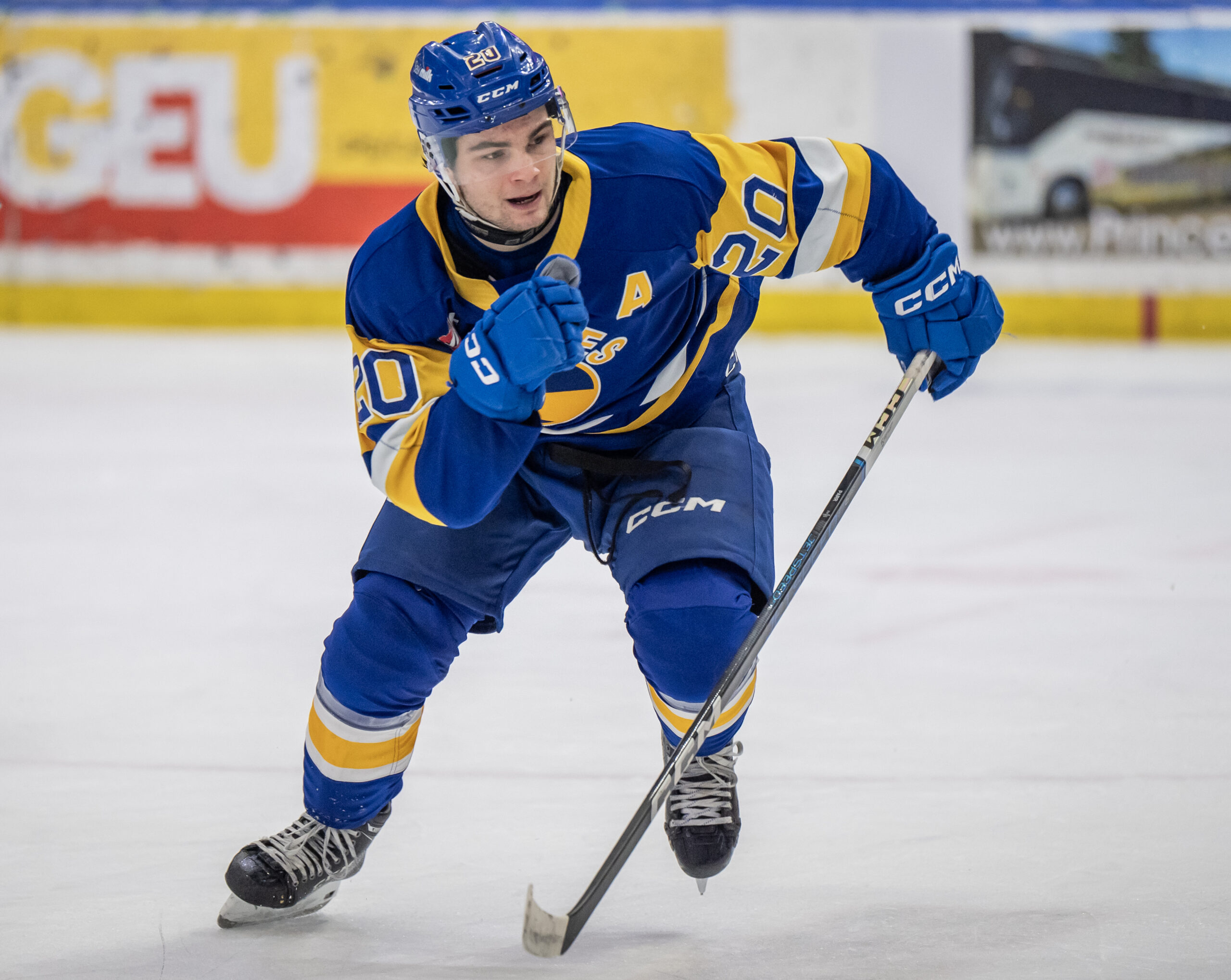
As the game began, our attention turned to the ice to see how Kaden performed. He put on a good show for his hometown crowd, playing tight, defensive hockey and wasn’t afraid to throw his 6-foot-2 frame around, but the rest of the Blades came out a little flat and were quickly overwhelmed by the quick, aggressive Wheat Kings. Luke Mistelbacher opened the scoring for Brandon in the first period, and rookie Prabh Bhathal scored his first WHL goal late in the second. The Blades got one back in the third, with Zach Olsen closing the gap to one, but the Wheat Kings didn’t lose any steam, leaving Joby Baumuller to pocket the empty-netter.
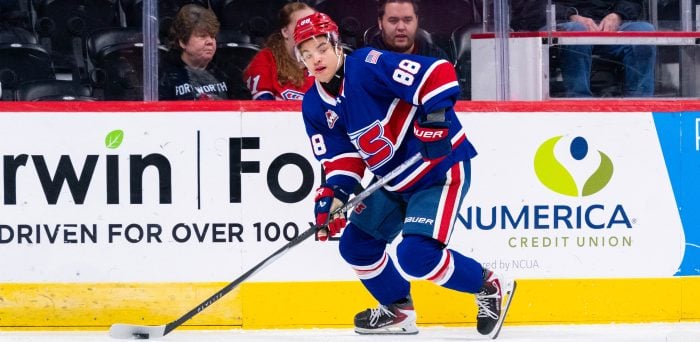
However, it was Jacobson who really stood out. He was fast, aggressive, and quick with his decisions and reactions. He was best when serving as his line’s playmaker, as he found some truly creative lanes to get the puck to his teammates. Every time he had the puck, you knew something good was going to happen, and it’s no surprise he finished the game with an assist on all three goals and was named the first star.
Brian was equally impressed with Jacobson, but he also mentioned that it had nothing to do with his father, Jared Jacobson, the Wheat Kings owner. Apparently, the city of Brandon isn’t a big fan of him. The previous owner, Kelly McCrimmon, was hugely popular with fans, and he built the team into what it is today. In 2020, he sold it to Jacobson, and things changed, some of which rubbed people the wrong way. According to Brian, those changes have pushed long-time fans away. This season, the Wheat Kings averaged the lowest attendance numbers in 30 years. Just 10 years ago, the team averaged 1000 more fans per game.
It also hasn’t been easy ever since Winnipeg left for Wenatchee in 2023. Like Swift Current, Brandon is not an easy place to get to, which limits the players they can recruit. Players need to fly into Winnipeg or Regina, then drive several hours to stay in a small city with very few things to do after the game. Without Winnipeg connecting Manitoba to the rest of the league, there’s even less of a draw to play in Brandon. That has created a bond among Manitobans; Brian mentioned that when Kaden went to various hockey camps across the prairies, he could immediately tell who was from Manitoba and who wasn’t. But it hasn’t replaced what was lost from the Manitoba rivalries.
The Wheat Kings were a fun team to watch. They played hard, fast hockey, and their young stars shone throughout the 60 minutes. Jacobson was easily their best player, but draft-eligible defenceman Giorgos Pantelas stood out with his big shot and high-end mobility, and he’ll be a key leader in 2026-27. Third-star Jayden Kraus should also return for his 20-year-old season as the team’s starting goalie, giving them a reliable presence in net while their young core continues to grow.
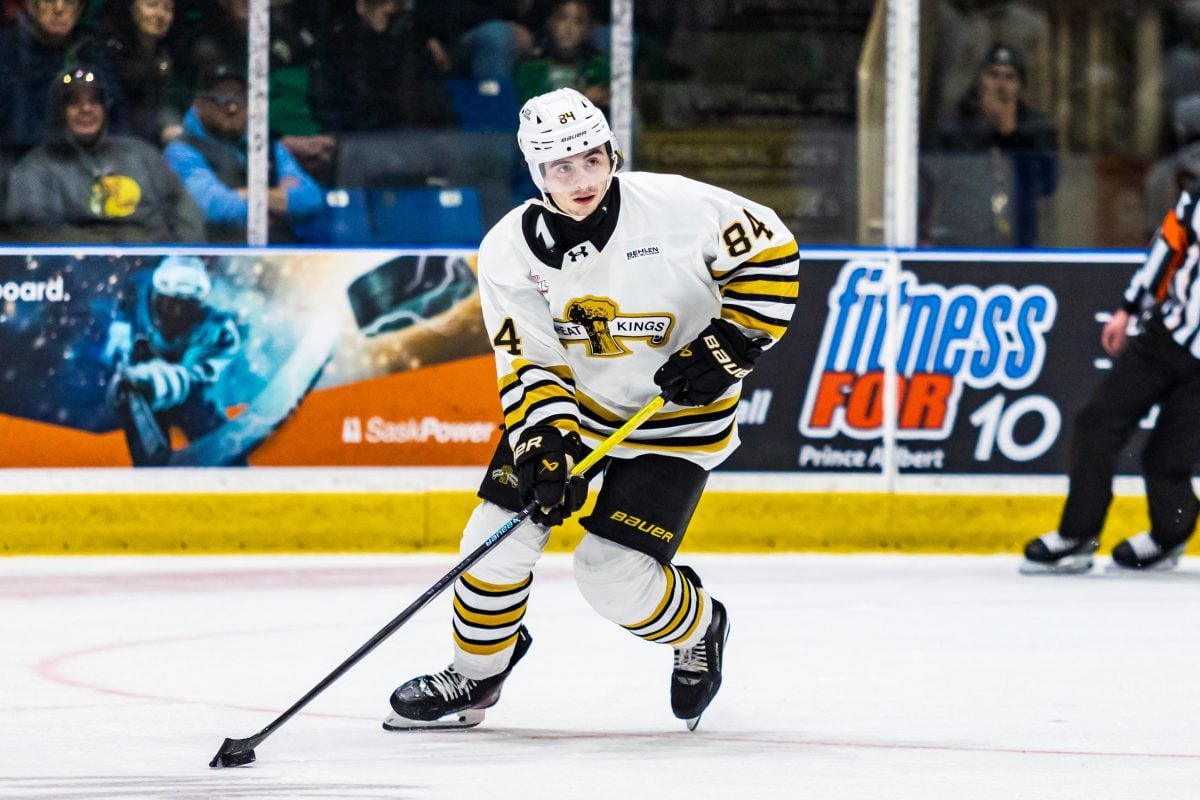
After the three stars were announced, I thanked Brian for chatting with me about his family and his hometown team. It wasn’t an experience I planned to have, but I was grateful that it did. It turned an isolating experience into one of the better hockey games I’ve seen on this journey, simply because I had another person to share it with.
Initially, I thought that Brandon had a sense of pride for outlasting every other Manitoba team, but instead, they miss sharing junior hockey with another city in their province. Games against the Blades or the Regina Pats are still good, but they lack that familiarity that comes from a good rivalry. Maybe one day, Manitoba will get another team and help Brandon feel a bit more included. With the WHL attracting more American prospects following the NCAA’s rule change, the league has opened the doors for expansion, and Winnipeg will always be an option worth considering. But until then, Brandon will have to go it alone.
Before my Great WHL Adventure, I likely never would have gone to Brandon, and there’s a low chance I’ll end up back there. It’s not really a stop worth making if you’re driving through. But I truly enjoyed my time there. I felt welcomed into the city and embraced with that small-town hospitality you can only get in these rural communities. It’s people sharing a sport they love and supporting the kids who chose their community to chase their dreams of one day playing in the NHL. No matter where you go, that will always be true, and as I turn my attention west, I know I’ll at least have that when I visit communities where I have even fewer connections than Brandon.
Free Newsletter
Get WHL coverage delivered to your inbox
In-depth analysis, breaking news, and insider takes - free.
Subscribe Free →