- Pending Restricted Free Agents
- Carter Mazur
- Sebastian Cossa
- Simon Edvinsson
- Pending Unrestricted Free Agents
- Patrick Kane
- Looking For Difference Makers in Free Agency
- Anthony Mantha
- Alex Tuch
- Go Big Game Hunting
- Robert Thomas
- Elias Pettersson
- Buy Low or Breakout Candidates
- Jiri Kulich
- Mason McTavish
- Brad Lambert
- Barrett Hayton
- Shane Wright
- Bradly Nadeau
After another season that will end with the Detroit Red Wings on the outside looking in at the Stanley Cup Playoffs, the team has one luxury at their disposal. Detroit has a massive war chest of cap space going into next season.
Now, in the post-flat-cap world it’s not entirely rare for teams to have more cap space than we’re used to, but Detroit is on another level compared to most teams. Detroit currently has about $31M in unused cap space for the 2026-27 season, with very few expensive deals to complete with their current players.
Let’s take a look at the pending free agents that Detroit will need to re-sign, as well as some of the other ways that they might be able to spend some of that cap space.
Pending Restricted Free Agents
Carter Mazur
Carter Mazur has shown that he is capable of being a highly productive AHL player over a pretty large sample and an effective bottom-six NHLer in a small sample. I expect Mazur to sign with Detroit on a one-way deal for a few years to give him the chance to blossom into the player the Red Wings have seen him as throughout his impressive development journey. That deal will use very little of the team’s cap space, likely under $1.5M per season.
Sebastian Cossa
Sebastian Cossa is in a similar position to Mazur as a successful American league player who is likely to earn an NHL role next season as the team’s backup.
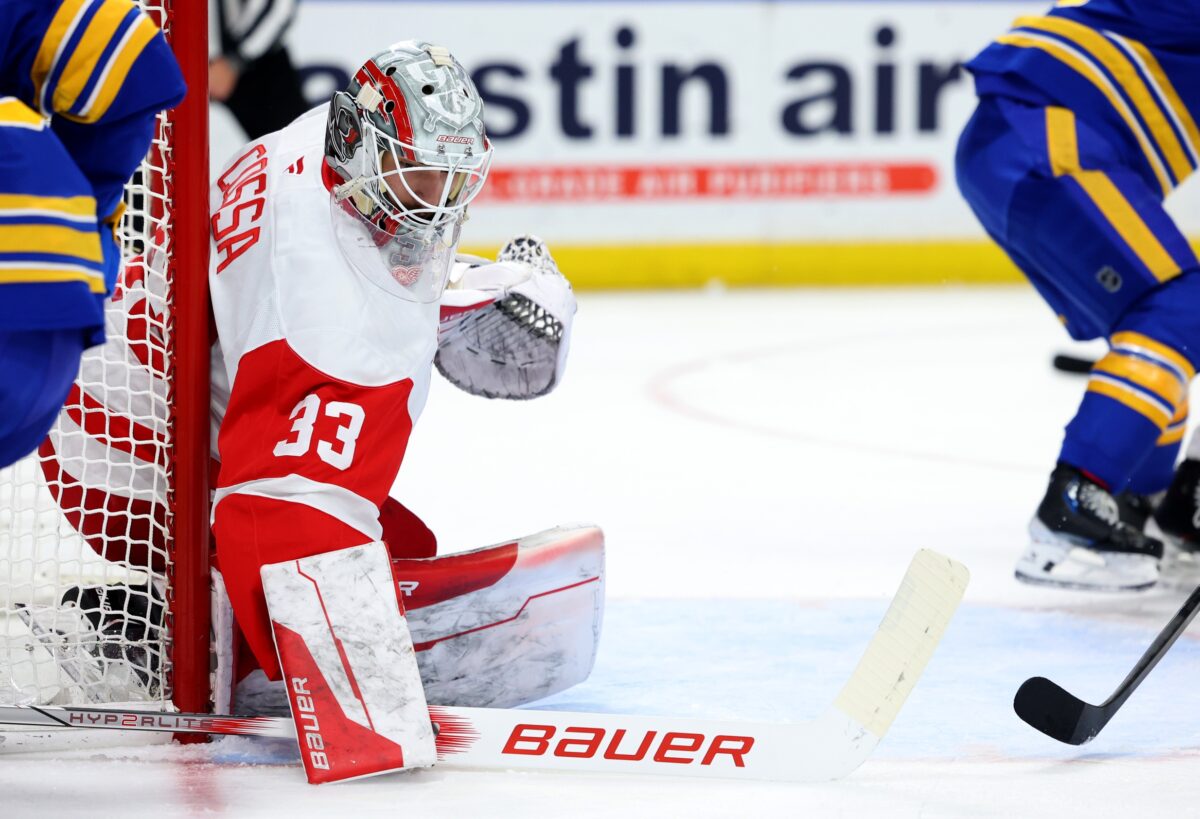
He still needs a contract for next season, and should land something like Jesper Wallstedt’s two-year contract worth $2.2M per season (signed roughly 18 months ago). Expect Cossa to extend for two or three years for an annual average value under $3M.
Simon Edvinsson
Simon Edvinsson is likely going to be the recipient of the biggest contract Detroit signs this offseason (unless DeBrincat signs a big extension). Recent extensions for young defensemen like Luke Hughes ($9M/year), Jackson LaCombe ($9M/year), and Thomas Harley ($10.6M/year) have reset the defense market.
For some perspective, Moritz Seider’s $8.5M/year contract will make him just the 20th highest paid defender in the NHL next season. I expect Edvinsson to become Detroit’s highest paid player, passing captain Dylan Larkin ($8.7M/year). For the purpose of this article, let’s say the two sides settle on a deal in the neighbourhood of $9.5M/year for eight years.
After these RFAs, Detroit is likely looking at $17-18M in remaining cap space. Let’s take a look at their pending Unrestricted Free Agents and get a sense for how much more they will need to spend to just maintain their roster.
Pending Unrestricted Free Agents
Patrick Kane
Detroit has a bit of a decision to make with Patrick Kane and his future, but I expect they will extend him on another affordable, bonus-heavy deal with very little term. Let’s assume they extend him for another year at the same AAV as this season of $3M.
If you include every forward under contract (as well as Mazur and Kane), Detroit could ice a young, but full lineup of 13 guys with Michael Brandsegg-Nygård, Emmitt Finnie, and Nate Danielson in the fold. That’s not to mention the possibility that Carter Bear is ready for the NHL as he appeared to be back in the Fall.
Regardless of how many youngsters make the lineup, I doubt that any of the remaining UFAs (David Perron, James Van Riemsdyk, Travis Hamonic, Erik Gustafsson, and Cam Talbot) are high priorities for Detroit.
If those young players make the lineup, and Detroit puts Axel Sandin Pellikka back on the blue line in the NHL, then Detroit will have roughly $14M to spend with no lineup holes to fill. That means their cap space can go toward improvements, not at the margins, but at the most important positions. Here are a few of the ways they could go about spending their remaining cap space.
Looking For Difference Makers in Free Agency
There was once a lot of chatter about how good the 2026 Free Agent class might be, with players like Kirill Kaprizov, Connor McDavid, Jack Eichel, Kyle Connor, and Martin Necas hitting free agency. However, that didn’t happen at all.
The expanding salary cap that will allow Detroit to spend a bit has made it much easier for teams to retain their star players and as a result, there are no serious difference makers left for free agency this Summer. There are still some really good players, but no game-changing talents like we once hoped. Here are a few of the best players available and what their fit might be like in Detroit.
Anthony Mantha
Anthony Mantha will be one of the most sought after players this summer. He has had an excellent year, but most importantly, he has stayed healthy. In his career, Mantha has played more than 70 games just once, and this season was the first that he reached 60 games played since 2022-23. Here’s a picture of what Mantha might look like in a Red Wings jersey.

He also set career highs for goals (32) and points (62) which should earn him a pretty nice contract. I don’t think the Red Wings will be in on Mantha regardless of the history between the two parties, but I wish him all the best.
Alex Tuch
Alex Tuch would be a great addition to the Red Wings, but it does feel nearly inevitable that he extends with the Buffalo Sabres before becoming a free agent. Tuch is a hometown player for the Sabres and is a well-loved player who serves as alternate captain. He has been underpaid for many years on a sweetheart deal that has paid him $4.75M/year since 2019, and that is absolutely going to change.
If he does somehow hit free agency, then the Red Wings will need to be cautious as he is likely to look for a long contract as a 29-year-old that would probably be inadvisable for Detroit to offer.
Go Big Game Hunting
The Red Wings have had one of the best groups of prospects for many years now, and this summer might just be the right time to cash in on that talent pool to swing a big trade. Detroit has a very real need in the second-line center position, and they would be well served by finding Larkin’s successor on the top line in the next few seasons as well. Here are a couple of ways they might be able to address that need.
Robert Thomas
Robert Thomas is a two-way center making just over $8M/year for another five seasons after this one. His name was in many trade rumours at this year’s trade deadline but a deal never materialized. I think the calm of the offseason might help facilitate this deal and the Red Wings have clearly struck up a comfortable working relationship with the Blues in recent years (just see the Vrana or Faulk trades).
Thomas is a playdriver at even strength, something that the Red Wings are in desperate need of. He won’t be cheap to land in a trade however, with the Blues reportedly asking for a young center, another good player, and at least a 1st round pick.
If Detroit were willing to part with either Marco Kasper or Nate Danielson, then they would absolutely have the pieces necessary to get the deal across the line. The biggest decision would be if they believe Thomas fills a big enough need to deal a young player that the team is very high on. If something like Danielson, Dylan James (prospect), Mason Appleton, and a 2027 1st gets the ball rolling then I think Detroit should go all in.
Elias Pettersson
The Vancouver Canucks and Elias Pettersson are in strange positions. Pettersson signed a massive extension that pays him $11.6M/year just two years ago, and has looked like a shadow of himself ever since. Before signing, he was a dominant two-way player, with the potential to put himself in Hart and Selke Trophy conversations. Don’t forget he already has an 89 point season and a 102 point season under his belt as a 27-year-old.

However, he hasn’t played at that level for an extended period. This deal would require the Red Wings to feel really good about their chances of getting him back to his near MVP-caliber performances of recent years. Pettersson has a full no move clause throughout the remaining seven years of the contract, and a team acquiring him could either be landing an elite player while his value is at its lowest possible point, or they could be acquiring an absolute albatross of a contract that will weigh on their cap sheet for the rest of the decade.
If the acquisition cost isn’t too significant, I wouldn’t actually be against trading for Pettersson on principle. However, I’d be very nervous to do so and would hope that Detroit could get the Canucks to take on a little bit of the less-efficient cap dollars that the Red Wings hold for the next couple of years. $11.6M is a lot of money, but that deal was worth 13.18% of the salary cap when it was signed, which would make an equivalent deal cost $13.7M for the 2026-27 season. A salary of $11.6M next season is roughly equivalent to a $9M deal in 2023-24 when Pettersson signed, so the salary will become less prohibitive as the years go on.
NHL salaries are set to explode (or they already did in the case of Kirill Kaprizov), and an $11M deal will look a lot more palatable in the 2028-29 season when the salary cap reaches $123M, nearly $30M higher than the cap was this season.
Buy Low or Breakout Candidates
Jiri Kulich
Jiri Kulich is a center for the Buffalo Sabres who I think could pop in a bigger role in the near future. However, the Sabres have a ton of young talented forwards that he is battling for ice time which could put one of them on the outs soon. Guys like Zach Benson, Noah Östlund, and Konsta Helenius are all fighting for similar roles so if any of them shake free in the coming year or so, Detroit would do well to snap them up.
Mason McTavish
Mason McTavish was the third overall pick in the 2021 NHL Draft and has scored 178 points in the NHL. This can barely be called “buying low”, but McTavish had a really down year in 2025-26. He scored a career low 38 points, underperforming expectations significantly after signing his first big contract. I doubt the Ducks are looking to move McTavish after just one down season, but any team that can pry him away now with his value at its lowest would be smart to do so.
Brad Lambert
Brad Lambert has had a fascinating development story. He was seen as a top prospect in his draft year, and has bounced back and forth between looking like a sure-fire top-six NHL centerman to looking like the kind of player you read about in “Biggest Draft Busts” articles.
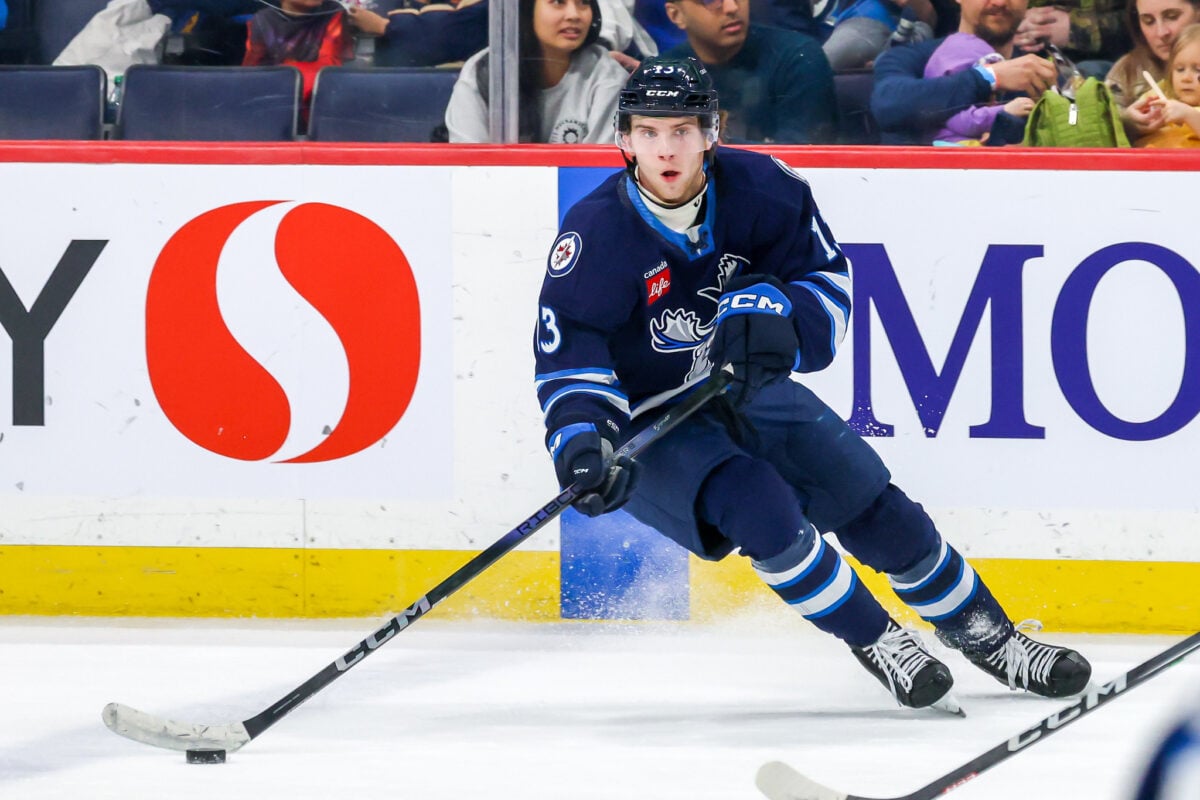
Lambert has roughly 300 professional games to his name at just 22 years old, but has struggled to consistently project as a difference maker. However, his skill and skating are so strong that I think he would be worth a flyer if the Jets begin to shop him soon. He’s at the make-or-break point in development where many NHL teams decide whether they’re committed or not and I wouldn’t be at all surprised if he is playing for a different organization come the 2026-27 season.
Barrett Hayton
Barrett Hayton is a young center who has alternated promising and disappointing seasons over the past five years. He hasn’t been nearly consistent enough for the Mammoth this season and is unlikely to play a top-six role for the team considering the rise of Logan Cooley. Hayton is a pending RFA this summer and I think Detroit would be well served either trading for his RFA rights or outright signing an offer sheet, especially considering his promising <–> disappointing pattern means he’s ready for a strong season in 2026-27.
Shane Wright
The Seattle Kraken thought that Shane Wright was going to be their first franchise defining superstar when they landed him fourth overall in the 2022 NHL Draft. He hasn’t reached anything close to those heights yet, though his 19 goal, 44 point performance in the 2024-25 season renewed hope a bit. However, he followed it up with a disappointing 11 goal, 26 point season this year. Maybe the Kraken and Wright would be interested in fresh starts, and the Red Wings could absolutely offer that, even trading back a young center in return perhaps?
Bradly Nadeau
This isn’t a “buy-low” situation as much as it’s a “buy before he explodes” situation. Bradly Nadeau has proven himself as a dominant AHL player, scoring 58 total goals and 111 total points across two full seasons with the Chicago Wolves. Nadeau dominated the NCAA and BCHL before that, and looks poised to break out as a stud in the NHL the moment he gets a bigger role.
Nadeau has played 15 NHL games across the past few seasons, but has an average ice time just over 13 minutes a night. There’s not really a clear space for him in the Hurricanes’ lineup next season unless they make a spot with a trade, so team willing to give him a big role might be able to sneak him away before he pops off.
Free Newsletter
Get Detroit Red Wings coverage delivered to your inbox
In-depth analysis, breaking news, and insider takes - free.
Subscribe Free →