The Pittsburgh Penguins still have flexibility, but flexibility only matters if the roster has enough value contracts around it. That is where president of hockey operations and general manager Kyle Dubas has a few important pieces working in his favor.
Pittsburgh is not in a normal competitive window anymore. The Penguins are still trying to remain relevant around Sidney Crosby, Evgeni Malkin and Kris Letang, but they are also trying to build a younger, cleaner roster for whatever comes next. That makes every contract more important. Overpaying for the wrong player can block opportunity. Finding value can keep the team competitive while the next version of the roster takes shape.
The Penguins’ cap space gives Dubas room to keep working, and the organization’s long-term flexibility gives Pittsburgh options beyond this season. Still, the best contracts on the roster are not only about future cap room. They are about players who can outperform their number right now.
Here are the Penguins’ three best contracts entering the 2026-27 season.
Sidney Crosby Is Still Pittsburgh’s Best Value
Crosby remains the easiest answer on the roster because his contract still does not match his value to the Penguins. Crosby is signed for two years with an $8.7 million cap hit, which continues one of the most famous numbers in modern NHL contract history. At this stage, the number matters even more because he is still producing like a star while carrying a cap hit below what elite centers usually cost.
Crosby had 29 goals, 45 assists and 74 points in 68 games during the 2025-26 season, which kept him above a point-per-game pace again. That kind of production would be valuable at almost any price. At $8.7 million, it remains the foundation of Pittsburgh’s entire cap structure.
The Penguins still ask Crosby to do more than score. He drives play, handles difficult matchups, raises linemates and gives the organization a competitive baseline even when the rest of the roster has questions. Pittsburgh’s recent center problem only makes that more obvious. The team has uncertainty behind him, but Crosby still gives the Penguins one of the league’s most reliable top-line answers.
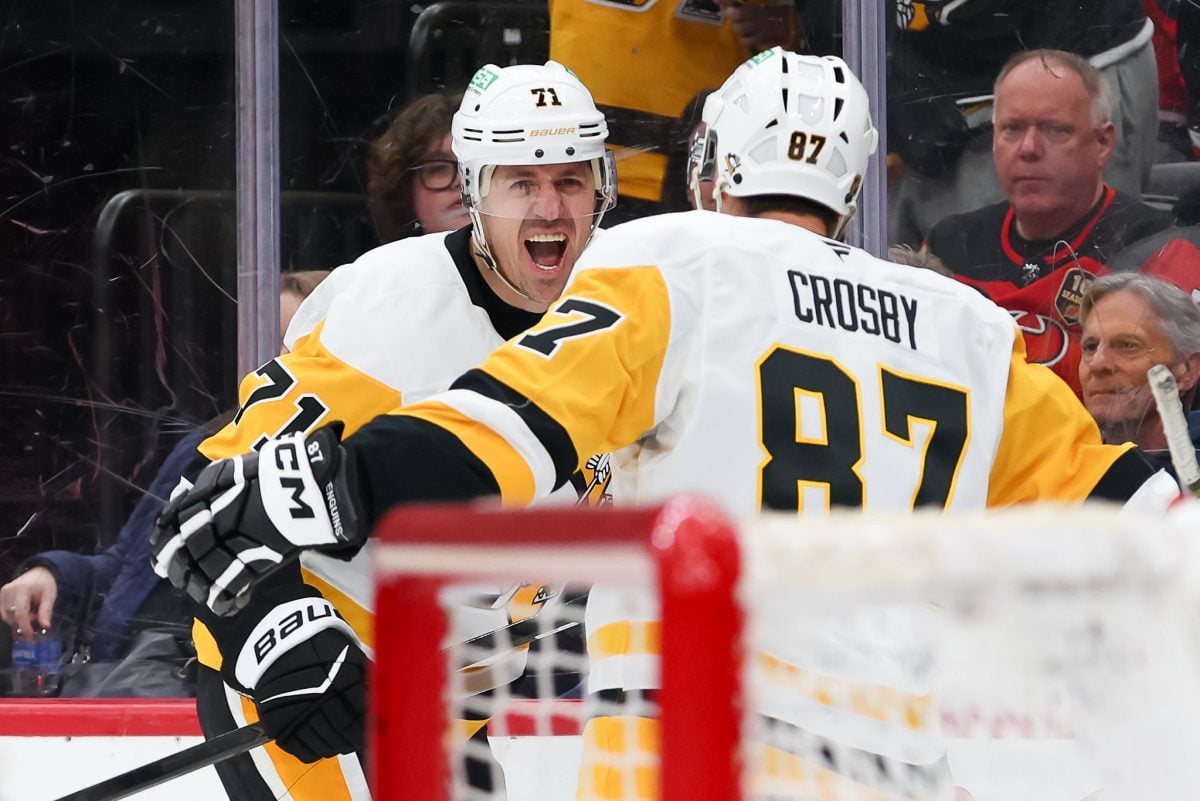
That is why this is not just a sentimental pick. Crosby is still the Penguins’ best player, still their most important forward and still one of the cleanest value contracts on the roster. If Pittsburgh is going to outperform expectations across an 84-game season, it starts with Crosby being worth far more than his cap hit.
Evgeni Malkin’s Short Deal Carries Real Upside
Malkin is not the same automatic second-line center solution he was for most of his career, but that does not make his contract a bad one. In fact, his one-year, $5.5 million deal could be one of Pittsburgh’s most useful values if he stays healthy and productive.
Malkin had 19 goals, 42 assists and 61 points in 56 regular-season games last season. That production still matters. He may need a different role, and his move to the wing changes how the Penguins organize their lineup, but the offensive talent has not disappeared. A player who can still produce at that level on a one-year deal below $6 million gives Pittsburgh real value without long-term risk.
That is the key part. Malkin’s contract does not trap the Penguins. It gives them one more season of a franchise icon at a number that can work if he remains a top-six offensive piece. Pittsburgh is not tied to multiple years of decline, and Dubas still has room to adjust the roster around him.
The deal also gives the Penguins flexibility with their younger forwards. If Malkin can still create offense on the wing, Pittsburgh can experiment with combinations involving Egor Chinakhov, Ben Kindel, Tommy Novak or other forwards trying to claim larger roles. That does not solve every lineup issue, but it gives head coach Dan Muse another high-skill piece at a manageable number.
There is risk because age is undefeated. Malkin will be judged by health, pace and whether his defensive limitations become harder to manage. But one-year contracts are built to limit that exact risk. For the Penguins, the upside is simple: if Malkin is anywhere close to last season’s offensive level, $5.5 million is strong value.
Ben Kindel’s Entry-Level Deal Gives Penguins Cheap Upside
Kindel is the opposite kind of value. Crosby and Malkin are established stars outperforming veteran contracts. Kindel is valuable because his entry-level deal gives Pittsburgh a young player with upside at a tiny cap number.
Kindel is signed through 2027-28 with a $982,500 cap hit. That number is exactly why he belongs in this conversation. If he becomes a regular NHL contributor, the Penguins will be getting meaningful production for less than $1 million against the cap. Teams trying to retool while staying competitive need that kind of contract.
Kindel’s rookie season gave Pittsburgh enough reason to take the possibility seriously. He had 17 goals, 18 assists and 35 points in 77 games, which is real production for a young forward still figuring out the league. He does not have to become a star immediately for the contract to matter. He only has to become a useful NHL player who can handle more responsibility over time.
That value becomes even more important because the Penguins have so many roster questions around their young forwards. Rutger McGroarty’s roster squeeze shows how crowded the opportunity picture has become, while Ville Koivunen’s uncertain path is another reminder that Pittsburgh needs prospects to turn into defined NHL pieces, not just interesting names.
Kindel’s contract gives the Penguins patience and urgency at the same time. They do not need to force him into a role he has not earned, but they should be motivated to find out what they have while he is still this cheap. If he becomes a middle-six forward on an entry-level deal, that is exactly the kind of internal value Pittsburgh needs.
Penguins Have Other Value Candidates
There are other contracts worth mentioning. Chinakhov could make his $6.25 million cap hit look good if his Pittsburgh breakout continues. His 18 goals and 18 assists in 43 games with the Penguins were strong enough to make his new deal one of the roster’s most important upside bets.
Joel Blomqvist is another value candidate because his $875,000 cap hit gives Pittsburgh affordable goaltending insurance. Kaedan Korczak’s $3.25 million deal could also look better if he becomes a reliable right-shot defenseman with term. Those contracts matter, but they require more projection than the top three.
That is why Crosby, Malkin and Kindel stand out. Crosby is still elite value. Malkin gives Pittsburgh short-term production without long-term commitment. Kindel gives the Penguins cheap upside at a time when young contributors could decide whether the retool actually works.
Penguins Need These Contracts to Matter
The Penguins’ best contracts are not enough by themselves. Pittsburgh still has major questions at center, on the blue line, in goal and throughout a crowded forward group. Good value does not erase those problems. It does give Dubas a better chance to solve them.
Crosby’s contract keeps the top of the lineup efficient. Malkin’s deal gives Pittsburgh one more year of high-end offensive upside without damaging future flexibility. Kindel’s entry-level contract gives the Penguins the kind of cheap young piece they need more of.
That is the formula Pittsburgh has to chase now. The Penguins can no longer rely only on star power, and they cannot afford to fill the roster with expensive placeholders. They need veterans who still outperform their numbers and young players who can grow into bigger roles before their contracts become expensive.
Entering 2026-27, Crosby, Malkin and Kindel give them three different versions of that value. If all three contracts deliver, the Penguins’ path to outperforming expectations becomes much more realistic.
Free Newsletter
Get Pittsburgh Penguins coverage delivered to your inbox
In-depth analysis, breaking news, and insider takes - free.
Subscribe Free →