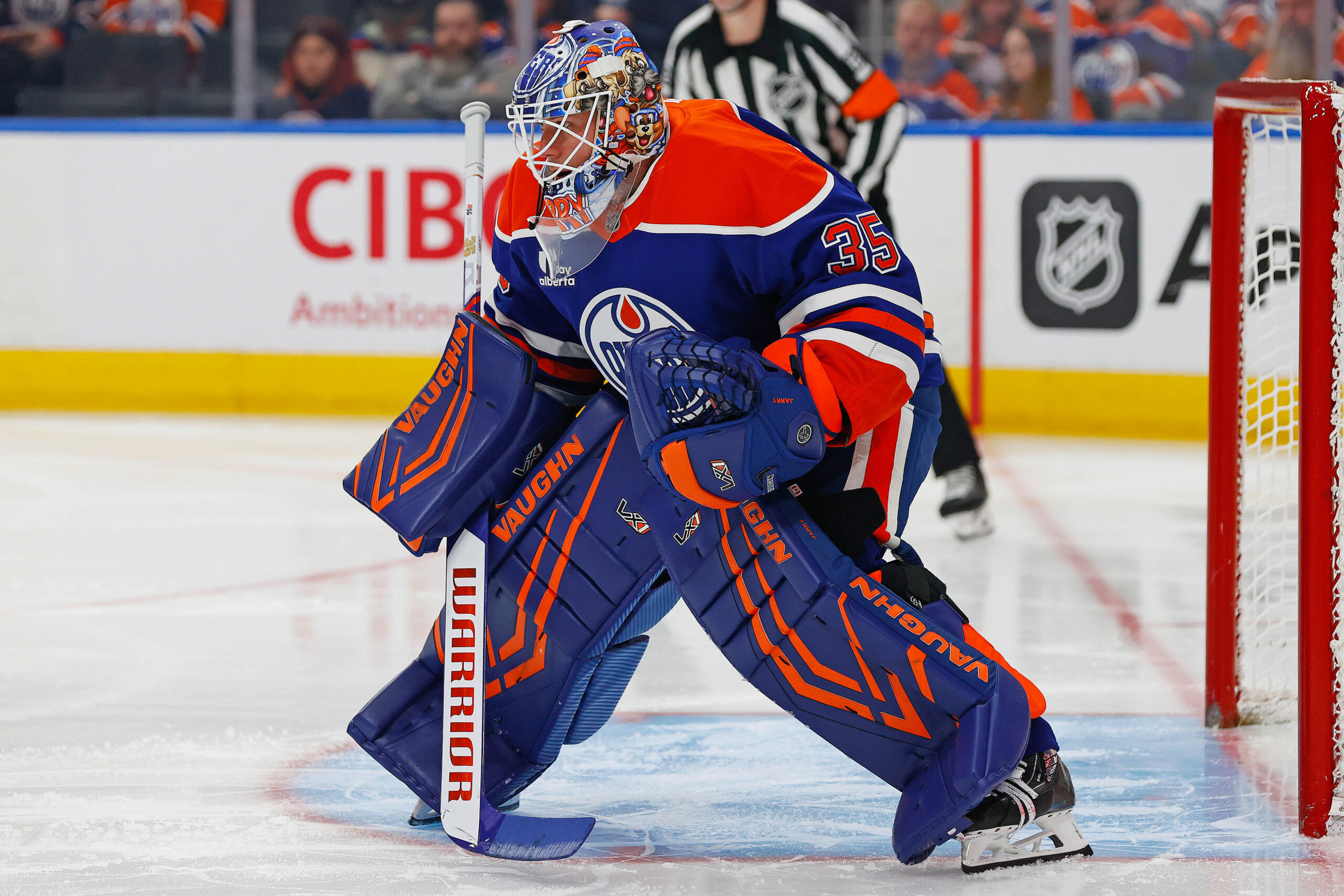
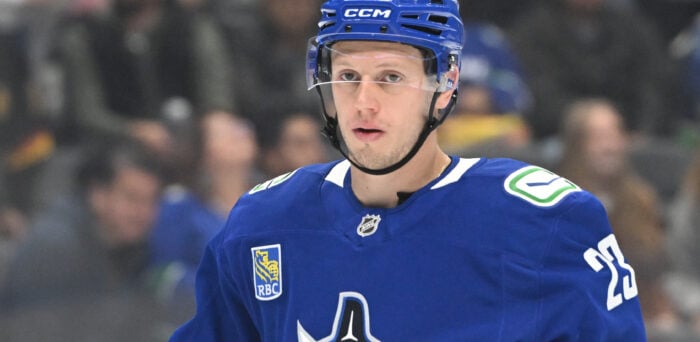
If it feels like you’ve read this headline before, it’s because you probably have. The latest wave of social media chatter linking New York Rangers forward Alexis Lafrenière to the Montreal Canadiens stems from yet another circulating rumour, but let’s be honest, Lafrenière-to-Montreal rumours have officially achieved offseason and trade deadline staple status. It’s the annual hockey tradition that just won’t quit.
Yet, while it’s easy to dismiss the online noise as pure fantasy, there’s a distinct difference in the landscape this time around. The recently revealed details of Montreal’s agonizingly close, down-to-the-wire miss on Matthew Knies at the trade deadline gave us a clear peek into general manager (GM) Kent Hughes’ playbook.

It proved beyond a doubt that the Canadiens are aggressively targeting big-bodied, impactful wingers capable of slotting directly into a top-six role. Lafrenière fits the archetype the Canadiens are missing. From a purely structural standpoint, it makes sense for Montreal to at least pick up the phone and inquire about the 2020 first-overall pick’s availability.
Pressure and the Drouin Treatment
His hypothetical arrival in Montreal would instantly invite comparisons to Jonathan Drouin‘s tumultuous tenure with the Canadiens. When Drouin was acquired in 2017, he was unfairly tasked with becoming the immediate saviour with the additional pressure as a homegrown talent expected to carry the offensive mantle while being forced to transition into a number-one centre. The resulting pressure, coupled with intense media scrutiny, ultimately turned his time in Montreal into a cautionary tale of mismatched developmental expectations.
For Lafrenière, the burden of being a Quebec-born first-overall pick would carry similar symbolic weight, but the baseline expectations would manifest differently. Rather than being asked to anchor an entire franchise from scratch, Lafrenière would step into a secondary role where he would be expected to continue with his current production (24 goals and 57 points) on a second line, with the hope he could exceed his top-six production. Essentially, he would be serving as an offensive finisher to complement Ivan Demidov rather than be a project to be molded.
Lafrenière’s psychological and tactical reaction to the Montreal pressure cooker would likely diverge from Drouin’s experience due to his experience in New York and the blueprint already laid out by the current front office. While Drouin arrived still searching for consistency and found himself highly sensitive to immediate criticism, Lafrenière has already survived a multi-year developmental gauntlet in New York, learning to block out outside noise to become a strong even-strength player on a very weak even-strength team.
Furthermore, Hughes has already demonstrated an ability to successfully insulate high-profile, homegrown talent, most notably with Mike Matheson. By acquiring Matheson as a mature piece rather than a saviour and consistently framing him as a stabilizing veteran leader rather than the focal point of the franchise, management shifted the narrative. Lafrenière steps into that environment, viewing the market not as a fragile trial to prove his worth but as a stable platform where local stars are supported.
Crucially, the expectations placed on Lafrenière would be filtered through this modernized organizational lens, entirely distinct from the rigidity of the Marc Bergevin era that hindered Drouin. Under Hughes and the current coaching staff, the Canadiens have made it an art form of deflecting media heat away from individual players, using transparent communication to focus on collective growth rather than individual salvation.
Just as management shielded Matheson from unfair criticism during defensive lapses by highlighting his immense workload and leadership value, they would provide the same for Lafrenière. While the Montreal fanbase would still demand elite production, the structural insulation proven by Matheson’s successful integration suggests Lafrenière would face a far smoother, healthier tenure than the overwhelming isolation that defined Drouin’s time in the city.
Canadiens Development Coaches Will Play a Role
The contrast between how Montreal and New York handle their prospects is night and day, and it tells you everything you need to know about where these two franchises are at. In Montreal, director of hockey development Adam Nicholas has built a progressive hockey laboratory that treats player development like an exact science. Nicholas isn’t just running standard drills; he’s focusing on the micro-details such as cognitive processing, spatial manipulation, and edge-work adjustments designed to let a player’s natural skill explode.
You see that patient, player-centric blueprint written all over the Canadiens’ roster. Add in head coach Martin St. Louis’ approach of intentionally creating a runway where young players can test their limits and use their high-end offensive deception without the immediate fear of being benched for making a mistake, and the development path has been quickly rising.
Hop on a flight down to New York, and it’s a completely different world with an entirely different set of institutional pressures. Under Tanner Glass, the Rangers operate a much more traditional, old-school pipeline where the mandate isn’t about redefining a kid’s game, it’s about forging reliable, error-free pieces who can seamlessly plug into a veteran-laden roster.
For a club that is beginning another rebuild process, this may change, but to modernize will take time. Glass and his staff have focused heavily on structural positioning, heavy wall-play, and defensive responsibility. Look at their first rounders over the last few years; when they grabbed the highly skilled Gabe Perreault 23rd overall in 2023, the immediate focus became pumping muscle onto his frame and teaching him how to survive the pro pace.
A year later, they drafted E.J. Emery at 30th overall, a big, mobile, non-flashy shutdown defenceman whose entire development curve is built around making the safe, simple play. While Montreal built a customized laboratory for individual upside, New York’s system is designed to manufacture disciplined, plug-and-play puzzle pieces, and the results on both sides speak for themselves.
The Fit and the Cost
Lafrèniere is a good player who has shown he can produce 50 to 60-point seasons, and even if he doesn’t improve at all (which is unlikely under Nicholas), that’s still solid second-line production. Until Juraj Slafkovsky broke out this season, they had similar point production, keeping in mind that Lafrenière doesn’t get to play regularly with a 101-point centre or a 51-goal winger. He is only 24 years old, and he is locked up at a pretty good number with a quickly rising salary cap. He was signed to a seven-year $7.45 million contract extension only two years ago, which takes him to the age of 30.
No doubt fans would love to clone Slafkovsky, or have had Knies land in Montreal, but adding a skilled winger with size who can play physically on a second line reliably isn’t that bad. He boasts solid advanced statistics with a strong expected goals for percentage (xGF%), sitting at 53.5%, second behind Norris Trophy-winning defenceman, Adam Fox. Considering how poorly the Rangers performed this season, that is a good outcome, as are his strong puck possession numbers with a 52.44% Corsi For, and 58.29% high- danger chances for percentage (HDCF%).
When analyzing a player like him, pulling strong analytical metrics like those above, on a spectacularly underperforming roster, is an indicator of a strong, self-sustaining playdriver. In the hockey data world, these underlying numbers act as a predictive forecasting tool, proving that Lafrenière isn’t merely a passenger riding the coattails of star teammates; instead, he is actively fighting the current and dragging his line into high-leverage scoring areas through his play.
Because his on-ice process is already mathematically sound, these numbers serve as a green flag for the Canadiens’ front office, signaling that his real-world production could improve when added to a strong young emergent core group of skilled players. That would translate into a massive improvement on a desperately needed second line in Montreal.
The chemistry that could be built between Lafrenière and Demidov is enough to make fans excited. Think about it: you’re pairing Lafrenière’s small area operational intelligence with Demidov’s hyper-creative, edge-work-driven planned chaos. Lafrenière has completely remolded his game into a five-on-five possession vacuum; he’s the guy who has begun to regularly go into the greasy areas, below the hash marks, shields the puck like a seasoned vet, and absorbs heavy contact along the boards just to extend a cycle.
Now, imagine him winning that board battle and slipping a subtle, high-IQ pass into space for Demidov. The young Russian phenom lives to manipulate space with dynamic, east-west movement, using his elite vision to carve open defensive structures the second a teammate creates an inch of room. Lafrenière acts as the heavy playing puck retrieval player, while Demidov provides the pure, high-octane offensive deception that leaves defenders completely twisted around.
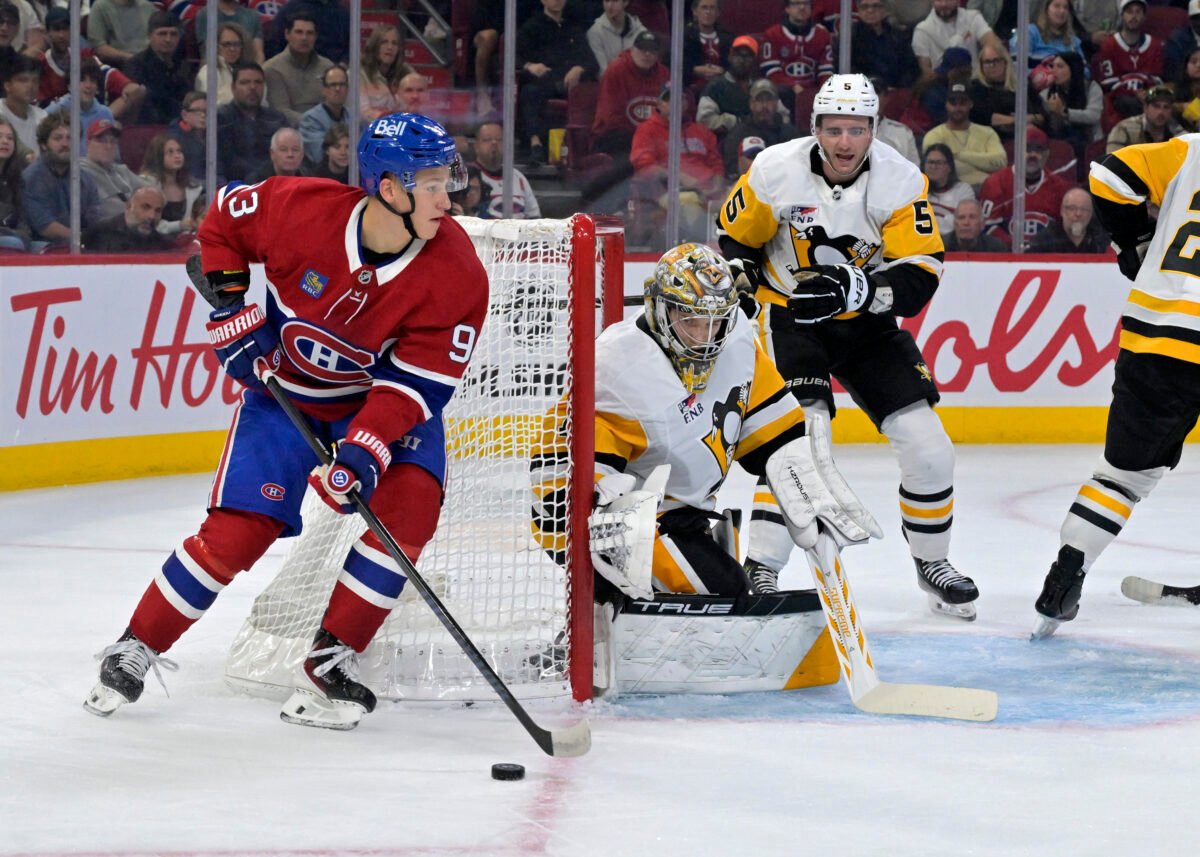
What makes this hypothetical duo so tantalizing is how well they could fit each other’s tactical puzzles. It could be a highly beneficial, symbiotic relationship: Lafrenière provides the structural insulation, the reliable forechecking, and the heavy physical edge that frees up the ice, while Demidov weaponizes that extra room to dictate the pace of the game. Put them together, and you have a pairing that truly complements one another.
While a portion of the market remains hesitant about taking on Lafrenière’s long-term cap commitment, his persuasive five-on-five underlying play-driving metrics make this the exact type of high-upside, top-six swing that Montreal’s front office has actively kicked tires on. I’m not sure what he would cost in a trade if he’s even available, but I imagine it would be less than the rumoured package for Knies.
So, for the Rangers to move on from Lafrenière, it would make sense they’d target draft capital and prospects. Hughes is likely to dangle the 28th overall pick in 2026, possibly even other picks as well. They would also require some defensive help in their prospect pool, meaning a player like American Hockey League (AHL) top prospect Adam Engstrom could be part of the package. Just those assets wouldn’t be enough, and additional winger prospects with size or a young depth roster player would likely be required.
If you are Hughes, what is the centrepiece that you give or offer to acquire a player of Lafrèniere’s quality? What interesting assets do you have to offer to convince another organization to part with such an important piece? The hardest part of the equation, if it happens, will be managing the narrative.
Stripping away the blinding glare of his status as a first-overall pick and a French-Canadian kid from Quebec is almost impossible here, and it ensures that any potential arrival would be met with an immediate, towering mountain of expectation. Ultimately, Lafrenière represents the exact high-upside, analytically dominant top-six winger Hughes would want to complement Demidov and elevate Montreal’s second line.
Free Newsletter
Get Montreal Canadiens coverage delivered to your inbox
In-depth analysis, breaking news, and insider takes - free.
Subscribe Free →