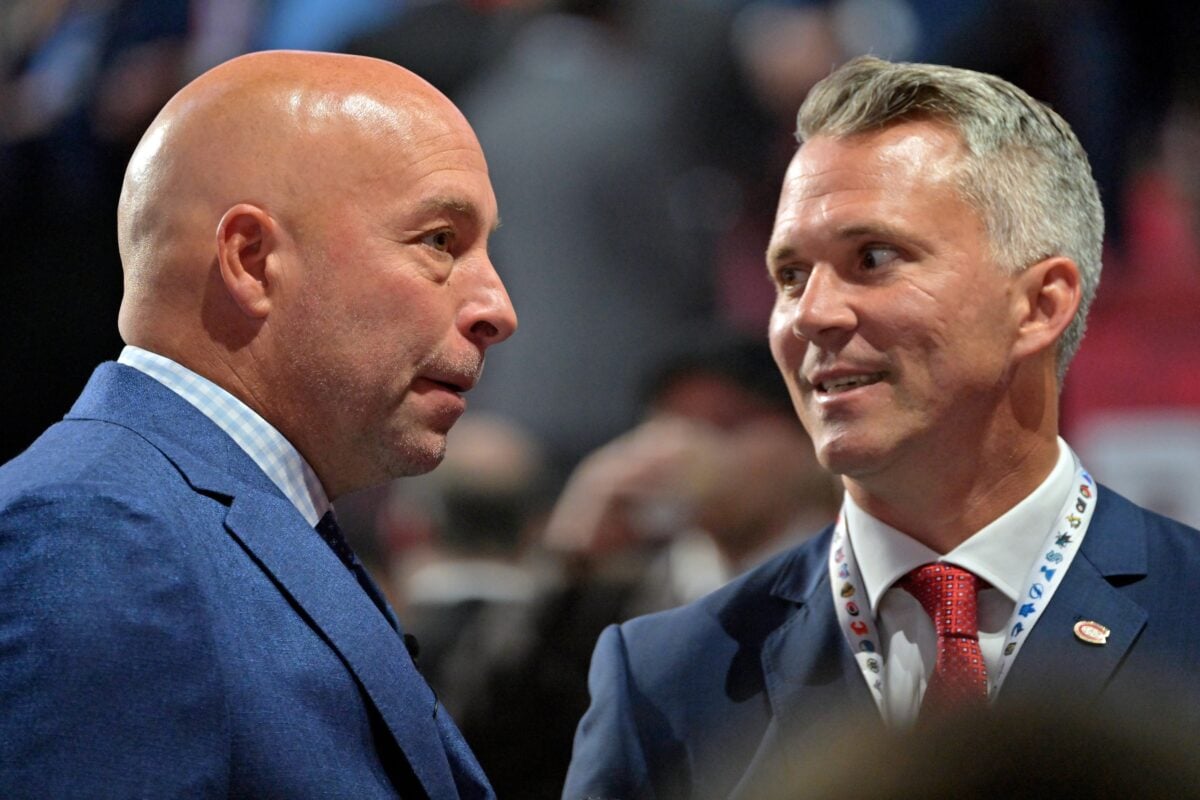
As the calendar turns past the mid-July mark, the euphoria of that deep spring run has given way to cold, hard summer calculations for the Montreal Canadiens organization. General Manager (GM) Kent Hughes and Executive Vice President of Hockey Operations Jeff Gorton have never been ones to deviate from their script. They didn’t do it when the team was picking near the top of the draft, and they certainly haven’t changed their posture now that the expectations have drastically shifted.
Nobody outside the walls of the Bell Centre expected a young group to rack up 106 points and push the heavyweights to the brink. But in the National Hockey League, yesterday’s success is nothing more than tomorrow’s target. The central question dominating the conversation from Rue de la Montagne to the micro-communities of hockey Twitter is simple: have the Canadiens done enough this offseason to not only maintain their ground but genuinely improve within a brutal, unforgiving Atlantic Division?
To answer that, you have to look past the lack of splashy, headline-grabbing unrestricted free-agent signings. Hughes opted out of the bidding wars that saw desperate teams dump barrels of cash into arguably the shallowest UFA pool in recent memory. Instead, Montreal’s management group doubled down on their core conviction that sustainable improvement comes from within. But while patience is a virtue, the Atlantic Division is a meat grinder. Let’s break down exactly where the Canadiens managed to take a step forward this summer, and where they risk falling back against their closest rivals.
Where They Improved: Structural Stability and Star Power
Make no mistake about it, the single biggest victory of Montreal’s offseason didn’t come via an external addition. It came via the stroke of a pen. Securing phenom Ivan Demidov to a massive eight-year, $73.2 million contract extension (that kicks in for the 2027-28 season) is absolute thievery compared to the signings of other high end restricted free agent (RFA) signings such as Leo Carlsson. While other franchises are staring down catastrophic cap crunches or navigating tense stalemates with their young stars, Hughes locked up the crown jewel of the team’s offensive future long-term. Demidov’s commitment provides a foundational layer of certainty that allows the rest of the roster puzzle to fall into place. He isn’t just a core piece anymore; he is a pillar.
Beyond the marquee contract extension, the Canadiens quietly executed an incredibly astute upgrade behind the bench. The hiring of Derek Lalonde as associate coach is a home run for head coach Martin St. Louis. Lalonde, who brings a Stanley Cup pedigree, having won back-to-back Cups as an assistant with the Tampa Bay Lightning, as well as some NHL head-coaching experience, represents an immediate tactical elevation. With Trevor Letowski stepping away from the bench, St. Louis needed this hiring. This wasn’t a corporate hire forced upon the coaching staff; it was a collaborative decision aimed at refining Montreal’s defensive structures and in-game adjustments.

Lalonde’s presence will be invaluable for a young, hyper-talented blue line featuring Lane Hutson, Kaiden Guhle who are tasked with taking the next developmental step. This addresses one of Montreal’s biggest deficiencies from last season, defence. They allowed 251 goals against, finishing 16th in the league. While they did improve defensively near the end of the season, without a clear improvement in this aspect, they will struggle to repeat their 106-point season. On the ice, Hughes also managed to trim some fat while injecting younger, cheaper energy into the bottom six. Trading veteran warrior Brendan Gallagher was an emotional pill to swallow for a fanbase that watched him bleed bleu-blanc-rouge for over a decade.
However, from a pure business and speed perspective, clearing that roster spot and adding some cap flexibility, despite the 50% salary retained, was necessary. This provides a depth forward an opportunity, someone like Florian Xhekaj, or more likely newly acquired Brett Berard, who plays a Gallagher-esque high-octane forechecking and an irritating, high-energy style. Combined with the targeted depth additions of Kaapo Kähkönen in net and Alex Belzile for leadership insurance, the roster boasts a clearer definition of roles from top to bottom. While Montreal does get high marks from some for their offseason work so far this summer, it is still a work in progress.
Where They Fell Back: The Arms Race and Unresolved Questions
While internal progression is the organizational mantra, hockey does not exist in a vacuum. The terrifying reality for the Canadiens is that while they stood relatively still on the trade and free-agent markets, the rest of the Atlantic Division went into a full-on arms race. The defending division champion Buffalo Sabres didn’t lose any of their core components. Perennial powerhouses Florida Panthers and Tampa Bay Lightning remain loaded, aggressive, and entirely unsatisfied with letting a young Montreal squad leapfrog them permanently.
Playoff regulars, the Boston Bruins and Toronto Maple Leafs made significant alterations to ensure they will compete for a playoff spot this season. Even the Ottawa Senators, who were forced into making significant moves, remain a playoff contending club. The entire Atlantic Division, with the exception of the Detroit Red Wings at this point, have remained legitimate playoff contending teams, but at most, only five can make it. By sitting out the primary free-agent market, Montreal inherently conceded the short-term transactional advantage to teams willing to overpay for instant help. If Lane Hutson or Juraj Slafkovsky experience even a minor sophomore or junior regression, the Canadiens lack the veteran insurance policies that division rivals spent millions to acquire this summer.
Furthermore, the decision to re-sign center Kirby Dach to a highly scrutinized one-year, $3.6-million contract extension raises more questions than it answers. It is a classic “prove-it” bridge deal, but in the context of Montreal’s future, it acts as a double-edged sword. If Dach breaks out and stays completely healthy, his next contract demands will skyrocket, complicating the long-term salary structure. If his injury troubles persist or his performance plateaus, the Canadiens are left with a critical hole at the second-line center position with zero term control. Yet it does seem to be a placeholder for the roster as it awaits Hage’s graduation to the NHL. In the meantime, in an Atlantic Division where down-the-middle depth determines playoff positioning, relying on a one-year patch for a crucial top-six piece feels like a gamble that could easily backfire.
Do or Do Not, There Is No Try
At the 2026 NHL Entry Draft, the Canadiens held the 28th overall pick, before trading up to 26th overall to select Russian forward Gleb Pugachyov. While it’s clear the Canadiens’ interest in the Russian winger was genuine, betting lines like Sportaza online sportsbook had a 75% chance that Hughes would succeed in his trade options involving the pick. However, they were wrong. While scouts love his upside, Hughes openly admitted he was hunting for an immediate impact trade using that selection. The fact that no blockbuster materialized means Montreal’s top-six forward group remains essentially unchanged.
The selection of Pugachyov also underscores a broader, lingering reality regarding Montreal’s depth chart which includes Michael Hage and Florian Xhekaj: the cavalry is coming, but it isn’t arriving tomorrow. Hughes has built a spectacular cupboard, but you can’t feed a hungry top-six with futures when you’re trying to survive the Atlantic Division today.
This lack of immediate trade traction doesn’t mean Hughes has deleted his cell phone carrier, the search for top-six reinforcement continues. While the rumours surrounding Columbus Blue Jackets forward Kirill Marchenko have died down, Hughes has made his name by not only picking his target, but also picking his spots, and the Russian forward is still on his targeting radar. Marco D’Amico suggested on The Starr and D’Amico Show that Montreal has not backed away from its interest. Instead, he believes the organization is positioning itself to capitalize if circumstances change stating that “You’re going to see it, it’s going to happen this season, where there are a couple of GMs on the hot seat that, if they’re not competitive, then that’ll [cost them] their job”.
But while the fan base might clamor for a sudden splash to match the division’s immediate arms race, the presence of Hage in the pipeline grants the front office an immense luxury of patience. Knowing he has the potential to develop into a legitimate, top-six center by next season means Hughes is under zero pressure internally to mortgage the future for a short-sighted, expensive fix today. This organizational insulation allows management to wait for the perfect trade target to materialize rather than forcing a deal out of desperation. While Florian Xhekaj and Pugachyov marinate on their own respective timelines to add size and grit to a bottom six line, Hage’s top-six centre upside serves as a security blanket, proving that while the Canadiens want to compete right now, they refuse to derail the very bright future they’ve spent years carefully constructing.
So, did they do enough?
If your definition of “doing enough” requires a general manager to light cap space on fire to win July headlines, then the answer is an easy no. But that has never been Hughes’ metrics for success.
Even with several more files left to be addressed, such as Arber Xhakaj’s next contract, the Canadiens are undeniably a more mature, structurally sound organization than they were two months ago. The Demidov extension guarantees long-term stability for the core, Lalonde provides tactical sophistication, and the graduation of top prospects into full-time roles will naturally elevate the floor of the lineup.
However, by choosing patience in a division that demands relentless urgency, Montreal has placed an immense amount of pressure on their youth. They are betting the house that internal growth will outpace the expensive, veteran acquisitions of their divisional peers. It’s a calculated, admirable gamble, one that aligns perfectly with the culture they are building in Montreal. But make no mistake: in the Atlantic Division, the margin for error is non-existent, and the ice is about to get a whole lot thinner.
Free Newsletter
Get Montreal Canadiens coverage delivered to your inbox
In-depth analysis, breaking news, and insider takes - free.
Subscribe Free →