


The NHL offseason is always full of a bit of drama, and the 2024 rendition was no exception. Among numerous other storylines, the Stanley Cup runner-up Edmonton Oilers faced a dilemma; they had barely any money to go around and needed to re-sign pending restricted free agents (RFAs) Dylan Holloway and Philip Broberg. The franchise had previously selected Holloway 14th overall in the 2020 NHL Entry Draft, and Broberg eighth overall the year prior. Neither had seemingly lived up to their draft positions and also didn’t have room to move up in their respective lineups, either. Both young men signed offer sheets with the St. Louis Blues that the Oilers couldn’t match, thus ending their time in Alberta and beginning a new era in Missouri.
However, it was recently suggested by Jeff Marek on “The Sheet” that the Calgary Flames were also in the mix for Holloway and Broberg’s services. The team is currently in the midst of a “retool on the fly”, as dubbed by general manager Craig Conroy, but surprisingly find themselves occupying a playoff spot in the NHL’s Western Conference. The Blues, however, are on the outside looking in despite the swift individual progressions of Broberg and Holloway. At the time of writing, Holloway is tied for second on the Blues with 16 points in 27 games. Broberg has also registered an impressive 12 points in 15 games, missing time due to injury. The Flames could have potentially used the two youngsters to expedite their re-tool. So what stopped them from getting these deals done?
A Murky Pathway to Playing Time
Well for starters, Holloway and Broberg would’ve had a tougher time factoring into the Flames lineup. Both the forward and defence cores are crowded with a healthy mix of young and veteran players. On the backend, Broberg would’ve likely been stuck somewhere in the bottom four; Rasmus Andersson, Kevin Bahl, Mackenzie Weegar and Daniil Miromanov occupy what is a formidable top four. Even down the road when the veterans are gone, the Flames are still very set on defence. They have blue chip prospects Zayne Parekh, Hunter Brzustewicz, Ilya Solovyov, and Etienne Morin, among others, on their way to the NHL very soon.
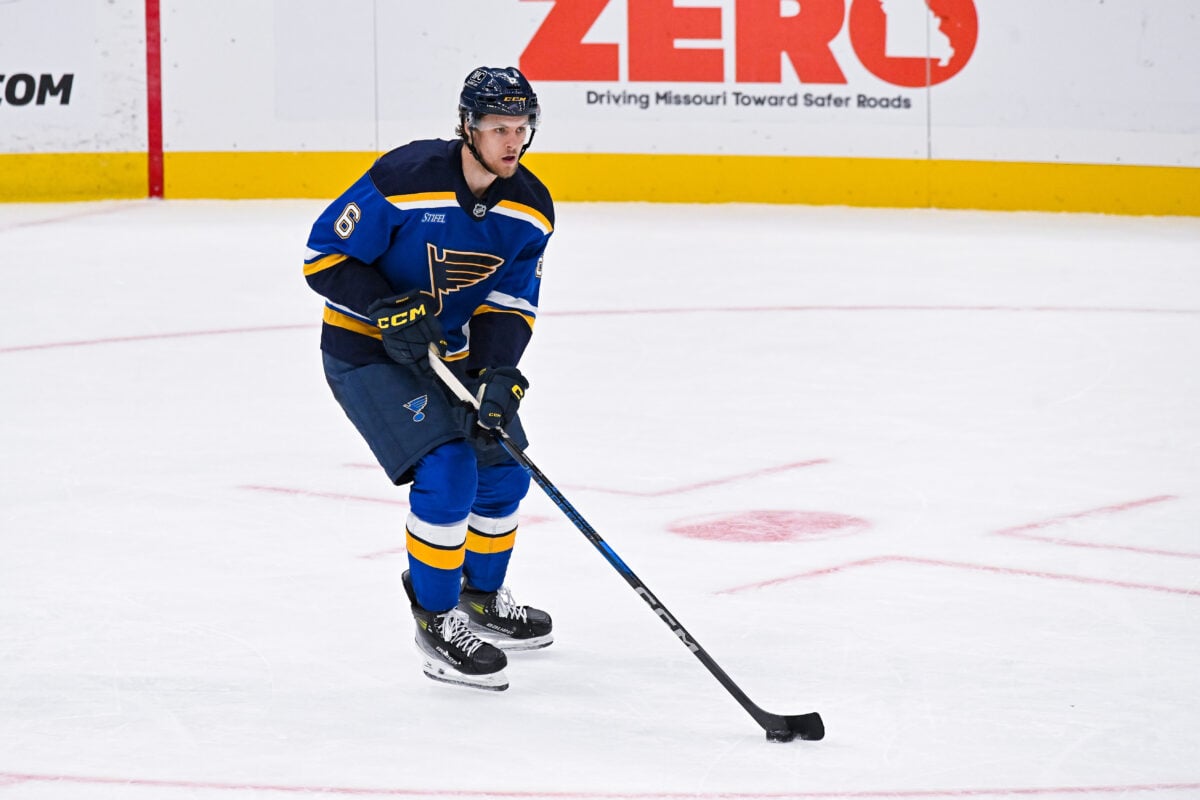
If Holloway played centre, he would have slotted into the Flames forward lines perfectly. Unfortunately, he plays the wing, of which the Flames have an abundance of. The team deploys Jonathan Huberdeau, Yegor Sharangovich, Blake Coleman, and Jakob Pelletier on the left side, which is primarily where Holloway lines up. The team also had Anthony Mantha in the position before he injured his ACL and was announced to be done for the season. If Holloway switched to his off-wing, he would have either taken away valuable playing time from developing Flames draft picks Matt Coronato and Martin Pospisil or be buried in the bottom six. So in essence, neither Broberg nor Holloway would have gotten the same playing opportunities that they have with the Blues.
The Financial and Other Associated Issues
Let’s be frank: it’s not like the Flames couldn’t have afforded to pay Broberg and Holloway. The franchise had the second-most cap space in the NHL in the offseason with approximately $30 million available on July 1. The Blues snagged Holloway with a two-year, $4.58 million deal and Broberg inked a two-year, $9.16 million contract. Both the term and average annual values (AAVs) were super team-friendly and designed as “prove it” deals; the players are given a short-term opportunity to showcase their skills and earn something with more security and higher monetary compensation. The problem would have arisen for the Flames this upcoming offseason. They need money to re-sign Coronato, Connor Zary, Pelletier, Bahl, and goaltender Dan Vladar, among others.
Speaking of compensation, the Flames also had the necessary draft picks to send in the Oilers’ direction; in order to successfully complete the offer sheet process, a team must send the former team draft selections decided by how much the AAV is. Broberg’s AAV got the Oilers a second-round pick in 2025, and Holloway’s netted them a 2025 third. The team must also send their own picks. The Blues had to make a trade beforehand to reacquire their second in order to get Broberg. The Flames have their own second and third as well as the Colorado Avalanche’s second in the 2025 Draft. The franchise needs these picks as part of their rebuild, whether they are used to select players or packaged in a trade to acquire young, proven talent.
In conclusion, the Flames made the correct decision by not pushing harder to sign Holloway and Broberg. Neither young man would have fit as perfectly into the Flames lineup as they do with the Blues, and would have posed problems in the Flames’ future plans.

