The NCAA free-agent signing period has begun, and the Toronto Maple Leafs have made their first move. The team has consistently shown interest in the college unrestricted free agent market, signing Jacob Quillan from Quinnipiac University last year. This year, they have kicked off the signing period by acquiring left-handed defenceman John Prokop from Union College. Many regarded Prokop as one of the top college free-agent defenders available, although this year’s market is generally considered weaker.
The contract is only for one year, and he will join the Toronto Marlies (American Hockey League) for the remainder of the 2024-25 season on an amateur tryout to work toward another contract with the organization. While he is already 23 years old and turns 24 later in the year, the organization sees something in him and is willing to try and see if they can get the most out of him. Here is what you should know about Prokop, the newest Toronto Marlie.
Get to Know Prokop More
At 6-foot-3 and 185 pounds, Prokop embodies the type of defenceman general manager Brad Treliving frequently targets in NHL transactions and minor league free agent signings. Last year, he chose Cade Webber from Boston University, who stands at 6-foot-7. This year, Prokop is in the same category as Philippe Myers, who is 6-foot-5. Treliving prefers larger and longer defencemen, and Prokop fits that profile perfectly.
Prokop is originally from Wausau, Wisconsin, and played in the United States Hockey League (USHL) for teams including Omaha, Muskegon, Green Bay, and Des Moines, until he turned 21. During his time in the USHL, he was not a high-end scorer, managing only one goal per season, with point totals under half a point per game. This performance led Prokop to Union College, which is not part of a major conference and has not been regarded as a top-tier program in recent years. However, the college won a national championship in 2014, thanks largely to Shayne Gostisbehere‘s outstanding play.
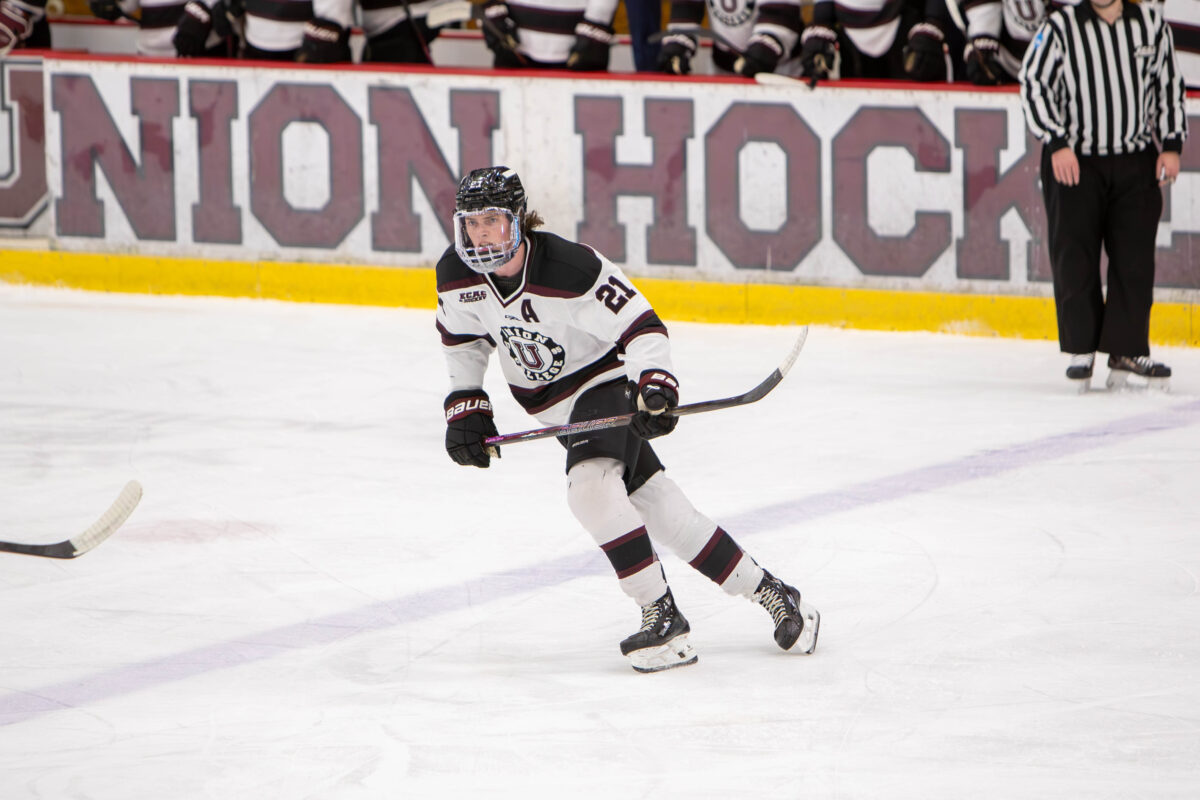
At Union, Prokop’s offensive performance improved significantly. As a freshman, he scored 20 points in 35 games, recording four goals and earning a spot on the ECAC All-Freshman Team. He then made a notable leap in production during his sophomore year, scoring 35 points in 36 games, which led his team in scoring among all positions. As a result, he was named first-team All-ECAC, received second-team honors as an East region All-American, and was nominated for the Hobey Baker Award, recognizing him as one of the best collegiate players in the nation. Although Prokop caught the attention of college free-agent scouts, he chose to return to school.
While Union’s on-ice performance and overall record improved this past season, Prokop’s production declined slightly. Nevertheless, his performance remained strong; he scored eight goals (the same number as the previous season) and recorded 27 points in 36 games. Once again, he was the highest-scoring defender on his team.
What Prokop Brings to the Organization
While Prokop’s offensive game needs some work, what he brings to the organization on day one is more of a shutdown player. This perspective is partly due to his offensive skills, which rely on straightforward, simple movements rather than dynamic plays. While he can be creative at times, he often appears predictable. Nevertheless, he does excel at defending in his own zone and effectively taking away time and space from opponents.
The positive aspect here is that there is still considerable potential for growth. Prokop plays a physical style of hockey and displays remarkable fearlessness. Furthermore, he is a solid skater for his size, particularly regarding back-checking. Once he learned how to take advantage of college teams to generate offence, we truly began to see his skating ability and playmaking skills. However, his decision-making with the puck and ability to read plays at high speed need improvement. Fortunately, spending more time in the AHL will allow him to develop these skills.
Related: Maple Leafs’ William Villeneuve Brings Two-Way Upside to AHL Marlies
Overall, you have a collegiate defenceman with the mobility and skill to be a legitimate point producer at the NCAA level, along with the size and potential physicality that NHL teams find appealing. Prokop may take some time to adjust to the speed and pace of minor league professional hockey, and he may need to learn to play a more physical style while also building muscle in the weight room. However, the Maple Leafs likely believe they have the resources and support system to help him develop.
All in All, It’s a Low-Risk, High-Reward Move
For the most part, this is a low-risk addition. Prokop could become an NHL player in a significant role for at least a while. However, he will turn 24 in May, which means he will be much further along in his development compared to many others in Toronto’s system. The Maple Leafs lack considerable defensive depth, and Prokop offers them a player with decent professional ability and good hockey sense. One could argue that he has a better chance of becoming an NHL player than someone like Webber.
This was a strong signing for Toronto. Adding more defensive depth is always beneficial, even if he doesn’t meet expectations. Dakota Mermis, William Villeneuve, Mikko Kokkonen, and Nicolas Mattinen will seek new contracts this summer, which could create opportunities with the Marlies. He will begin his professional career there in the coming days as he adjusts to the game’s faster pace and higher skill level. From that point, we’ll see how Prokop performs during training camp. As an older prospect, he has less room for development — what you see is generally what you get. However, he possesses the traits you want from a college signing, and with any luck, he can at least make a positive impact in the AHL.
