


After winning the Presidents’ Trophy less than a calendar year ago, the New York Rangers find themselves on the outside looking in for a playoff spot. Considering their underwhelming performance this season with an aging forward core, they should begin a retool. Specifically, it should be around defenseman Adam Fox and goaltender Igor Shesterkin. But why? Isn’t that a bit overdramatic?
Rangers Seeing That Father Time Is Undefeated
New York has a top-heavy roster. Stars are evident, then there’s a bit of a drop-off afterward. But what happens when a majority of those stars are in their 30s, and Father Time makes his inevitable appearance? Well, you get the 2024-25 Rangers. They are led by five veteran forwards, and each of them is playing substantially worse than last season. Aside from Alexis Lafreniere, Will Cuylle, and Gabe Perreault at some point, there’s a lack of youth present, too.
Related: New York Rangers’ Top 10 Prospects for 2024-25
Artemi Panarin scored 49 goals and 71 assists last season, which is remarkable even without context. But he did that at the age of 32—only five players have scored 120 points in a single season at that age or older: Wayne Gretzky (32; 130 points), Phil Esposito (32; 127 points), Marcel Dionne (33; 126 points), and Jaromir Jagr (33; 123 points). He’s on an 82-game pace of 88 points this season, which is still an all-time great showing for someone just shy of their mid-30s, but it’s not enough for New York. Expectations are unfairly high.

Panarin’s decline is by no means a bad thing, even if we disregard the age factor. He’s 12 points ahead of any other Ranger in scoring, so his contributions are quite elite. The same can’t be said for the other veterans on the team, though. J.T. Miller, Chris Kreider, Mika Zibanejad, and Vincent Trocheck are making a combined $28.625 million against the salary cap, and all have some sort of trade protection.
The problem with those four is that they’ve all seen noticeable decline points-wise, corresponding to their age. I hate to be the bearer of bad news, but it historically doesn’t get much better from here. Yet, Kreider is under contract through 2026-27, Trocheck through 2028-29, and Zibanejad and Miller through 2029-30. Considering each of them has already celebrated their 31st birthday, it’s a bit worrying that only Miller has an 82-game point pace of above 56.
To visualize this a bit better, below is a graphic showing their points per 60 minutes by age. The gray dots represent every forward season with 500 minutes of ice time since 2007-08, to give you an idea of historical aging trends.
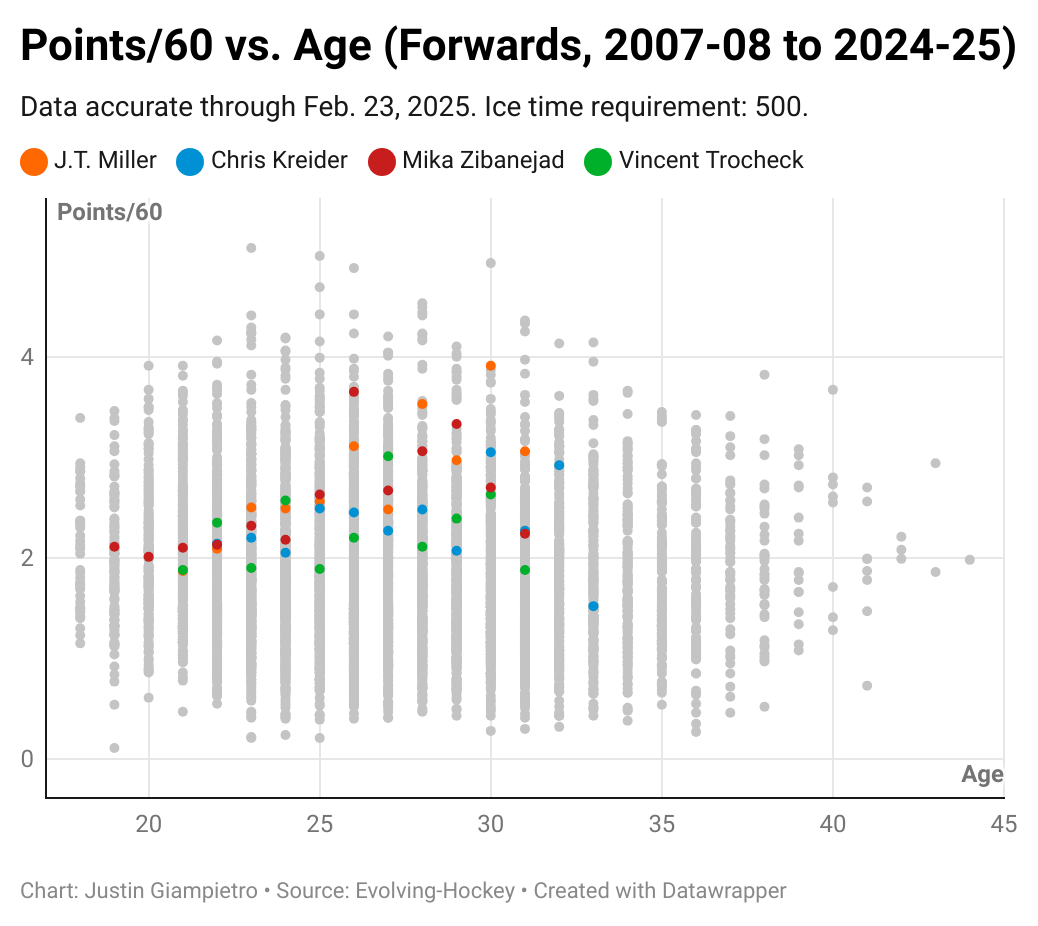
Compared to their previous season, every player above has seen a scoring drop. As you can see, the decline really starts to set in around the age Miller, Kreider, Zibanejad, and Trocheck will be next fall. New York can always “run it back”, but is it too late for that? Has their time already passed?
Rangers Mustn’t Triple Down
If the Rangers finish this season as one of the 13 worst teams in the NHL, the first-round pick they sent to the Vancouver Canucks for Miller (later flipped to the Pittsburgh Penguins) will defer to 2026. In a theoretical overhaul of the veteran core, the Penguins would likely be laughing to the bank. But that shouldn’t dissuade the Rangers from doing what’s right.
Related: Rangers’ Game Against the Sabres Proves Why They Should Be Deadline Sellers
There could be a world where things get better next season if the Rangers triple down, adding a few pieces in the summer. Shesterkin sees positive regression, the power play does, too, and defensive reinforcements significantly improve the team’s play-driving at 5-on-5. Sounds good, no?
The Rangers could indeed be doing a much better job of building around their core. Had they done so last offseason, they’d probably be a playoff team. But the 82-game point pace of Stanley Cup winners over the past decade is approximately 108—there’s a bar in the NHL. It’s entirely unreasonable to expect an offense almost exclusively led by players who will be 32 and over next season to flip a switch and play contending hockey again.
A few things went the Rangers’ way in 2023-24 for them to win the Presidents’ Trophy, but Panarin’s historical defiance of the aging curve was a big one. In the playoffs, Shesterkin’s brick-wall performance carried the load. Panarin saw some point regression in the postseason, but a core a year younger than they are today was only enough to win 10 of the required 16 games for a championship—that’s 62.5%. So, the question becomes, what else can realistically improve?
In the last five playoff seasons, there have been 62 goalie entries with 250+ unblocked shot attempts faced.
— Justin Giampietro (@justingiam) February 24, 2025
Among them, #NYR Igor Shesterkin ranks in the following for goals saved above expected per 60 minutes:
– 2nd (2023; R1 Loss)
– 3rd (2022; R3 Loss)
– 8th (2024; R3 Loss) pic.twitter.com/x0KeBDy8Lz
The Rangers don’t have a lot of trade pieces, nor do they have a ton of help coming up. At some point, you just have to let it go. It’s possible, but pretty unlikely, that this core wins a Stanley Cup as constructed.
Rangers Should Begin a Retool
The Rangers don’t have to continue going down this path. But pivoting from it will take some sacrifices.
Though Fox and Shesterkin are hardly young anymore, they are still franchise cornerstones. One would imagine they remain one of the best in the business at their position for many seasons to come—they should be going nowhere. Lafreniere and Cuylle should stick around, while major prospects should be a part of the future. Everyone else, more or less, is on the chopping block.
If the Rangers can trade their core forwards (Panarin, Miller, Kreider, Zibanejad, and Trocheck), then that’d be splendid. If it takes a buyout to rid of some of the longer contracts, so be it. Whatever it takes, it’s paramount that money is freed, and future assets are brought in. It can help set forth a new era of Rangers hockey, rather than dying on the “well, we’re already in this mess” hill.
When it comes to reacquiring elite talent, there shouldn’t be much panic at all. Players flock to play and live in New York—it shouldn’t be hard to convince stars to sign long-term. The Rangers already cheated their way to contention this way, in a sense, as Panarin and Fox wouldn’t be playing for this team if not for its location. So, they should be able to repeat the process.
Sometimes, you have to tone down your ego and do what’s best. General manager Chris Drury took a team that hadn’t won a playoff series in over four calendar years when he was hired and made them a juggernaut. That deserves praise. Is he willing to make the hard decision to take an intentional step back to make a great leap forward long-term, or would he rather do the “safe” thing and keep on trucking?

