Analytics don’t always tell the whole story, but when two different sets of underlying numbers point in the same direction, patterns start to form. That’s exactly what happens when we look at the Toronto Maple Leafs’ defense using Expected Goals (xG) and High Danger Scoring Chances (HDSC). These even-strength metrics help filter out noise from special teams, shooting luck, and goaltending swings. What’s left is a clearer picture of who is driving play — and who is struggling to keep up.
Before diving into the storylines, here are the two charts that help shape the analysis:
Expected Goals Differential (xGF – xGA)
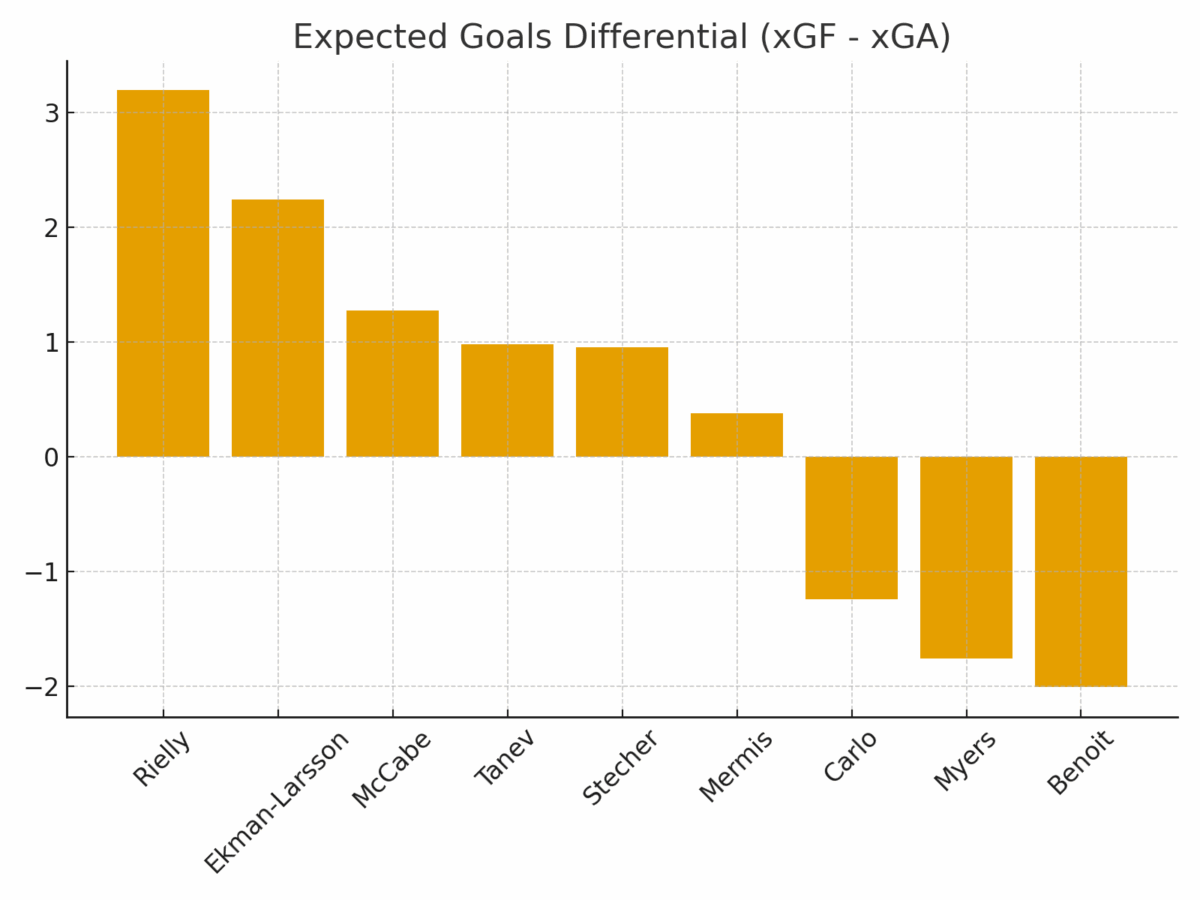
This chart shows the expected goals differential (xGF-xGA) for nine players. Morgan Rielly leads the group with the highest positive differential, indicating strong play in generating scoring chances while limiting opponent opportunities. In contrast, Simon Benoit and Philippe Myers show negative differentials, suggesting they have been on the ice for more expected goals against than for, highlighting areas where defensive performance could improve.
High Danger Chance Differential (HDCF – HDCA)
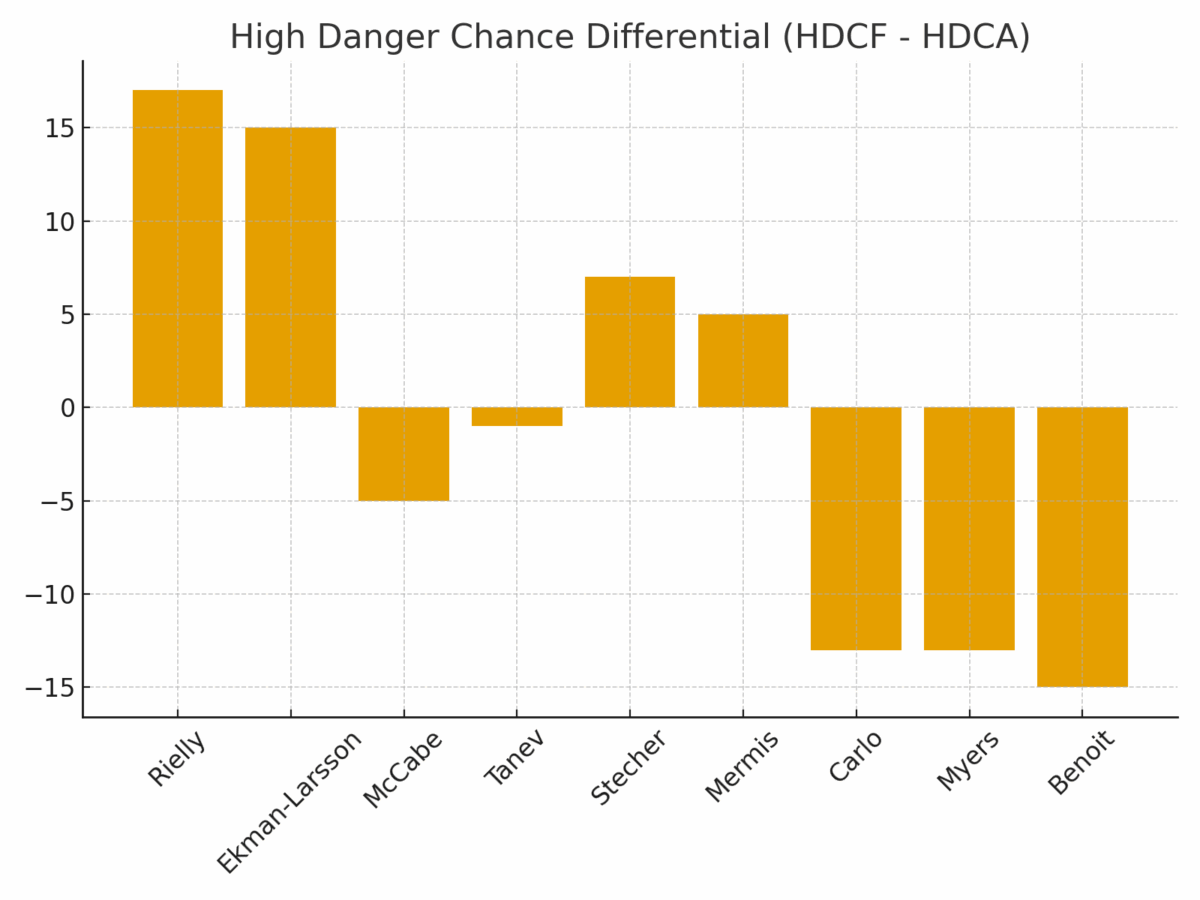
The chart shows a clear separation among the Maple Leafs’ defensemen in high-danger performance. Rielly and Ekman-Larsson lead the group with strong positive differentials, while Troy Stecher (who was picked off waivers recently) and Dakota Mermis also contribute solid results. On the other end, Brandon Carlo, Myers, and Benoit sit in the negative, giving up far more dangerous chances than they generate.
Rielly, Ekman-Larsson, and the Quiet Drivers of Play
Rielly’s actual goal numbers this season don’t flatter him. At even strength, he’s now fallen to negative-5 in actual goal differential, a number that suggests defensive breakdowns or tough minutes. Yet the underlying metrics tell a very different story. Rielly leads all Maple Leafs defensemen in both Expected Goals differential (plus-4.19) and High Danger differential (plus-17). Those two measurements are usually strong indicators of territorial advantage, puck control, and general defensive effectiveness.
Ekman-Larsson sits comfortably behind him in both categories. His plus-2.24 in Expected Goals and plus-15 in High Danger Chances are almost perfectly aligned with his strong actual production (plus-5 after being plus-7 earlier). If anything, his numbers are the most “honest” on the blue line. What you see is what the data confirms.

Together, they’re the Maple Leafs’ most consistently effective pairing by underlying measures. Even when the team bends, these two rarely break.
The Middle Tier: McCabe, Tanev, Stecher, and Mermis
Jake McCabe remains one of the more interesting cases. His goal differential has dipped from plus-6 to plus-3, and his underlying numbers paint him as a “slightly positive” player rather than one driving results. His plus-1.27 xG differential suggests he contributes to more offense than he surrenders, but his negative-5 in High Danger Chances indicates opponents get the better-quality looks when he’s on the ice. He’s far from struggling, but he’s no longer clearly in the top tier of Leafs defenders.
Chris Tanev’s numbers form a mixed bag: plus-5 in actual goals, plus-0.98 in expected goals, and negative-1 in high-danger chances. For him, that’s not surprising. His value has never lived in the analytics columns. He passes the eye test nightly, making small plays that stabilize whoever he’s paired with. Even with underlying numbers that hover around neutral, his overall impact has been positive. His injury has set the team back.
Then there are Mermis and Stecher, two depth players whose analytics explain why the organization turned to them when injuries started to mount. Mermis sits slightly positive in both xG (plus-0.38) and HDSC (plus-5), impressive considering his limited role and matchups. Stecher, meanwhile, has been a burst of efficiency: plus-0.98 in expected goals and a remarkable plus-8 in high-danger chances. The sample size is small, but his early results support the eye test — he’s been sharp, motivated, and effective.
The Struggling Tier: Carlo, Myers, and Benoit
Carlo’s season has raised eyebrows, and his numbers substantiate the concerns. Hovering near zero in actual goals and slightly below in expected goals, he takes a sharp decline when it comes to high-danger chances (negative-13). The quality of looks he’s giving up outweighs what he contributes.

Myers and Benoit round out the bottom. Myers is a team-worst negative-7 in actual goals and is similarly poor in high-danger opportunities at negative-13. Benoit is not far behind, recording the worst HDSC mark on the team (negative-15). These two lines of data support why their minutes have decreased and why the Maple Leafs turned to Stecher and Mermis instead.
What the Numbers Tell Us About the Maple Leafs’ Defense
Even-strength metrics reveal that the Maple Leafs’ defense isn’t as poor as some narratives suggest. Several players — particularly Rielly, Ekman-Larsson, and Stecher — are driving legitimate positive results despite inconsistent team play.
And at the bottom, the data helps explain why Toronto’s depth defense has been reshuffled. The numbers aren’t perfect, but they draw a clear, stable map: who’s supporting winning hockey, and who’s lagging.
[Note: I want to thank long-time Maple Leafs fan Stan Smith for collaborating with me on this post. Stan’s Facebook profile can be found here.]
Free Newsletter
Get Toronto Maple Leafs coverage delivered to your inbox
In-depth analysis, breaking news, and insider takes - free.
Subscribe Free →