The calendar has turned to 2026, and for the Ottawa Senators, the page turn couldn’t have come soon enough.
As the Senators took the ice on New Year’s Day against the Washington Capitals, there was a palpable sense of unease lingering from the final weeks of 2025. This wasn’t just about a few losses; it was about the manner of those losses. The 4-3 victory over Washington didn’t just put two points in the standings; it served as a stark, physical repudiation of the inconsistencies that plagued this group throughout December.
To understand the significance of this win, you have to look at the hole they were digging themselves out of.
The Month of Missed Opportunities
December is often the month where pretenders are separated from contenders, and the Senators spent the bulk of it straddling that line uncomfortably. On paper, a 6-5-1 record for the month looks like treading water. In practice, it felt like sinking.
Related – Blue Jackets Overcome Travel Nightmares to Handily Defeat Senators
The team ended 2025 on a three-game skid (0-2-1), effectively erasing the goodwill generated by a modest four-game winning streak just prior. This inability to sustain momentum has been the hallmark of frustrating seasons past, and it reared its head again at the worst possible time.
The lowest point came against the Columbus Blue Jackets. That 4-1 loss wasn’t just a defeat; it was an indictment of the team’s preparation. Columbus arrived in Ottawa a mere three hours before puck drop due to travel chaos — a scenario that usually results in “bus legs” and a sluggish start for the visitors. Instead, the Senators were the ones who looked asleep at the wheel.
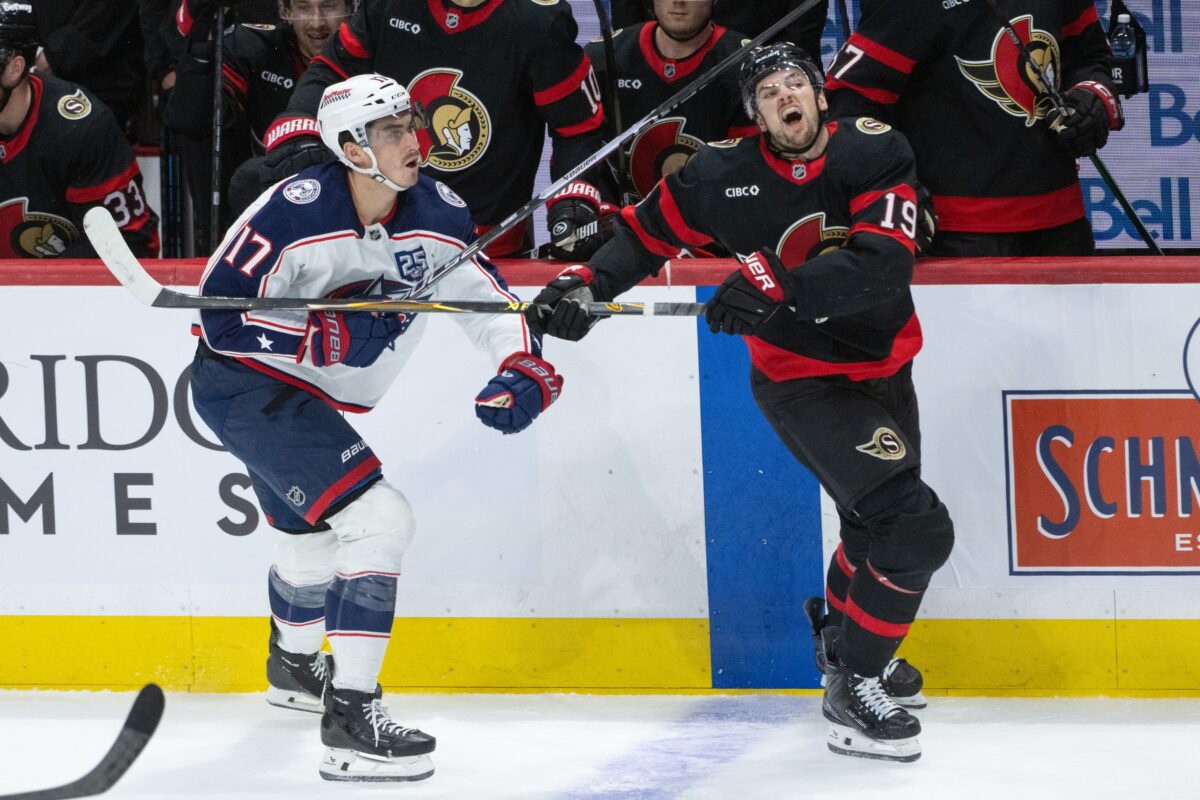
Head coach Travis Green didn’t mince words, labeling it one of their worst outings of the year. The fans agreed, with boos raining down and seats emptying long before the final horn. That game highlighted a lack of killer instinct: despite outshooting Columbus 21-10 over the final two periods, the offence was anemic. They generated chances but lacked the finish, a problem compounded by a defensive structure that seemed to evaporate at critical moments.
Navigating Roster Turbulence
It is fair, however, to acknowledge the hand the Senators were dealt regarding personnel. Stability is the bedrock of consistency, and Ottawa had precious little of it to close out the year.
The absence of Shane Pinto for 10 games due to a lower-body injury disrupted the chemistry down the middle, forcing line shuffles that left the offence disjointed. With Lars Eller, Tyler Kleven and Thomas Chabot all on the injury report at some point in December, the Senators were forced to rely on the next man up, with predictable results.
Answering the Bell: Physicality and Tone
The New Year’s Day matchup against Washington required a reset, and the Senators delivered one immediately. If the Columbus game was defined by lethargy, the Capitals game was defined by friction.
The tone was set before the puck even dropped. Brady Tkachuk, never one to shy away from the emotional heavy lifting, engaged in a shoving match with Tom Wilson during warmups. It was a calculated message: the passivity of December was gone.

That edge carried into the game. When Thomas Chabot took a high hit, it wasn’t a scrum that ensued, but a decisive response. Drake Batherson — a player known more for his hands than his fists — dropped the gloves with Justin Sourdif. Seeing a scorer stand up for a defenceman galvanizes a bench. It signaled that the team was engaged emotionally, a stark contrast to the “business as usual” approach that led to the flat performance against the Blue Jackets.
Resilience in the Face of Adversity
Old habits die hard, and for 20 minutes, it looked like the Senators might slide back into their slump. They exited the first period trailing 2-0, a deficit that, in recent weeks, would have signaled a collapse.
Related – Senators Week Ahead: Schedule & Storylines – Eller, Ullmark, Pinto and More
But the response in the second period showed a mental fortitude that had been missing. The tactical adjustments were evident — cleaner exits and a more aggressive forecheck — but the personnel decisions also paid dividends. Nick Jensen, who sat as a healthy scratch in the previous game, returned to the lineup with a point to prove and delivered a crucial goal to help tie the game.
When a coach scratches a veteran, it’s a gamble. It can alienate the player or wake him up. In Jensen’s case, it provided the spark the backend needed. The Senators clawed their way back to even terms not through luck, but through a refusal to let the game drift away.
Closing the Deal
The third period was perhaps the most encouraging 20 minutes of hockey the Senators have played in a month. In the Columbus loss, possession didn’t translate to danger. Against Washington, possession was weaponized.
The Senators dominated zone time, hemming the Capitals in and cycling the puck with intent. Even when a potential go-ahead goal was waved off — a moment that could have easily deflated a fragile team — they remained composed. There was no panic, no deviation from the structure.

This time, the pressure broke the dam. With just 2:22 remaining, Fabian Zetterlund uncorked a one-timer to seal the 4-3 victory. It was a clutch finish in a high-leverage moment, exactly the kind of execution that was absent during the holiday skid.
One win doesn’t fix a season, and the inconsistencies of December won’t be forgotten overnight. However, the nature of this victory — coming back from a deficit, physically engaging a heavy opponent, and getting contributions from depth players and stars alike — offers a blueprint for how the Senators can salvage the second half of the 2025-26 campaign.
They looked like a team that finally realized that talent alone isn’t enough; you have to hate losing more than you enjoy winning. On the first day of 2026, they played like it.
AI tools were used to support the creation or distribution of this content, however, it has been carefully edited and fact-checked by a member of The Hockey Writers editorial team. For more information on our use of AI, please visit our Editorial Standards page.
