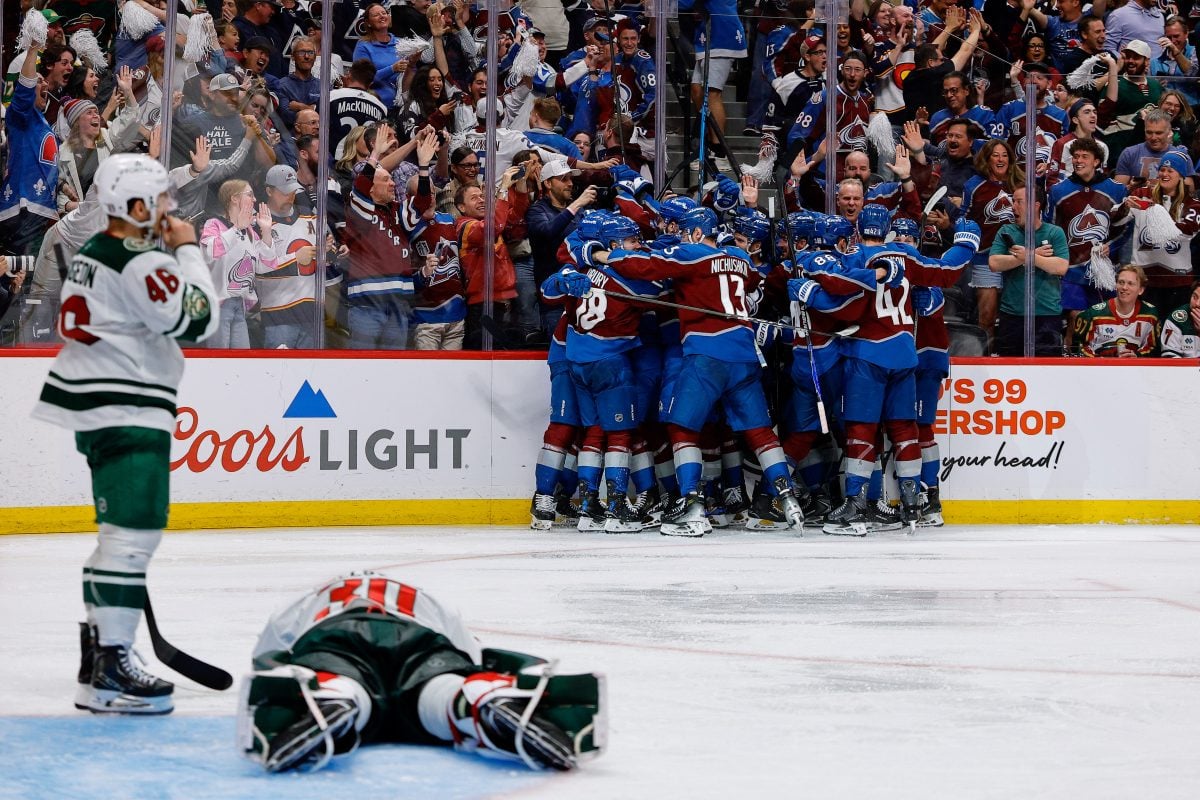
The Minnesota Wild have officially been eliminated in five games after a heartbreaking Game 5 defeat in overtime to the Colorado Avalanche. It was always going to be a challenging series, with the Avalanche dominating the NHL from the opening night of the 2025-26 season to the present.
After watching the series, here are the three reasons that led to the Wild losing their first second-round appearance since 2015.
Lack of Center Depth and Key Injuries
Heading into the playoffs, the lack of center depth was always a huge area of concern for me when it came to the roster Wild general manager (GM) Bill Guerin put together. In my pre-series article outlining X factors, I wrote that it was one of the Wild’s weaknesses.
The weakness only got worse after Joel Eriksson Ek, who was incredible in all facets of the game against the Dallas Stars in Round 1, missed all five games in the series.
The injury to Eriksson Ek pushed Michael McCarron into a larger role, and we also saw the insertion of Danila Yurov, who didn’t play at the end of the first round and was going through his first playoff experience of his career.
Both McCarron and Yurov had roles that were too big for what they were actually capable of, and it significantly hurt them in the series.
The Jonas Brodin loss was also crushing for the Wild. I found that although Guerin deserves a lot of credit for the Quinn Hughes acquisition, the blue line depth performed terribly in the series without Brodin.
Jake Middleton was exposed for most of the playoffs, posting a shockingly low expected goals for percentage (xGF%) of 41.17. I thought he really struggled with the pace in this series and was exposed far too often when the Wild desperately needed him.
Zach Bogosian was also a terrible fit in a series like this. The 35-year-old veteran doesn’t seem to have the legs to keep up against a team that can skate like Colorado. Much like Middleton, Bogosian posted a terribly low xGF% of 40.83, and head coach John Hynes not being able to trust his bottom pair in limited minutes was crushing.
Couldn’t Handle Colorado off the Rush
The Wild were far from a slow team, and they have the ability to skate with almost any team in the NHL. The problem was that they were in a series with maybe the only team they couldn’t skate with, and it showed through the five games.
Colorado never struggled to find offense during this series, and the difference in pace of play is evident in the NHL Edge’s advanced data. The NHL breaks the skating into three different categories of speed bursts: 22-plus mph bursts, 20-22 mph bursts and 18-20 mph bursts.
Through the playoffs, the Avalanche recorded 19 more 22-plus mph speed bursts than the Wild and 44 more 20-22 mph speed bursts than the Wild.
The speed seemed to have gotten to the Wild throughout the series, and they weren’t able to pull the Avalanche into a slower, more physical matchup. This hurt the bottom six and the defensive depth big time.
I also felt that with the speed, the Avalanche gained the zone too easily throughout the series, which opened the Wild up. This created opportunities and turned into a ton of shots in the middle of the ice. This is also shown in the NHL Edge shot chart.
The Penalty Kill Wasn’t Good Enough
The Wild were undisciplined at times, and when a team’s penalty kill isn’t at its best, it’s a recipe for disaster. It started last series with the Stars keeping themselves in games regardless of the fact that they got destroyed at even strength because of the power play.
The struggle on the penalty kill continued in this series, with the Avalanche going 5/13 on the power play during the series.
The biggest problem I had with the penalty kill goes back to something I mentioned earlier when discussing the speed the Avalanche played with. They got far too many chances in the middle of the ice.
I found that when the Avalanche got in a rhythm moving the puck on the power play, the Wild found themselves chasing. This is when the breakdowns happened.
As you can see in the goal above, when Martin Necas began to step towards the slot, Brock Faber pushed up and Middleton had a tough time adjusting, which left Gabriel Landeskog open in the slot.
Later that game, the Wild got lost again on the penalty kill while trying to adjust positioning, which gave Nazem Kadri a lane to make a seam pass to Nathan MacKinnon, who made no mistake on the one timer.
The ease with which the Avs were able to create chances in the slot was a death blow to the Wild’s season.
Free Newsletter
Get Minnesota Wild coverage delivered to your inbox
In-depth analysis, breaking news, and insider takes - free.
Subscribe Free →