It’s been over three months since the college eligibility rules for Division 1 schools changed to allow players in the Canadian Hockey League (CHL) to play in the NCAA. In the aftermath, leagues and players are adjusting to the new reality, and it hasn’t been easy. The United States Hockey League (USHL) upped their transfer fees to upwards of $50,000 to dissuade recruiting while dealing with two teams that hired anti-trust lawyers after being barred from joining the Ontario Hockey League (OHL) in December. Meanwhile, there are still rumblings that Gavin McKenna and Porter Martone are considering the NCAA for next season, given the amount of money some college stars can rake in through sponsorship deals.
Yet, despite all the uncertainty, the players don’t seem worried. They don’t see college as a looming threat; rather, this rule is just another way for players to have more control over their careers. It’s an exciting time to be a junior hockey player, especially out West, where many of these options haven’t been available to everyone. In my conversations with players who have gone through the recruiting process, their experiences shed a very different light on the rule change and should give some reprieve to those still worried about what might come.
The WHL Leads the Way in College Commits
Players across the CHL have embraced the new opportunity to play Division 1 hockey next season and beyond, but none more so than those in the Western Hockey League (WHL). Since Braxton Whitehead became the first CHL player to verbally commit to an NCAA program, 42 other opponents and teammates have followed him as of Feb. 20. That’s 18 more than the OHL and over double what the Quebec Maritimes Junior Hockey League (QMJHL) has seen.
It’s difficult to pinpoint why the WHL is head-and-shoulders above its fellow CHL leagues, but it could come down to lack of exposure. In the Eastern part of the country, players have much more access to the NCAA, with many big-name American schools sitting just a couple of hours away. In the West, however, the closest school is in Grand Forks, North Dakota, a 14-hour drive from Calgary. So, for many players growing up in the prairie provinces, college hockey wasn’t even on their radar.
“It’s a new world for us WHLers that never looked into that path,” admitted former Saskatoon Blade and current Prince George Cougar Ben Riche. “It’s a bit stressful when you’ve got a bunch of teams coming to you and talking to you and trying to tell you why their school’s better, and you don’t really know much about college hockey at all. So, it was a big learning curve. A lot of phone calls, a lot of Zoom calls.”
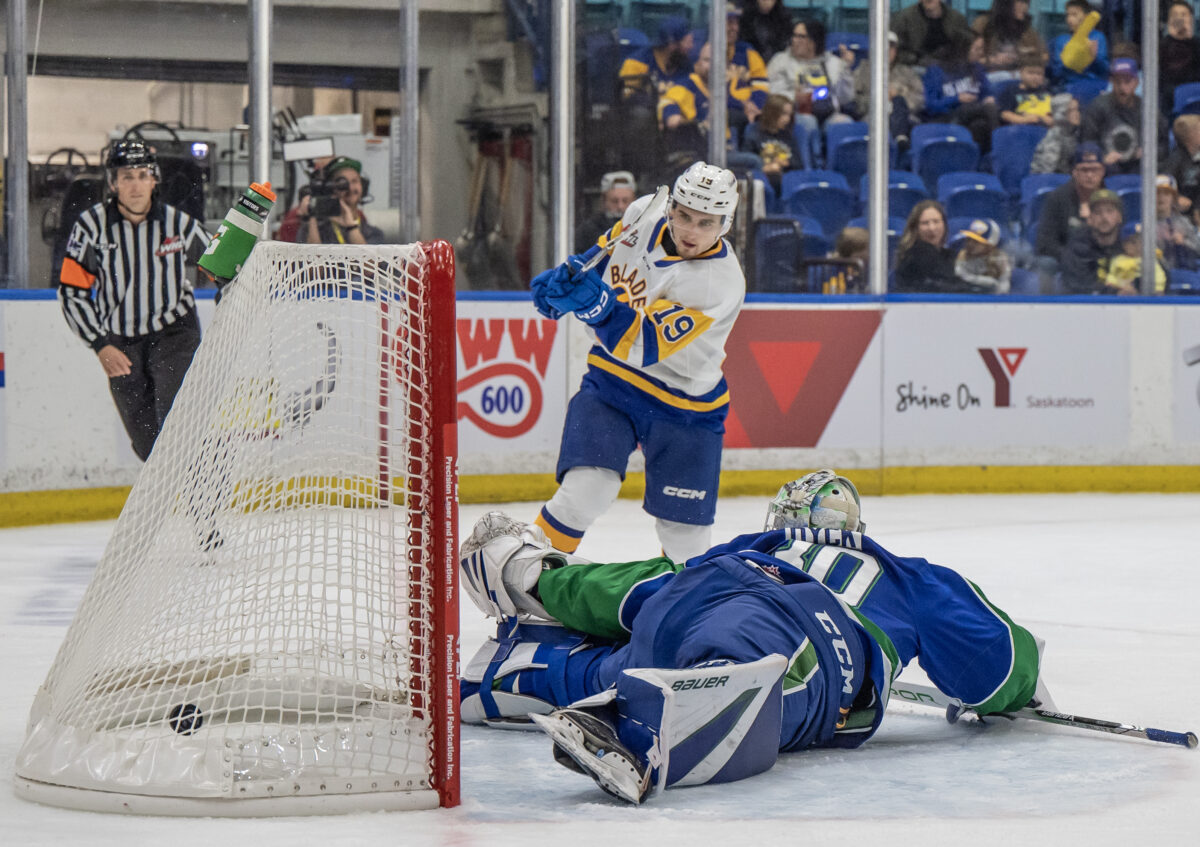
The West is hardly an unexplored frontier for the NCAA. Several of its biggest stars, from Cale Makar to Macklin Celebrini, grew up in WHL markets, and big Division 1 schools will spare no expense to find their next star, no matter the distance. Still, it’s not easy for programs on the other side of the country to break into those areas. Blades’ defenceman Grayden Siepmann heard all their pitches back before he joined the Calgary Hitmen in 2020-21. “Before even I came to the Western League, (colleges) were trying to recruit me,” he recalled. “I can’t really remember (the process). Growing up in the Vancouver area, I was always interested in the WHL, watching Vancouver Giants games. So, it’s hard to say now, but now that I have both options, I’m not really complaining.”
Maybe that’s what it all comes down to – choice. While a 15-year-old kid in Ontario can just as easily choose to play in either the OHL, hop down to Chicago to play in the USHL or join the prestigious Shattuck St. Mary’s prep school in Minnesota and still come home on weekends, a kid in B.C. has to make a life-changing decision if he wants to play anywhere other than the WHL. That’s a tough decision for a 15-year-old, but it’s much easier to make when you’re 19 or 20 and have had time to think about your options.
NCAA Offers Lots of Benefits to Junior Players
For decades, players and their parents have debated the pros and cons of choosing college hockey over Major Junior. Each option offers its own benefits, and it all depends on what the player wants most out of hockey. But now players are finding that they can have both, with a specific element that fits them best.
For Riche, it was about finding a good mix of athletics and academics. He became the second-youngest player to commit to the NCAA when he agreed to join Quinnipiac University in 2026-27. “Ultimately, they were a school that stood out to me,” he said. “I like that their academics were just as good as their athletic programs, so I’m happy with the choice I made.”
Related: New CHL-NCAA Agreement Won’t Change Junior Hockey Landscape
Blades’ captain Ben Saunderson also committed to Quinnipiac. But for him, it was about continuing his dream of turning hockey into a career. “I think it was just the best fit for both sides. Their playstyle is kind of my game, and they’ve been a winning team,” he said. “I think it’s super beneficial for the guys that are late bloomers. It’s tough to make that jump to pro, so to go (to Quinnipiac) and play high-level hockey for another five years and then try to make that jump to pro after older, stronger guys, I think it’s really cool.”
Siepmann, who is off to the University of Minnesota-Duluth in the fall, fell into a similar boat as Saunderson but with an added caveat. “I think the biggest eye-opening thing is they’ve had the most free-agent games in the NHL, so that was a big thing I was looking at, and I think over the next three or four years, or however long I’m there, it’ll be good for me to just develop and not play a whole lot of games, just focus on my off-ice stuff and things I need to get better at to make it to the next level.”
Young Stars Unlikely to Leave Early
With a little something for everyone, it’s hard not to see why so many WHLers have committed to an NCAA program, but that makes the looming threat of young stars leaving before they finish their time in the league feel that much greater. There’s no question that colleges have made aggressive pitches to McKenna and Martone, who could become the biggest college hockey stars in years. But, despite the appeal, it seems highly unlikely any would leave.
Now, that’s not to say McKenna or players like him haven’t considered it. The NCAA is now weighing much more heavily on players’ minds than ever before, and many players wouldn’t be surprised if younger players decided to go the college route. “It depends on the person,” said Riche. “You could ask each and every one of them, and you might get a different answer, so I’m not really sure about that one.”
However, Jack Kachkowski has a different perspective than most WHLers. Acquired in the deal that sent Tanner Molendyk to the Medicine Hat Tigers, the defensive defenceman initially wasn’t going to play WHL hockey. Back in 2022, he made a verbal commitment to the University of Nebraska-Omaha and joined the Alberta Junior Hockey League (AJHL) to retain his eligibility. “I was playing U18s, and I was getting approached by a few college teams and had a couple of offers,” he recalled. “Omaha had me on a fly-down and an official visit, and I really liked it there. So, I decided to commit there and then continued to play AJHL.”
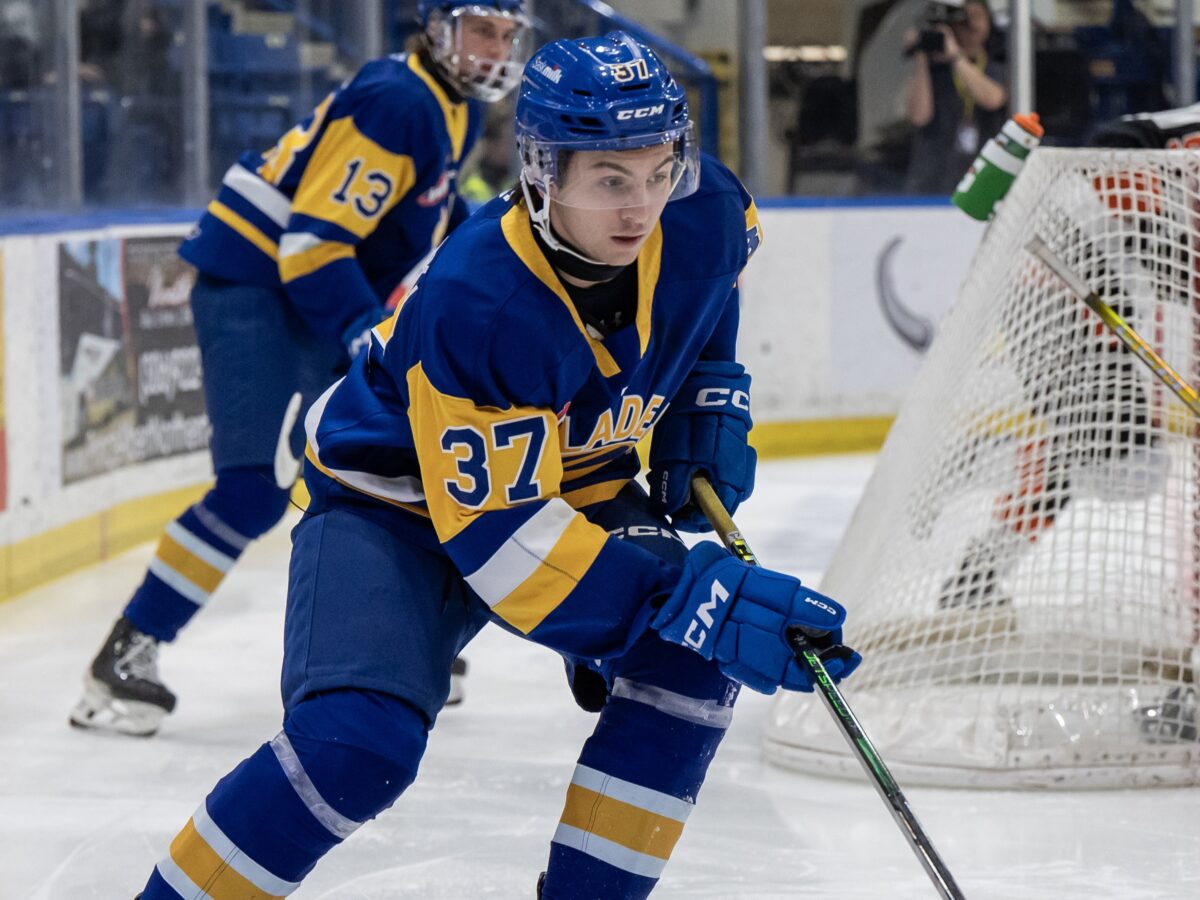
But all that changed in 2023-24. “The team I was playing on in the AJHL, I wasn’t playing as much as I wanted, and I was kind of looking for a little bit of a change of scenery, and Medicine Hat had offered to sign me, and I jumped all over it. I understood I had to lose my commitment, but at the same time, I felt there was going to be a rule change in the future and that ended up coming to fruition, so the decision was easier knowing that.”
The NCAA rule change was one of the worst-kept secrets in junior hockey; when Kachkowski transferred from the AJHL to the WHL, the official announcement was still about a year away. If it were to go through, he’d be in a much better position to transfer to Omaha if he were playing bigger minutes with the Tigers than struggling in Junior A. He would get more development time and start earning money for school, thanks to the WHL scholarship program, which offers a year of tuition and compulsory costs (textbooks, fees, etc) to any post-secondary institution for each year of junior hockey you play.
“With the WHL scholarship, you kind of don’t want to leave those years on the table,” said Kachkowski. “You want to play as much to max out that scholarship before, so I don’t think players will necessarily be leaving years on the table. I can’t speak to the other players, but personally, for me, I’d like to play here as long as possible and then after my career and the job’s over, then go and pursue the NCAA.”
The thought of potentially securing one of the big name, image, and likeness (NIL) sponsorships didn’t have much impact on Kachkowski. Not only is he not a star, but hockey players have rarely been offered the big bucks that have gone to college football and basketball players. Additionally, Canadian players can’t actively work on NIL deals or do paid promotional work because of their student visas. It’s why Riche delayed his freshman season to 2026-27. “I think (next season) is just another year of development for me,” he said. “It’s my first year that I feel that I’ve taken a really big step in doing what I believe I’m capable of.”
It’s still tough to know what will happen in the future. All four players I talked to were careful not to speculate too much or put words in other’s mouths. But all of them had confidence in the health of the WHL. Players aren’t looking at the first ticket out; they want to play here. It’s a choice they made years ago when they were starting their hockey careers and fielding questions about whether they would choose the NCAA or Major Junior path.
Now that the decision can be pushed down the road, the players have heaved a collective sigh of relief. They finally have an opportunity to think things through fully before making a choice. It’s why you haven’t seen a large cohort of young players leave, and it’s why you won’t in the future. It all comes down to more choice, and that’s all the players ever wanted.
