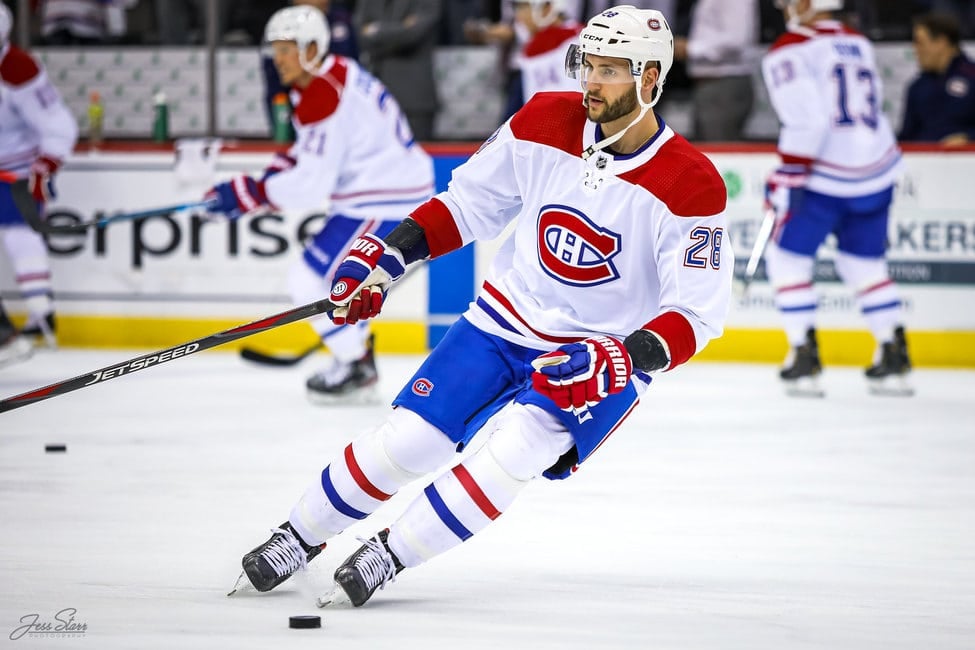
This past weekend the NHL released its choices of Montreal Canadiens from the past 25 years to make up the organization’s first and second quarter-century teams. Generally speaking, the choices seemed spot-on, with current Habs Nick Suzuki and Brendan Gallagher making the second team.
On one hand, the fact Suzuki, arguably the team’s best current player and a legitimate No. 1 centre, only made the second team is a sign of the underrated depth the Canadiens have displayed since 2000. On the other? A third quarter-century team probably wouldn’t be all that competitive looking at who’s left.
Here’s this writer’s proposal:
Defensemen
Jeff Petry: Probably the player with the best case to sneak into the official selections, with Sheldon Souray finding himself the odd man out relative to the second team instead, Jeff Petry was at one point seen as a co-No. 1 defenseman for the Canadiens, alongside Shea Weber.
A veteran of eight seasons and 508 games with the Habs, Petry represented one of ex-general manager Marc Bergevin’s top acquisitions. Bergevin gave up second and fourth-round 2015 draft picks, getting instead a smooth-skating, possession-driving defenseman in his prime who would go on to score 70 goals and 248 points during his tenure.
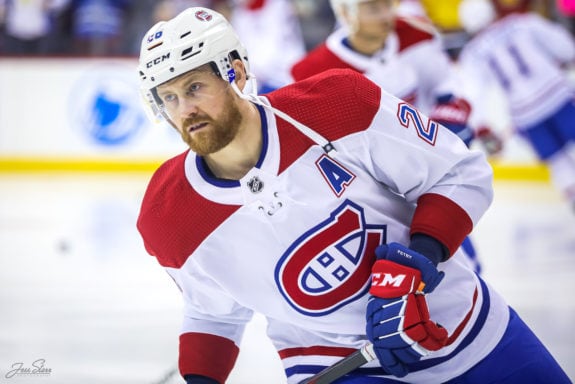
While Petry’s tenure(s) ended under less-than-ideal circumstances, twice, that shouldn’t be held against him or merit an asterisk on his accomplishments, including as a key component of the 2021 Stanley Cup Final team, alongside so many Canadiens who ended up being selected instead of him. He seriously could have been named, without anyone so much as batting an eyelash regarding his legitimacy as one of the team’s four best defenseman from the last quarter-century.
Patrice Brisebois: This is where things get dicey, because Patrice Brisebois wasn’t exactly enamored by many Canadiens fans. Still, Brisebois ended his time with the team with 896 games played and 371 points, just below Serge Savard, ranked sixth in scoring among all Habs defensemen. Granted, a large chunk of those games came in the 1990s. However, he was still with the team from the start of the century to 2004, at which point he moved on to the Colorado Avalanche. Returning to town to play the final two seasons in his career, he played six complete seasons with the Habs this century.
If you’re going with the defenseman who’s had the biggest impact on the team (beyond who was already selected), you maybe go with Mike Matheson or even rookie Lane Hutson. However, if you’re going with the defenseman who had the biggest impact over the longest stretch of time, it’s probably Brisebois, whether you like it (him) or not.
Forwards
Michael Ryder: Another player with multiple Canadiens stints, Michael Ryder rejoined the Canadiens for the 2013 Stanley Cup Playoffs as a trade-deadline acquisition. Despite the Habs getting upset in Round 1 in five games by the Ottawa Senators, Ryder was arguably a huge success in his second go-around, scoring 10 goals and 21 points in 27 regular-season games as a pending unrestricted free agent (with the Habs also getting a 2013 third-round pick, while trading the Dallas Stars Erik Cole’s big contract, which wasn’t working out, in exchange).
Considering Ryder’s initial departure from the organization in 2008 as a free agent, it was a mild surprise that he could be as productive as he ended up that stretch. After all, in 70 games that last season, he had scored just 14 goals and 31 points. Regardless, overall, upon joining the Canadiens as a 23-year-old following several seasons in the minors, Ryder emerged as a respectable top-six forward with a great shot that had led to him being a perennial 30-goal threat. As a result, even though it may not seem like it, Ryder is probably the safest choice here.
Cole Caufield: Ryder actually just barely missed the 2004 Calder Memorial Trophy as the league’s top rookie. Cole Caufield probably feels similarly, seeing as he had been seen as one of the favourites to win the 2022 award after debuting late the previous season (and end up a key contributor on the 2021 Stanley Cup Final team). However, things obviously took a turn for the worse, with Caufield struggling out of the starting gate under Dominique Ducharme.
Even getting demoted at one point, Caufield scored just one goal and eight points in his first 30 games before Martin St. Louis got hired as the team’s new head coach. He ended his rookie season with 23 goals and 43 points in 67 games, meaning, under St. Louis, he scored 22 goals and 35 points in 37 games, making a good case that, under the right circumstances, he could have captured the Calder, which went to Detroit Red Wings defenseman Moritz Seider instead.
Since then, excluding a shoulder injury that cut his 2022-23 season short, Caufield hasn’t looked back, developing into a consistent offensive threat. While the 24-year-old may have been looked past due to his relative lack of time served with the team, his coincidentally 250 games played at the time the lists came out aren’t exactly a small sample size. This is what he brings to the table. In Year 2 of his current eight-year, $62.8 million contract, he’s poised to do much the same for some time.
Brian Gionta: This was probably the hardest choice to make. Players like Phillip Danault, Jonathan Drouin, Alex Galchenyuk and Richard Zednik were in the mix for the last forward spot, each having good reasons to be selected and maybe not so much in some instances. Ultimately, Gionta, as a regular goal-scoring threat, having scored 97 and 0.32 per game while with the Canadiens (303 games over five seasons) gets the nod, especially taken into consideration his captaincy, taking it on eventually following the 2009 departure of his predecessor Saku Koivu.
Signing on to join the Canadiens from the New Jersey Devils in 2009-10, Gionta’s debut alongside that of other new arrivals like Scott Gomez and Michael Cammalleri was a changing of the guard. Gone were Koivu and Alex Kovalev, iconic players who helped form the franchise’s first quarter-century team. And, while Gionta only became captain one year later, he was a huge part of the largely unexpected run the Canadiens went on in the spring of 2010, when the eighth-seeded Habs beat the Presidents’ Trophy-winning Washington Capitals in Round 1 and the Stanley Cup-champion Pittsburgh Penguins in Round 2… only to lose to the seventh-seeded Philadelphia Flyers in Round 3.
Gionta was officially captain, however, of the team that nearly beat the eventual-Cup champion Boston Bruins in a seven-game first-round series the next season. They actually did defeat the Bruins on his watch in another seven-game series, this time in the second round in 2014, en route to another conference-final appearance, against the New York Rangers. That series’ first game marked the infamous Chris Kreider-Carey Price collision, which arguably led to the ultimate 4-2 series defeat and helped shape the team’s next decade. Hitting unrestricted free agency that summer, Gionta understandably moved on to join the Buffalo Sabres, also as their new captain. Canadiens fans know firsthand why he might have been the eas(ier) choice in that context.
Goaltender
Jaroslav Halak: To a degree, Jaroslav Halak is more of a sentimental choice than, say, Cristobal Huet. However, even though Huet has the statistical edge and was more of an undisputed No. 1, at least for a time, Halak’s level of playoff success, namely during that run in 2010, was too significant to ignore, especially without Huet having ever won a series while with the Canadiens from 2005-08.
Their stints obviously overlapped. Huet was traded at the 2008 deadline to the Washington Capitals for a second-round pick, effectively to make room for Price. And, while Price took the reins in 2008-09, Halak ended up playing more games than him in 2009-10, leading into the aforementioned three-round run. So, obviously, the Canadiens had to make a hard decision that summer, choosing between the blue-chipper or the goalie who had captured the hearts of the city that spring.
With Price having made the first quarter-century team (as the franchise leader in games played and wins with 361), he ended up being the right choice, obviously. However, dealt to the St. Louis Blues that offseason, Halak ended his career with 581 games, last appearing in the NHL in 2022-23 for the Rangers. So, he enjoyed some measure of longevity. With the Canadiens, Halak went 56-34-7 with a 2.62 goals-against average and .919 save percentage. He may not have the hardware of a Price (or Jose Theodore), but Halak posted more than respectable stats in line for a reliable starter for his era, making him the right choice here.
Free Newsletter
Get Canadiens History coverage delivered to your inbox
In-depth analysis, breaking news, and insider takes - free.
Subscribe Free →