The term rebuild is no longer a dirty word; however, patience is still the hardest sell in hockey’s most passionate market. For the Montreal Canadiens, the transition from accumulating draft assets to executing a competitive ascension is well underway.
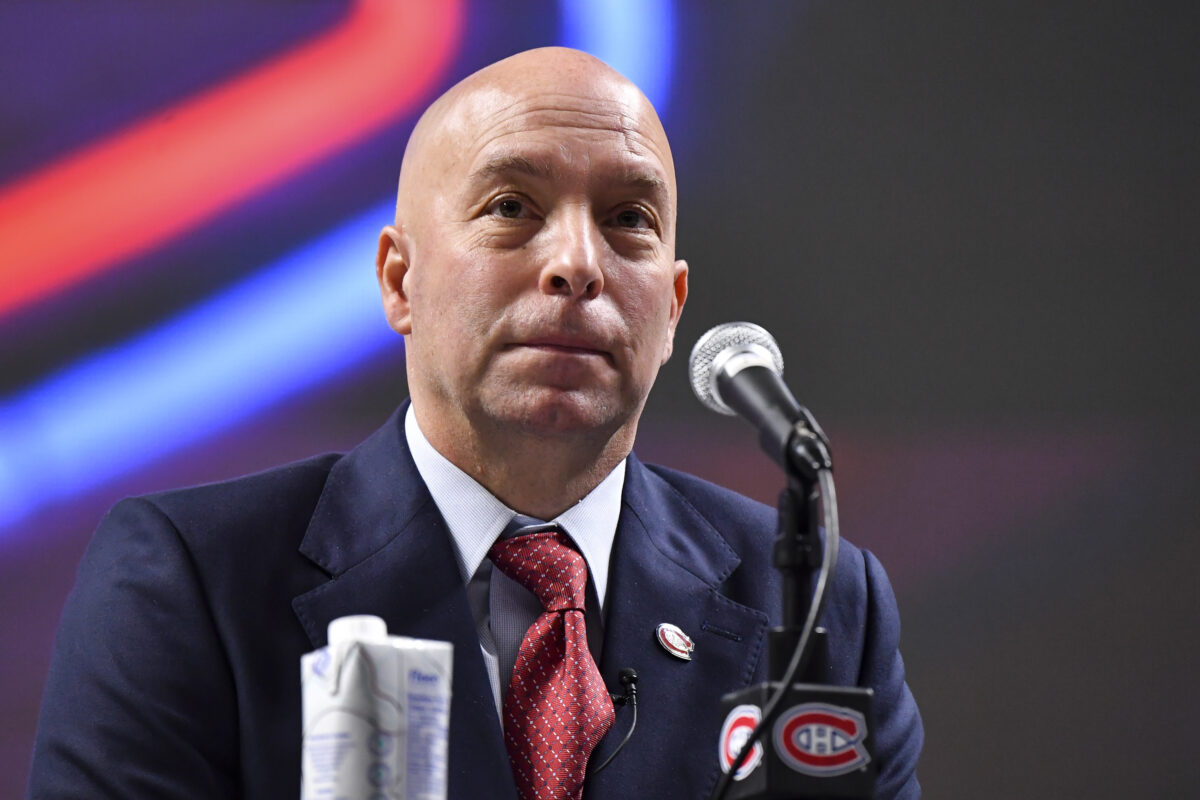
The impending arrival of some of their highly touted prospects could precisely be why general manager (GM) Kent Hughes has the luxury of avoiding costly mistakes. Their prospects have allowed management to confidently walk away from overpaying aging unrestricted free agents (UFA) as temporary, short-term patches. Instead of clogging future roster spots with hasty summer signings, the front office is keeping the runway clear for these young players to step up and claim permanent roles in Montreal on their own merits.
As management tries to find a way to improve upon a 106-point season and an Eastern Conference Final appearance, the phrase “NHL-ready” when it comes to their prospects is thrown around with increasing frequency in front office press conferences and fan forums alike.
But what does being NHL-ready actually mean?
Defining What It Is to Be NHL-Ready
In the high-stakes world of player evaluation, the term “NHL-ready” is often misunderstood as a synonym for raw, explosive talent or gaudy junior-league scoring statistics. In reality, surviving the jump to the greatest league on the planet is less about a prospect’s highlight-reel capability and more about their capacity to handle the high-speed, the brutal physicality and the mental demands. True readiness is a complex equation of functional core strength to win board battles, split-second cognitive processing to make plays under relentless pressure, and an ability to play a disciplined “200-foot” game with a full commitment to defensive reliability. Without these foundational pillars, even the most naturally gifted young players risk being swallowed up by the relentless pace of the NHL.
Crucially, being NHL-ready does not imply that a prospect has reached their absolute ceiling or is a finished product. Instead, it signifies that they have established a critical baseline of maturity. That they can survive the speed of the game and actively contribute to wins without having their long-term growth stunted. When a young player is rushed before reaching this threshold, the physical toll and psychological blow of repeated mistakes can shatter their confidence and derail their trajectory. Canadiens fans can simply look back at the laundry list of players that busted because they were rushed to fit Montreal’s roster needs, such as Louis Leblanc and Alex Galchenyuk.
True readiness means the coaching staff can trust the player in structural, high-pressure situations, allowing them to learn on the job and refine their game directly at the highest level without compromising the team’s success.
This delicate balance of developmental readiness is currently playing out in real-time within the Canadiens organization, spotlighted by three uniquely distinct prospects: David Reinbacher, Owen Beck, and Florian Xhekaj. Each of these young players represents a completely different developmental archetype, from Reinbacher’s poised, blue-line efficiency and Beck’s cerebral, two-way center work to Xhekaj’s aggressive, heavy-forechecking power-forward style.
Despite their vastly different paths and positional responsibilities, have all three prospects truly demonstrated enough of the physical and mental habits required to translate their games to the pro level and secure permanent NHL roles? More importantly, can anyone fill the roles the club desperately needs to progress this rebuild?
David Reinbacher: Poise, Pacing, and the Blue-Line Logjam
Selected fifth overall in 2023, David Reinbacher’s primary calling card has always been his exceptionally high floor. He is a modern-style, mobile, 6-foot-3 right-shot defenseman whose value is measured in clean zone exits, gap control, and defensive economy rather than highlight-reel end-to-end rushes.
After a challenging, injury-riddled stretch that included knee surgery and a fractured hand, Reinbacher put together a highly encouraging, substantive 2025–26 campaign in the American Hockey League (AHL) with the Laval Rocket. Recording 24 points and a reassuring +18 rating in 57 games.
In that time, he proved he could handle the heavy forechecking of the North American pro game. His brief late-season recall culminated in an assist during his NHL debut.
The Readiness Verdict
Defensively, Reinbacher is virtually NHL-ready. His defensive positioning, active stick, and body positioning along the walls are exceptionally mature for a 21-year-old with only 97 total games of North American professional hockey under his belt. He doesn’t panic when pressured; he uses his frame to shield the puck, absorbing contact to make short, crisp, highly accurate breakout passes.
However, “readiness” in Montreal is complicated by organizational depth. The Canadiens boast a crowded left side on the blue line, which could cause some to spill over to their weak side on the right. With several defensemen locked into NHL roles, rushing Reinbacher into a bottom-pair role with limited minutes could very well be counterproductive to his ceiling as a responsible, two-way defender who could complement star defenceman Lane Hutson.
For a defenseman, true NHL readiness means having the stamina and processing speed to defend top-six opposition. Reinbacher’s trajectory points to another start to a season in Laval for the 2026–27 season, likely serving as the first call-up option and refining his offensive blue-line activation.
Florian Xhekaj: The Unicorn Bottom-Six Physical Force
The younger brother of Canadiens defenseman Arber Xhekaj, Florian has forged an identity that is uniquely his own, yet carries that same menacing, physically imposing edge. Standing 6-foot-4 and weighing nearly 205 pounds, Xhekaj is a throwback power forward with a surprising touch of skill around the net.
His 2025–26 season with Laval showed he can provide offence with a mean streak, scoring 17 goals and 29 points, while adding 182 penalty minutes in 64 regular-season games. He is a violent forechecker who delights in being a nightmare for opposing defensemen trying to retrieve pucks. He also provides a highly effective screen in front of the net when he isn’t grinding pucks out of his board battles.
During a brief five-game NHL call-up last season, he registered his first NHL assist and proved his physical style can transfer cleanly to the big league.
The Readiness Verdict
Being “NHL-ready” for a power forward like Xhekaj is measured differently. He does not need the elite playmaking of a top-six winger, but he must avoid being a defensive liability or a liability in the penalty box.
Xhekaj’s 182 PIMs in Laval suggest a young player still learning how to balance his role as a physical deterrence, enforcer and impact power forward. He can benefit from his elder brother’s experience in navigating the times to fight and the times to simply take a number. Mainly because in the NHL, putting your team short-handed because of undisciplined post-whistle scuffles will get you benched.
However, his 17-goal output proves he isn’t just an enforcer; he has a functional offensive touch. He is NHL-ready in terms of raw, functional strength, the ability to win small-area wall battles and the ability to crash the front of the net. To become a full-time Montreal Canadien, he needs to tighten his defensive positioning and master the fine art of controlled aggression.
Owen Beck: The High-Floor Tactician
If you were to build a bottom-six NHL center in a laboratory, they would look exactly like Owen Beck. He is a defensive savant whose details, faceoff technique, stick positioning, back-checking lane selection, and spatial awareness are already at an NHL standard.
Beck got a prolonged, 15-game look with the Canadiens during the 2025–26 season, scoring his first career NHL goal. While his offensive output at the NHL level was modest, his work rate, reliability, and physical willingness, logging 24 hits and eight blocked shots in limited ice time, showed he belongs. In the AHL, Beck proved his offensive baseline is growing, putting up a respectable 33 points in 58 games for the Rocket.
The Readiness Verdict
Of the three prospects, Beck is the most demonstrably NHL-ready. Because of his pro-style habits, work ethic, and high hockey IQ, he has a game that translates seamlessly across different lines. Unlike top-six scoring prospects who wilt if played in a defensive fourth-line role, Beck can drop into a defensive-zone-start, penalty-killing, physical-grind role and still help his team win hockey games. He processes the game defensively at an elite speed. While his offensive upside is projected more as a high-end third-line center rather than a point-per-game playmaker, his immediate defensive utility makes him a lock to challenge for a permanent NHL roster spot out of camp.
The Big Picture: Roster Fits and the Next Steps
As Montreal moves closer to its competitive window, these three players represent the depth and role player styles a winning, modern playoff roster relies upon.
Each of these three prospects has a distinct developmental path and role to play in the franchise’s upcoming competitive window. With Reinbacher’s top projection as a future top-four shutdown anchor thanks to his developing elite positioning and calm breakout passing, though he is slated for heavy minutes in AHL Laval while waiting for a roster spot to open on a crowded blue line. Down the middle, the highly reliable Beck (who can also play reliably on the wing) is poised to compete directly for a permanent bottom-six role at the next main training camp, bringing a high-floor game, elite defensive IQ, and exceptional faceoff skills to the table as a projected third-line two-way center.
Meanwhile, Xhekaj is a physical winger who projects as a menacing, net-front, bottom-six force with a heavy forecheck, but he will likely spend more time refining his discipline and zone-start management before making the permanent leap to becoming a permanent fixture. When we talk about the Canadiens’ future, it is easy to focus solely on the high-end offensive players like Nick Suzuki, Cole Caufield, or Ivan Demidov. But championship teams also need to be built on depth and role players.
Having players like Reinbacher, Beck, and Xhekaj transitioning from “highly touted prospects” to “NHL-ready contributors” is the luxury of a deep, patient rebuild. They also provide management the luxury to wait and not make panicked summer signings. Whether they start opening night in Montreal or start the season in key top-line roles with Laval, their arrival signals that the Canadiens are no longer just collecting talent; they are building a team designed to play, and win, heavy hockey.
Free Newsletter
Get Montreal Canadiens coverage delivered to your inbox
In-depth analysis, breaking news, and insider takes - free.
Subscribe Free →