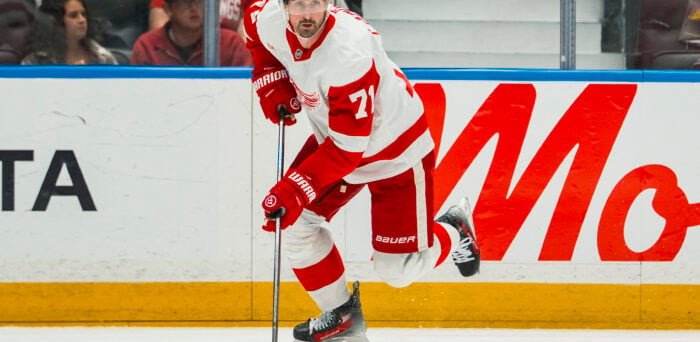
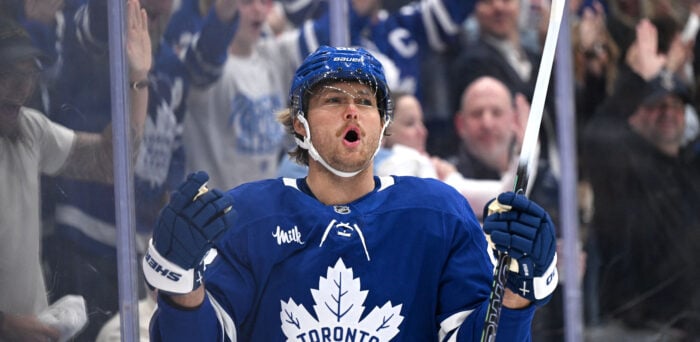
For weeks, the Detroit Red Wings have made young centers a priority in their Dylan Larkin trade talks. While those talks drag on and the club leans on what we called its one card left to play, one of the answers may already be wearing a Red Wings sweater.
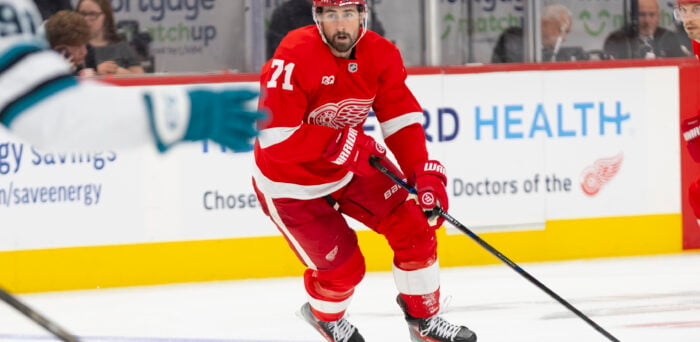
Emmitt Finnie, a 21-year-old who was taken 201st overall in the 2023 Draft, has stepped into the middle of Detroit’s top line since Larkin was suspended. He isn’t a finished product, and he isn’t a one-for-one replacement for a player who led the club for years. But his play is starting to change the math on what Detroit actually needs to get back.
How Emmitt Finnie Became a Center Again
Finnie spent most of his rookie season on the wing, often alongside Larkin. This season, an early injury to Marco Kasper opened a spot down the middle, and head coach Todd McLellan moved the young forward back to the position he played in junior.

Even the coaching staff had doubts at first. After an Oct. 13 overtime loss to New Jersey, McLellan said that because of the forward’s speed, the staff “weren’t sure that he would grasp the center-ice position right away,” according to the Red Wings’ game recap. He added, “He’s been trained as a winger in the League, but we believe he’s a center.”
That night, Emmitt Finnie scored a goal and added an assist while centering Alex DeBrincat and Michael Brandsegg-Nygård, and his line produced all of Detroit’s offense. It was an early sign that the experiment had a future.
Finnie Has Taken Over the Top Line
Larkin’s suspension, which began Oct. 29, left the first-line center job open. Finnie got the first chance to fill it, playing between DeBrincat and Viktor Arvidsson, according to CBS Sports’ player notes.
He has responded. Entering Tuesday’s game in Tampa Bay, Finnie had seven goals and 11 points in 15 games, along with a plus-10 rating and a 4-game point streak that included three goals. That production arrived at exactly the moment the lineup needed someone to absorb the minutes Larkin left behind.
The team results have been mixed, which is fair to expect. Detroit has gone 2-2 since the suspension and sat at 7-6-3 after a 4-2 loss in Tampa Bay on Tuesday, according to ESPN’s game recap. Still, the Red Wings haven’t collapsed without their former captain, and the young center is one reason why.
Why Finnie Changes Detroit’s Larkin Ask
Detroit hasn’t hidden what it wants. Sportsnet’s Elliotte Friedman reported on Oct. 22 that the club was targeting young centers in talks, including prospects still finding their way. That focus made sense when the club had no obvious internal option to take over the top line.
If Finnie keeps this up, the logic shifts. Detroit wouldn’t need a center to come back in every possible package. It could instead ask for the best young asset a partner is willing to move, whether that player is a center, a winger, or a defenseman.
That approach would also widen the pool of realistic offers. A team that can’t spare a young center might still have a top prospect on the wing or on the blue line. Right now, Detroit risks passing on those packages simply because of the position the player lines up at. A capable internal center removes that limit and gives interim general manager Shawn Horcoff more ways to say yes.
There is a cap angle, too. Larkin’s contract counts $8.7 million against the cap every season until 2030-31. If his replacement comes from inside the organization, Detroit can use the room created by a trade to address other needs instead of spending it on another center.
That flexibility matters with teams like Minnesota. Our case that a Wild package built around Danila Yurov falls short still applies, and a strong internal option makes that position easier to hold. The same goes for Washington, where our look at Ilya Protas and the Capitals centered on a young pivot. Detroit can still chase a young center, but it no longer has to accept one just because of the position he plays.
Finnie Isn’t Larkin Yet
There is a reason to be careful. Finnie is barely a month into his second NHL season, and a hot stretch at a new position doesn’t guarantee he can handle top-line matchups for a full year. Opponents will adjust, and the shooting luck that helps any young scorer usually evens out.
Dylan Larkin also brings things that don’t show up in a short sample. He has been a reliable two-way center for a decade and carried a heavy workload against other teams’ best players. Detroit shouldn’t price him as if a 21-year-old has already made him expendable.
The rest of the lineup is still sorting itself out, too. Andrew Copp has moved into a bigger role down the middle, and the goaltending picture became less certain when Daniil Tarasov replaced John Gibson after the first period on Tuesday, according to the same ESPN recap. Depth at every position will be tested as the season goes on.
On the brighter side, Brandsegg-Nygård has emerged as one of the league’s top rookies, as our look at why he’s an early Calder Trophy front runner explained. Those pieces give Detroit options, not certainty.
What Finnie Means for the Larkin Standoff
The real value of Finnie’s emergence is time. The Red Wings already hold one card in this standoff, the suspension, and a young center who can handle the top line strengthens that hand.
Every week Finnie produces, Detroit has less reason to accept a deal it doesn’t like. The Red Wings went looking for a young center outside the organization. They may still find one, but they might also realize that part of the answer was already on their roster.
Free Newsletter
Get Detroit Red Wings coverage delivered to your inbox
In-depth analysis, breaking news, and insider takes - free.
Subscribe Free →