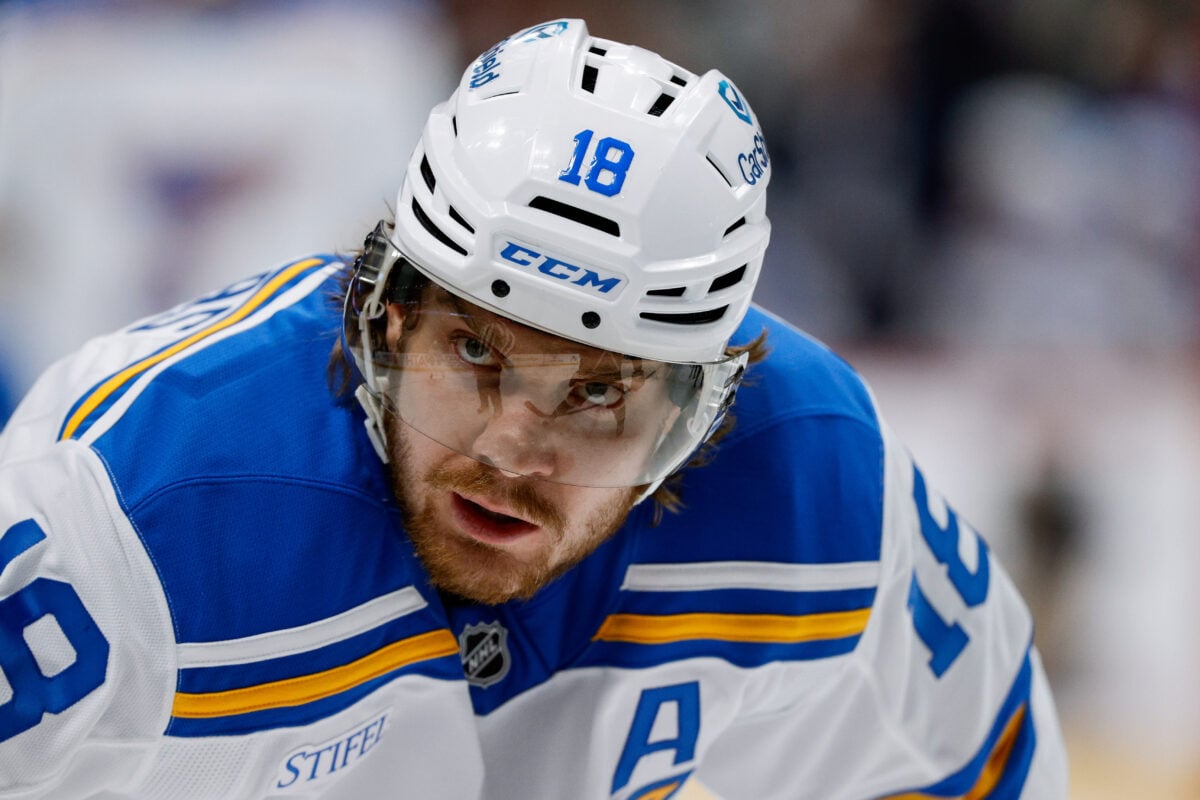
You can easily attribute reports the Montreal Canadiens are in the mix for St. Louis Blues forward Robert Thomas to Habs general manager Kent Hughes simply doing his due diligence. After all, if a player of Thomas’ calibre is actually available, a player who, as a centre, clearly addresses a pressing need for them down the middle, he’d be doing a disservice to the organization to not so much as kick tires with Doug Armstrong, his Blues counterpart.
With reports coming out that the Atlantic Division-rival Buffalo Sabres have emerged as arguable front runners to acquire the 26-year-old pivot, suddenly Hughes’ due diligence takes on another dimension. The Canadiens may be able to afford letting Thomas slip through their fingers, but letting him slip into the hands of the Sabres could hold long-lasting ramifications regarding the outlook of the Atlantic, with both teams in a relative dead heat, as they jockey for playoff position down the stretch.
More than that though, the Canadiens and Sabres are among the league’s absolute youngest teams. To their credit, the Habs continue to improve on a linear, year-over-year basis after bottoming out in 2021-22. So, you have to believe their window to contend will open sooner rather than later. Nevertheless, an acquisition of this magnitude could represent a shift in the balance of power in the Atlantic for years to come. While the Sabres’ path to mere playoff contention has been much more circuitous, with their last appearance literally predating the last NHL lockout, no one should dispute the level of young talent they have as a result. That fact speaks to the undeniable advantage they have in the Thomas sweepstakes.
Hage Too High a Cost?
Regardless, the Canadiens are no slouches in terms of the strength of their farm system. The crown jewel of their current prospect pipeline is arguably forward Michael Hage, who’s at least projected to get a shot at filling the team’s second-line centre spot in the near future. It’s no shock the Blues reportedly covet him and that any package that would successfully pry Thomas out of St. Louis would revolve around him (just for starters).
Any hypothetical hesitation on the part of Hughes to pull the trigger is understandable, as is any trepidation on the part of Canadiens’ fans. Ideally, you don’t empty your cupboards for any one trade, and you would have to believe other futures like defenseman David Reinbacher, maybe even present young roster players like Oliver Kapanen, would figure in as well. However, Thomas’ age, contract situation ($8.125 million cap hit until 2031) and high level of production all point to him being worth it to an extent, especially if it means the Sabres don’t get him instead.

If the inclusion of Hage is indeed what is holding up a potential deal, the rational way for the Canadiens to look at the situation is as follows: You need an elite centre to play with Ivan Demidov, to get the most out of the rookie. Hage may turn into that player, but Thomas, who’s the same age as leading-scorer Nick Suzuki for more context, is arguably that player already.
Thomas Would Solve Huge Problem for Habs
It would suck for the Canadiens to have to lose Hage, but the emphasis should be on “have to,” because the situation dictates there really is no choice here. Assuming the Habs have what it takes to match any package the Sabres are offering and that something/someone is Hage, you have to go for it, if you’re Hughes, not so much to go for it this specific season, but in the years that follow, with Thomas’ prime effectively coinciding with what looks like the team’s window.
Is Thomas the one piece that propels them into a Stanley Cup contender right now? Not likely, because holes still remain, most notably in net, but, with prospect Jacob Fowler seemingly on the verge of making the NHL, that issue looks like it will resolve itself soon. The team’s hole at centre on the second line is probably the second-biggest issue holding them back, with Kapanen seemingly owing a great deal of his rookie-season success so far to Ivan Demidov’s skill. Just imagine the damage Demidov could do from a goal-scoring perspective if he has more of a chance to be the beneficiary of elite-level playmaking instead of being the source of it.
The hole down the middle has plagued the Canadiens dating back to before the point at which Hughes traded for Kirby Dach at the 2022 NHL Entry Draft. So, well over the length of this rebuild. Remember, Hughes’ predecessor, Marc Bergevin, traded for Christian Dvorak to fill that same spot the previous offseason. Obviously, none of these solutions have worked.
Bergevin probably should have seen Dvorak as more of a middle-six centre based on his track record up to that point. Meanwhile, Dach was a relative gamble as a still-unproven high draft pick. His long string of injuries hasn’t helped him reach his potential, which he may not ever. The difference between Thomas and each of these failures is simple: He’s already proven himself as a top-end centre. The fact that he’s still as young as he is hints at greater room to grow. He’s a relative certainty whereas Hage is still an unknown.
Related: Host Canadiens Steal Show by Getting Slafkovsky, Dach at 2022 Draft
Under those circumstances, certainty should win out, without question. While Thomas is only one potential part of the answer for the Canadiens, him going to the Sabres presents significant problems for the future. If you’re Hughes and you can both avoid those problems and help solve one of your own in one fell swoop, sheer logic says you make the trade, that is if there is one to be made. Everyone should know soon enough whether there is, at least on the part of the Habs or Sabres. Whether Hughes goes for it depends on two factors, i.e., if Thomas would fall to the Sabres instead if he chooses not to, and what the deal in its entirety looks like, because obviously there is a red line. In this one case Hage shouldn’t be it, though.