The 2025-26 NHL season was supposed to be the coronation of Dustin Wolf.
For years, the Calgary Flames have operated with the understanding that the crease eventually belonged to Wolf. He was the most decorated goaltender outside the NHL, a relentless worker, and last season, a Calder Trophy finalist. When general manager Brad Treliving’s regime passed the torch and Craig Conroy handed Wolf a massive seven-year, $52.5 million extension, the message was clear: The future is now.
To support the young franchise pillar, management brought in Devin Cooley—a journeyman with a modest resume—on a two-year, $1.55 million deal. The plan was textbook: Wolf plays 55 games, takes his lumps, and grows into the role, while Cooley spells him on back-to-backs to soak up minutes.
But as we hit the quarter-pole of the season, that narrative hasn’t just been challenged; it has been completely upended. In one of the most fascinating goaltending subplots in the league, the “anointed one” is faltering, while the guy brought in to open the bench door is playing some of the best hockey in the world.
A Tale of Two Trajectories
To understand the headache facing head coach Ryan Huska, you have to look at the disparity in performance. It isn’t just that Wolf is struggling; it’s that Cooley has been elite.
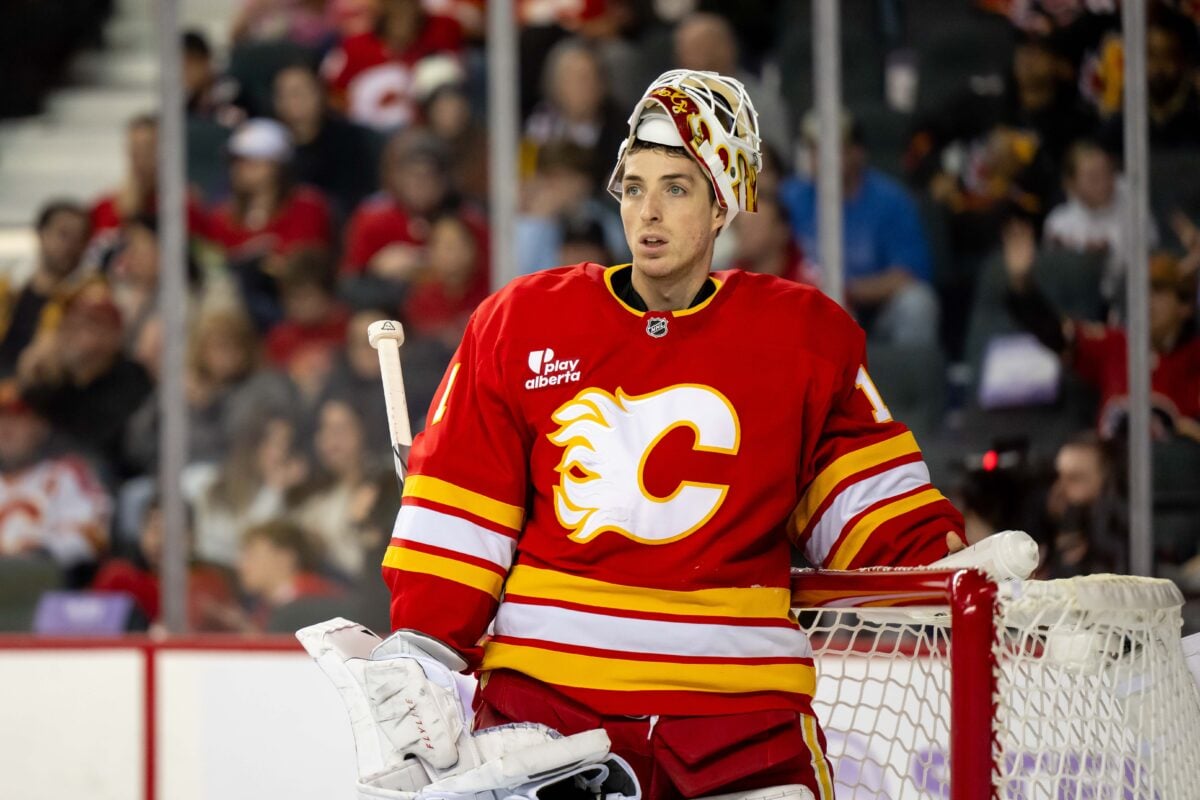
Wolf is currently enduring a quintessential “sophomore slump.” With a record of 6-12-2, a save percentage dragging at .890, and a goals-against average (GAA) north of 3.00, he looks like a goaltender burdened by expectation. In a recent outing against the Tampa Bay Lightning, he was pulled after allowing three goals on just four shots—a mercy kill that highlighted his current fragility.
Related – The Long Game: Why the Flames Just Handed the Keys to Conroy (Again)
Conversely, Cooley has been a revelation. In his recent stretch of starts, he has maintained a .930 save percentage and a GAA hovering around 2.00. But standard boxcar stats can be misleading, often reflecting the defense in front of the goalie more than the goalie himself. This is where the advanced metrics paint a damning picture for Wolf and a heroic one for Cooley.
If we look at goals saved above expected (GSAx)—a metric that essentially measures how many goals a goalie prevents compared to a league-average netminder facing the same shots—the gap is massive.
- Wolf sits at a minus-2.44. In layman’s terms, he is letting in pucks that an average NHL goalie would stop.
- Cooley, meanwhile, boasts a GSAx of 10.71. He isn’t just making the saves he’s supposed to make; he is stealing more than ten goals that, by all rights, should have been in the back of the net.
The “Nothing Matters” Doctrine
What sparked this metamorphosis in Cooley? Physically, he has always had the tools—size and athleticism were never in question. The difference this season appears to be entirely between the ears.
Goaltending is arguably the most psychologically taxing position in pro sports. In the past, Cooley admits to crumbling under that weight. He has spoken candidly about “second-guessing” himself and the stress that accompanied his rough NHL debut with the San Jose Sharks, where he posted a ballooned 4.98 GAA. He was trying to be perfect, and it paralyzed him.
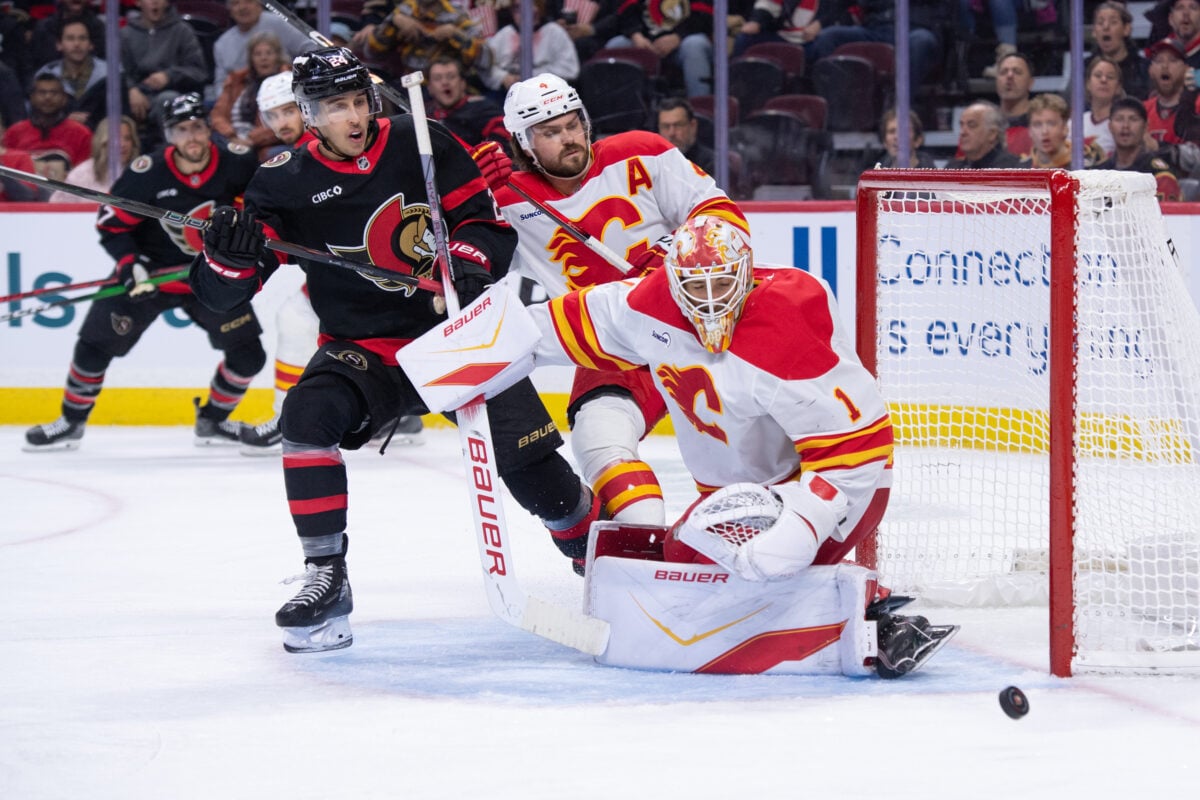
This season, he has adopted a radical, almost philosophical approach to the pressure. When asked recently how he stays composed while facing elite shooters, Cooley delivered what might be the quote of the year:
“Nothing matters. Nobody cares. We’re all going to die.”
It sounds dark, perhaps even nihilistic, but for Cooley, it is liberating. This mindset has stripped away the fear of failure. If the worst-case scenario is irrelevant in the grand scheme of existence, giving up a rebound doesn’t seem so terrifying.
This attitude has manifested physically on the ice. He is loose. Teammates have noted it; coaches have noted it. He’s been spotted singing along to arena music during TV timeouts and joking with opponents like Andrei Svechnikov in the middle of play. He is playing with the carefree energy of a Beer League goalie, but with the technical precision of a Vezina Trophy contender. He stopped trying to “save the franchise” and started trying to have fun.
The Coaching Dilemma
Huska is now in a position that no coach envies, though it is a “good problem” to have.
The organizational mandate is clearly to develop Wolf. You do not sign a goaltender to a $52.5 million contract to have him watch from the bench while a journeyman takes the starts. However, the NHL is a results-oriented business, and the locker room knows who gives them the best chance to win.
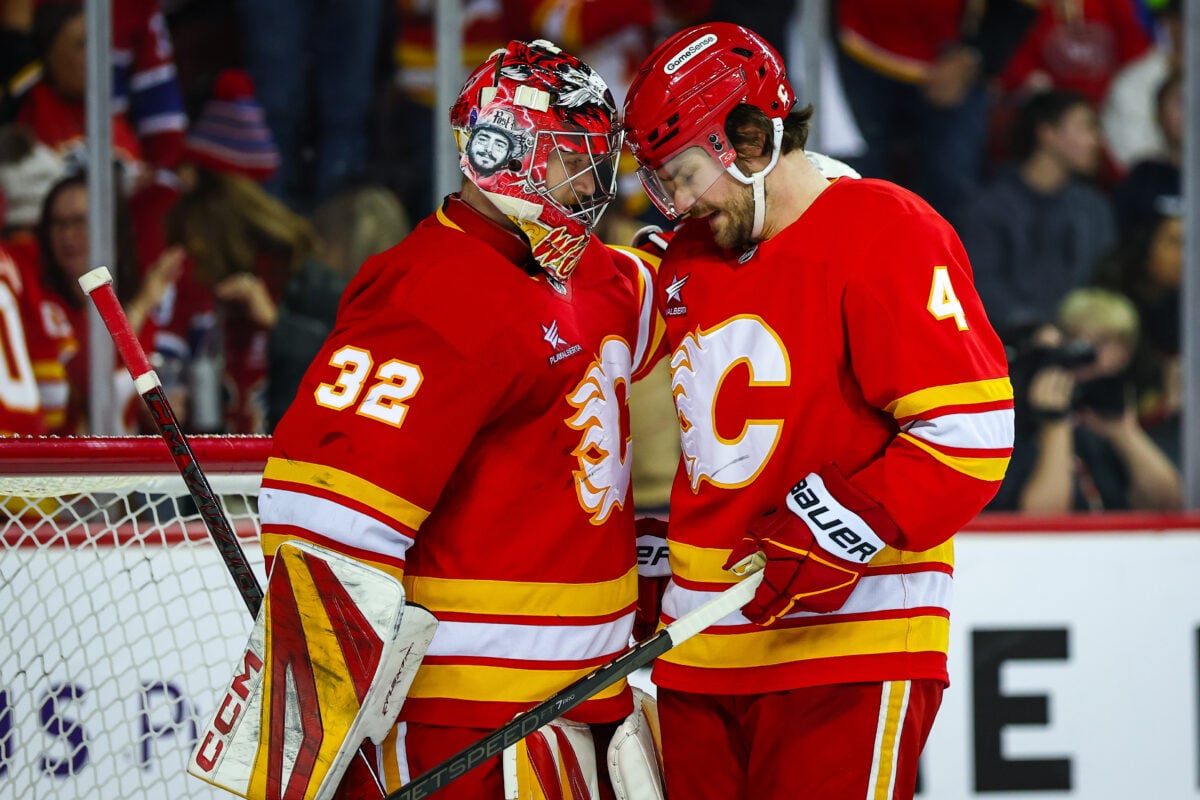
Huska has already signaled a shift in philosophy. The sentiment that they must “overplay Dustin” to force his development is gone. Cooley has forced his way into the rotation, starting four of the last six games not because of charity, but because he beat top-tier heavyweights like the Dallas Stars.
Related – Flames Defenceman Rasmus Andersson Has Vastly Improved His Trade Value
Huska noted recently that Cooley is “finding a way to get us points.” In a league where parity is at an all-time high, points are currency you cannot throw away to protect a prospect’s ego.
The Anti-Tank Commander
There is a final, thick layer of irony to this situation. The Flames, by most objective measures, are a rebuilding team. They sit near the bottom of the standings, and the logical long-term play is to secure a high draft lottery position.
Last season, it was Wolf who single-handedly ruined the team’s “tank” efforts down the stretch by stealing games they had no business winning. This season, the script has flipped. Cooley has been jokingly dubbed the “anti-tank commander.” He is playing well enough to drag a roster with significant holes into competitive games, potentially damaging their odds at a franchise-altering draft pick.
The Verdict
It remains to be seen if Cooley can sustain this level of play. Goaltending is notoriously volatile; “voodoo,” as the old adage goes. We have seen backups catch lightning in a bottle for 20 games only to regress to the mean.
But for now, the Flames have a legitimate controversy on their hands. They have a franchise goalie who looks lost, and a Nihilist in the other net who is stopping everything because he realizes none of it actually matters.
Strangely enough, that might be exactly the mindset the Flames need right now.
AI tools were used to support the creation or distribution of this content, however, it has been carefully edited and fact-checked by a member of The Hockey Writers editorial team. For more information on our use of AI, please visit our Editorial Standards page.
