After beginning the season with the AHL’s Grand Rapids Griffins, Marco Kasper was quickly called up to the NHL in a bottom six-capacity. He needed some time to adjust to the pace of NHL play, but filled his role admirably, though he didn’t produce a ton of points in the early goings of this season.
Shortly after Head Coach Todd McLellan took the team over, Kasper was given a chance to play on the top line with Lucas Raymond and Dylan Larkin, and his game took off immediately. He had been doing a good job defensively and in transition in the bottom-six, but hadn’t been able to capitalize on his chances very often, but with Detroit’s two best offensive players by his side, Kasper has leveled up significantly.
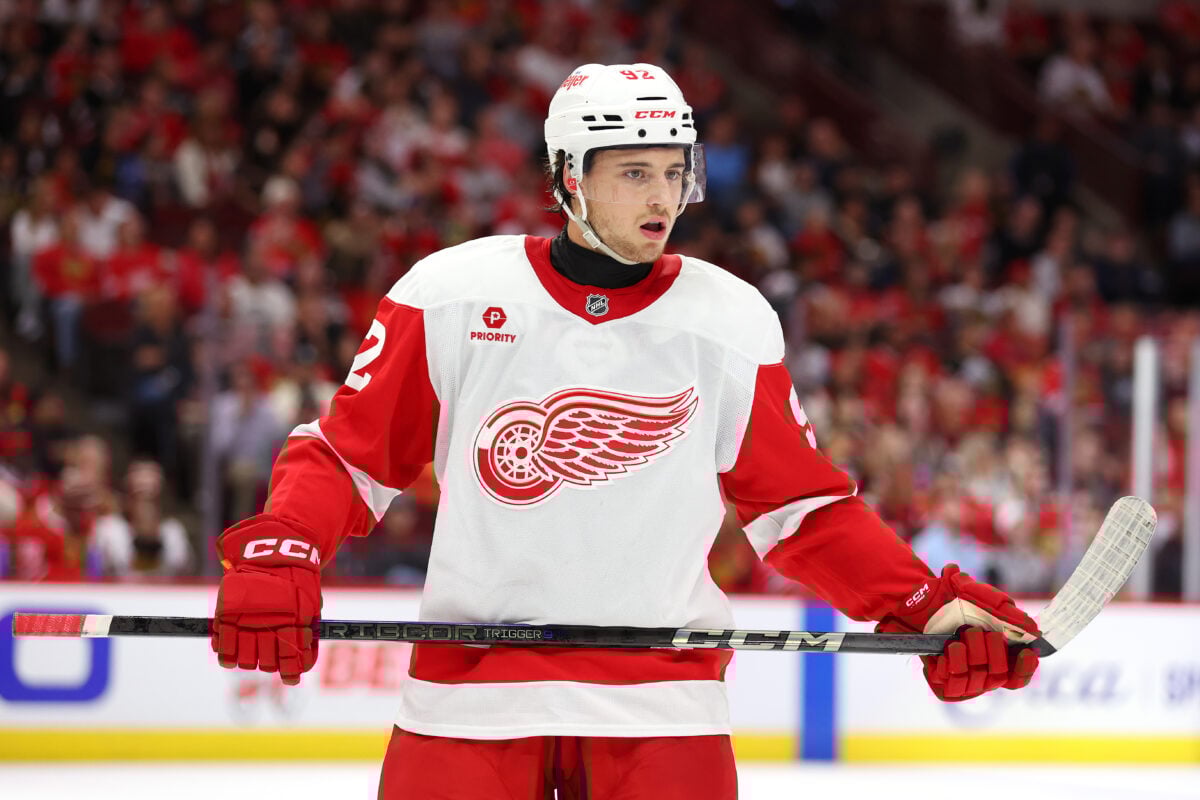
Recently, McLellan has had an even bigger ask for Kasper, centering the second line with Andrew Copp out for the season with a pectoral injury. While the sample size is still incredibly small, there are already reasons to believe Kasper could handle being Detroit’s 2C for the remainder of this season, and possibly going forward as well. Let’s take a look at Kasper’s wild ascension so far this season, and what it means for the Red Wings.
Drafting and Developing Kasper
In his draft year, Kasper was seen by many as a hard-working, two-way center with very limited offensive value, the kind of guy you hope can become your third-line center and a key penalty killer. However, the Red Wings believed that his speed and tenacity weren’t his only skills and that he had a lot more offense to give as a pro player as he developed.
Related: Fair Expectations for Axel Sandin Pellikka in North America
Detroit was quickly vindicated on that front, as Kasper scored 23 points in 52 SHL games, the second-most among U19 players and a massive improvement from the 11 points he scored in his draft season. When Rögle’s playoff run ended, the Red Wings wasted no time signing Kasper and getting him into his first NHL action in the Spring of 2023. Unfortunately, he was injured in his debut and didn’t play again until the 2023-24 season began.
He spent the entirety of the 2023-24 season in Grand Rapids where he could get used to living on a new continent while playing more minutes and being allowed to make mistakes with lighter consequences. Kasper’s comfort level and production improved as the season continued, with him being one of the Griffins’ top players by the end of the year and into the AHL playoffs.
Kasper’s Season to Remember
Despite his success late last season, Kasper began the 2024-25 season in the AHL once again, though this stint only lasted two games (where he scored two points) before he was called up to replace Austin Watson in the Red Wings’ lineup. Much like his first months in the AHL, Kasper didn’t light up the scoresheet early on, with just seven points in 29 games to start the year under Derek Lalonde.
However, as soon as he was given the opportunity to play higher in the lineup, Kasper has flourished with 19 points in the 31 games since the team’s head coaching change. That’s a jump from 0.24 points per game to 0.61. It hasn’t just been points either, as Kasper has fit in wonderfully on the top line with his high motor and tenacity leading to Detroit’s most dangerous offensive players playing with the puck more often than not.
McLellan’s Second Line Experiment
Since Andrew Copp has been sidelined with his injury, Detroit has mostly played JT Compher as their second line center between Patrick Kane and Alex DeBrincat. However, in their past three games, Detroit has subbed big Elmer Soderblöm into Kasper’s spot on Larkin’s wing, and placed Kasper down the middle on the second line.
While he was drafted as a center, Kasper has played on the wing for the vast majority of his NHL minutes so far. This is a big ask for a 20-year-old rookie, but he has looked up to the challenge so far. Detroit’s second line is already showing some chemistry, and exploded offensively Wednesday night against the Buffalo Sabres, with Kane scoring five points, DeBrincat scoring four, and Kasper earning three for himself.
Early returns have been really positive for this second line, as they’ve outchanced and outshot their opponents by a significant margin through roughly 30 minutes together at 5v5. They’ve outshot the opposing team 25-11 (69.4 Shots For Percentage), outscored them 3-0, and have an Expected Goals For Percentage of 67.5% (stats via Natural Stat Trick).
How Detroit Would Benefit From Kasper as a Long-Term 2C
Obviously this is still an incredibly small sample size, but if Marco Kasper can not only hold down the fort defensively as the second line center (something he has proven capable of so far in his short career), but produce points at a reasonable second line rate, then Detroit would be incredibly pleased. He has shown himself to be a responsible defensive player and a pest on the forecheck, but the main question around Kasper was still going to be if he could be a strong offensive player in the NHL.

His 0.61 points per game rate over the past 31 games is a 50-point pace over a full 82 game season, and even if he plateaued there as a full-time 2C, I think Detroit would be thrilled that they took him eighth overall back in the 2022 Draft. However, with more time to adjust to the speed and physicality of the NHL I think Kasper can be even better, giving Detroit a second line that they can trust to take legitimate minutes at even strength to take some of the offensive load off of Larkin and Raymond.
Kasper holding onto the 2C spot for the rest of this season and going forward would also be a good thing for top prospect Nate Danielson who won’t be expected to shoot up the lineup immediately and can work his way up on the wing, in much the same way that Kasper has done this season.
Related: The NHL’s Top 100 Prospects – Midseason Update
The bottom line is this. If Kasper can adequately fill the role he has been placed in, then Detroit has an answer to one of the tougher questions a team faces when they rebuild, and gives them a lot more certainty down the middle after Compher and Copp are gone.