Life comes at you fast. One minute, you’re hitting publish on an article grading forwards for a Philadelphia Flyers team whose roster hasn’t changed a bit since its season ended a month ago. The next thing you know, a regular member of the team’s top-six defensive core and backup goalie have been traded out of the country.
There will still be grades in here for Emil Andrae and Sam Ersson, as well as the other five defensemen who played a regular role on the 2025-26 Flyers and, of course, Dan Vladař. Like up front, we’ll exclude some of the lighter used players (if you thought analyzing Porter Martone’s 19 games was rough, good luck with Oliver Bonk’s two-game trial). With the draft approaching and free agency not too far behind, there’s no time to waste.
A-Tier: Someone Expected and Someone Not
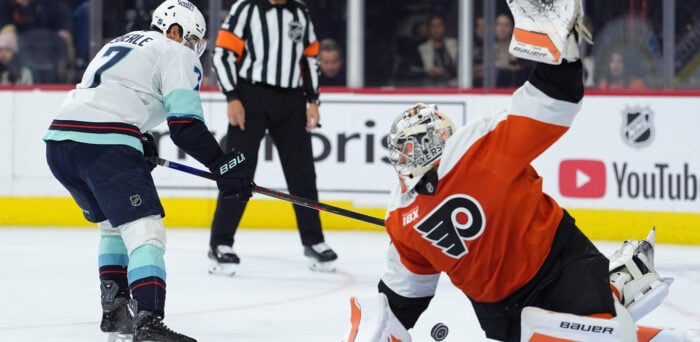
The easiest player to place in this tier is someone no one expected to be this high entering the season. What stands out most about Vladař’s first season with the Flyers was his consistency. Despite a brief injury absence in January, the 28-year-old more than doubled his previous career high in starts when adding the playoffs. Only four times did Vladař record a sub-.900 save percentage (SV%) in back-to-back games, and only once did it reach three straight games.
He didn’t run out of gas down the stretch, either. Vladař delivered a .931 SV% in six regular-season April starts, winning five of them. After somehow not recording a shutout in the regular season, he notched two in the first round, including a 42-save masterpiece to lead the Flyers to their series-clinching overtime victory in Game 6.
Vladař’s sixth-place finish in Vezina Trophy voting is the highest by a Flyers goaltender since Roman Čechmánek was runner-up in 2001. The rumored long-term extension coming does carry significant risk due to his age and lack of track record. But when you look at how well he played, it’s hard not to fault the Flyers for wanting to capture this type of goaltending, even given the position’s year-over-year volatility. From analytics to the eye test to postgame quotes, it’s an easy A for Vladař.
Travis Sanheim checks in a hair below at an A-minus. It’s now been a few seasons of Sanheim steadying himself as a top-pair defenseman, and he showed everyone his prowess on the big stage. After being scratched for Canada’s Olympic opener, he earned a regular role and eventually a silver medal. Plus/minus is an extremely flawed stat, but Sanheim was plus-6 (tied for second on his team), and his lone point was a huge one as he set up Shea Theodore’s third-period equalizer in the semifinals against Czechia.

That performance didn’t directly help the Flyers, but his playoff effort sure did. Sanheim showed he’s a different player than in his last time under the NHL’s bright lights in his first game, breaking a 1-1 tie with a dazzling goal halfway through the third period. The Flyers outscored the Penguins 5-2 with their number one defender on the ice at 5-on-5, and he was also part of a mostly stout penalty kill. The second round drags down his underlying numbers, but he hung in there against top competition in both series.
His regular season play was also excellent. Sanheim led the Flyers’ backend with a 53% expected goal share at 5-on-5, where the Flyers outscored the opposition by seven goals. His 11 goals were a career-high, and his 37 points perfectly split the middle of his output the last two seasons. With the salary cap skyrocketing, Sanheim’s $6.25 million should look like a bargain for most, if not all, of the remaining five seasons, even if age starts to hit him a bit after turning 30 in March.
B-Tier: The Future Is Now the Present
Jamie Drysdale and Cam York are linked in many ways on the Flyers’ blue line. The former Anaheim Duck and California native are close friends. Their similar size (both under 6-foot-1 and 200 pounds) is part of why the Flyers viewed Andrae as expendable. Drysdale scored the Flyers’ first goal in each of their two playoff series; York scored the last goal in their first, delivering the most celebrated Flyers marker in over a decade.
So, it’s no surprise to see them in the same group. Do they deserve the same grade, however? Given they spent most of the second half together, it’s not a surprise they grade out very closely. Drysdale had six more points but played in four extra games. They were separated by just 1% in 5-on-5 goals for share and about 1.5% in xG. Drysdale was about 4% better in the latter department than York in the playoffs, but York had the edge in the former category.
Subjectively, it does feel like Drysdale is making more progress while York has stagnated. Maybe that’s due to Drysdale’s goal-scoring surge; his five goals after Feb. 1 were tied for ninth in the NHL. Perhaps it was because he stayed healthy for the first time since 2021-22. Or because York is settling in as more of a two-way player than the offensive defenseman many saw in him when the Flyers drafted him 14th overall in 2019, one pick ahead of Cole Caufield. Even with their glut of wingers, that one still stings a bit.
Objectively, though, it’s too close to call. The best friends rank out evenly with a B each, although there’s room for both to climb.
C-Tier: The Vets
You could make a case that a C-plus is way too low for Rasmus Ristolainen. In the regular season, the Finnish defenseman had the team’s second-best 5-on-5 xG share, and his transition to the pair alongside Sanheim coincided with the Flyers’ late-season surge. The beast that is playoff Risto was awoken for the first time, and especially in the first round, Ristolainen met the hype. His four assists were tied for the team’s playoff lead, and he scored as part of the second-period barrage in Game 3 of the first round.
However, the best ability is always availability. And for the third straight season, Ristolainen failed in that area. This was the third straight season he missed at least 38 games, not making his season debut until Dec. 16. Offensively, he was close to a black hole with just one goal and 13 assists in the regular season. Despite not being the point producer he was with the Buffalo Sabres, the Flyers gave him extended power-play time, an opportunity he rarely capitalized on.
It’s not Ristolainen’s fault that he was used that way, but it still has to be accounted for. The end is likely near for him in Philadelphia, either via trade (likely this summer) or walking as a free agent at the end of 2026-27. A lot has gone wrong since he arrived in 2021-22, but if nothing else, his play down the stretch and in the Pittsburgh Penguins series is a positive memory to hold on to.

Nick Seeler does a lot of the same things that Ristolainen does — throw the body, block shots, play low-event hockey. But given his lesser usage and performance, especially in the playoffs, where he managed just a 36.61% xG share, he has to come in a little lower. Another respectable season of third-pair performance gives Seeler a standard C.
Andrae plays a much different style than Seeler, but he gets the same grade. Andrae was slightly more offensively proficient, especially given he played about 330 minutes less than Seeler at 5-on-5. His micro stat profile is intriguing, and it’s definitely possible the Flyers kick themselves for not developing him further in Philadelphia. Still, this doesn’t feel like a Vince Dunn situation where a massive breakout is imminent with increased usage. We’ll find out which way things go soon enough.
D-Tier: Until Next Time
There were plenty of reasons to be skeptical when the Flyers signed Noah Juulsen last summer. Rick Tocchet played the 2015 Montréal Canadiens first-round pick more than any coach he’s ever had, and the reward the prior season was 35 games without a single point.
It will likely be one-and-done for Juulsen in Philadelphia, and his tenure was fine enough. He wasn’t great; his 46.17% xG share at 5-on-5 was the worst of any regular Flyers defenseman. But they came out even in goal differential, and Juulsen wound up with a career-high 10 points. There will always be that beautiful cross-ice pass to set up Ristolainen’s goal in Game 3 against the Penguins. He gets a passable D.
Ersson was firmly in F territory at the Olympic break. His turnaround since then has been well documented: -17.77 goals saved above expected (per MoneyPuck) and an .856 SV% in 24 games before, 0.73 GSAE and a .912 SV% in seven games after, picking up six crucial wins. The Flyers wouldn’t have made the playoffs if he hadn’t turned it around; they also would’ve made them much more comfortably if not for his previous struggles.
Ersson got to end his Flyers tenure on a high note, and there’s no reason to kill the vibe. His last act gets him into D-minus territory. On to the next grade: Toronto Maple Leafs (unless they don’t qualify him, which is definitely possible).
Looking Ahead
There are fewer players graded here in the forward grade, and with two in A territory and two more traded, less movement for upward mobility. Drysdale feels like the big candidate here, especially if a potential Ristolainen trade opens the door for him to play alongside Sanheim, an opportunity he’s rarely had but could be ready for if he hits the ground running in the fall.
The big question here is whether Vladař can maintain his place atop the chart. If he drops to the B-range, it’s not the end of the world for the 2026-27 Flyers’ ambitions, nor would it automatically sour a potential extension. But Vladař hasn’t always, if ever, played at even that level before this season. We’ll find out whether last season was just normal goaltending variance or whether Philadelphia really is the perfect place for the 28-year-old.
Free Newsletter
Get Philadelphia Flyers coverage delivered to your inbox
In-depth analysis, breaking news, and insider takes - free.
Subscribe Free →