This is our second Toronto Maple Leafs’ player review. Yesterday, we wrote about Auston Matthews and what we believe makes him the best player in Maple Leafs’ franchise history. Today, we’ll look at our second Maple Leafs’ player – Mitch Marner.
As a reminder if you missed yesterday’s Matthews’ post, we’re basing much of these reviews on the film study and note-taking of long-time Maple Leafs’ fan Stan Smith. As he reviews each game after it’s played, he notes what each player does with the puck, without the puck, where they are, and what they’re doing while not directly involved in the play, etc.
The purpose of our upcoming series of posts is to review and discuss Maple Leafs’ players based on Stan’s notes. Today, it’s Mitch Marner. Tomorrow, we’ll be looking at Michael Bunting.
Maple Leafs’ Player Two: Mitch Marner
We’ve read so often that Mitch Marner is overpaid and overrated. When you look at comparable players and what their salaries are, there’s some truth to the claim. It’s difficult to argue that Marner is not overpaid.
If he is however, it’s not by much, maybe 10 percent. Mind you, for a player making over $10 million a season, 10 percent is still a lot of money.

As for overrated? In our opinion, he’s underrated. He’s one of the best playmakers in the league. He sees the ice so well and controls the play when he has the puck on his stick. Throughout his career, regardless of whatever line he’s on, he’s the player linemates trust to carry the puck from the defensive zone to the offensive zone.
What’s amazing when you watch game film of Marner is how often opposing players back off and give him room when he has the puck.
Marner Sets Up Shop in the Team’s High Slot
While Marner doesn’t have blazing straight-line speed, he still moves the puck from zone to zone very well. His patented move once he enters the offensive zone is to hold up and allow his linemates to gain the zone and get into position to receive a pass.
The area from the center of the high slot to the blue line between his defenders is his “house” in the opposing zone. That’s where he likes to control play. Not only does that allow him to see and use the whole zone to his advantage, but it also allows him to cover for his defensemen if they decide to pinch.
Marner’s Good At Stripping the Puck From Opponents
While Marner isn’t a physical player, he’s not afraid to go into the corners. Rather than use his body to separate opposing players from the puck he utilizes his excellent hand-eye coordination to strip the puck from an opposing player. He’s also adept at intercepting and knocking passes out of midair using that same skill.
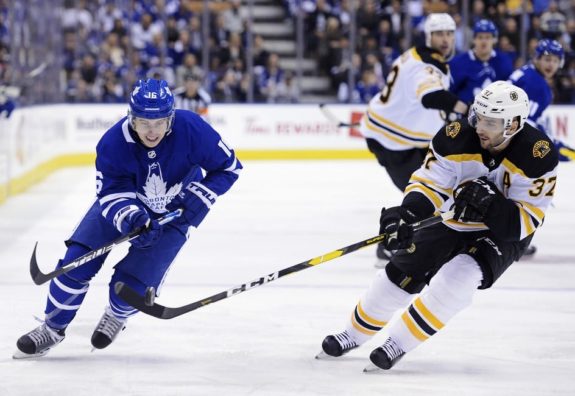
(THE CANADIAN PRESS/Nathan Denette)
One thing he has always been good at, and one reason he usually leads the team in takeaways, is skating up to an opposing player from behind, lifting his stick, and stealing the puck. It’s a skill that his teammates, especially Matthews, now use to create turnovers.
Marner is also strong at intercepting pucks defensively in his own zone. He sees the lanes and anticipates the play really well. That is one of the reasons he is used a lot on the penalty kill.
Marner’s Added Goal Scoring to His Game
On the negative side, Marner has a tendency to overplay the puck at times and tries to be too “cute” with it. He has created turnovers for his own team by holding onto the puck too long, or by trying to feather it through areas of the ice that just aren’t open. These passes can look great when they work, but not so great when they don’t.
Earlier in his career, Marner would always have that pass-first mentality that allowed defenders to target his linemates and not worry about Marner’s chances to score. This past season he scored goals at close to a 50-goal pace over the last half of the season.
Marner is now thinking about both passing and shooting. That change in priority has opened up more opportunities for him and (by proxy) for his linemates who now find themselves freer to set up in unoccupied space.
Marner’s Production, Looking Ahead
While we don’t expect Marner to become a prolific goal scorer, we think he’ll become a consistent 30-goal, 100-point player for a number of years to come. The team’s first line of Marner, Matthews, and Bunting have turned into one of the best in the entire NHL.
For the Maple Leafs, that’s the kind of production that will help keep the team near the top of the NHL standings.
[Note: I want to thank long-time Maple Leafs’ fan Stan Smith for collaborating with me on this post. Stan’s Facebook profile can be found here.]
Free Newsletter
Get Toronto Maple Leafs coverage delivered to your inbox
In-depth analysis, breaking news, and insider takes - free.
Subscribe Free →