The 2026-27 season starts this month, so let’s continue our Edmonton Oilers player preview series. The last player we looked at was Colton Dach, and now we turn our attention to the final goalie on the roster.
General manager Stan Bowman made a huge blunder last December when he acquired Tristan Jarry and Samuel Poulin from the Pittsburgh Penguins for Stuart Skinner, Brett Kulak, and a 2029 second-round pick. He gave up a ton for an inconsistent goalie who was on waivers the season prior. They had a starting goalie with a $2.6 million cap hit, but decided to trade him for a goalie with two more seasons and a $5.375 million cap hit. This deal made no sense because they gave up quality pieces and now have a horrendous contract on the books, with term.
That trade was bad then, and it’s even worse now. Jarry has struggled mightily since his arrival. He posted a 3.86 goals-against average (GAA) and an .858 save percentage (SV%) in 19 games (16 starts) since the trade. He also got injured during his third game with his new team, missing the next 11 games. He wasn’t the same when he came back, and eventually lost the net to Connor Ingram. He only started one playoff game.
Now, he comes into 2026-27 looking to bounce back as part of a three-goalie system, with two new partners. The Oilers acquired Devon Levi from the Buffalo Sabres and signed Frederik Andersen in free agency. Unfortunately, Andersen will be out for most of October with an injury sustained in the Stanley Cup Final. So, it will be up to Levi and Jarry to carry the load. The start of the season will be crucial for the veteran netminder. Will he win the starter’s job over the more inexperienced Levi, or will the youngster take the reins? Here’s Jarry’s 2026-27 player preview.
Worst Case Scenario
The worst-case scenario is simple. Jarry continues to struggle and eventually finds himself on waivers when Andersen returns, or he stays in the press box and doesn’t play until someone else gets injured. If that’s the case, the Oilers are in trouble.
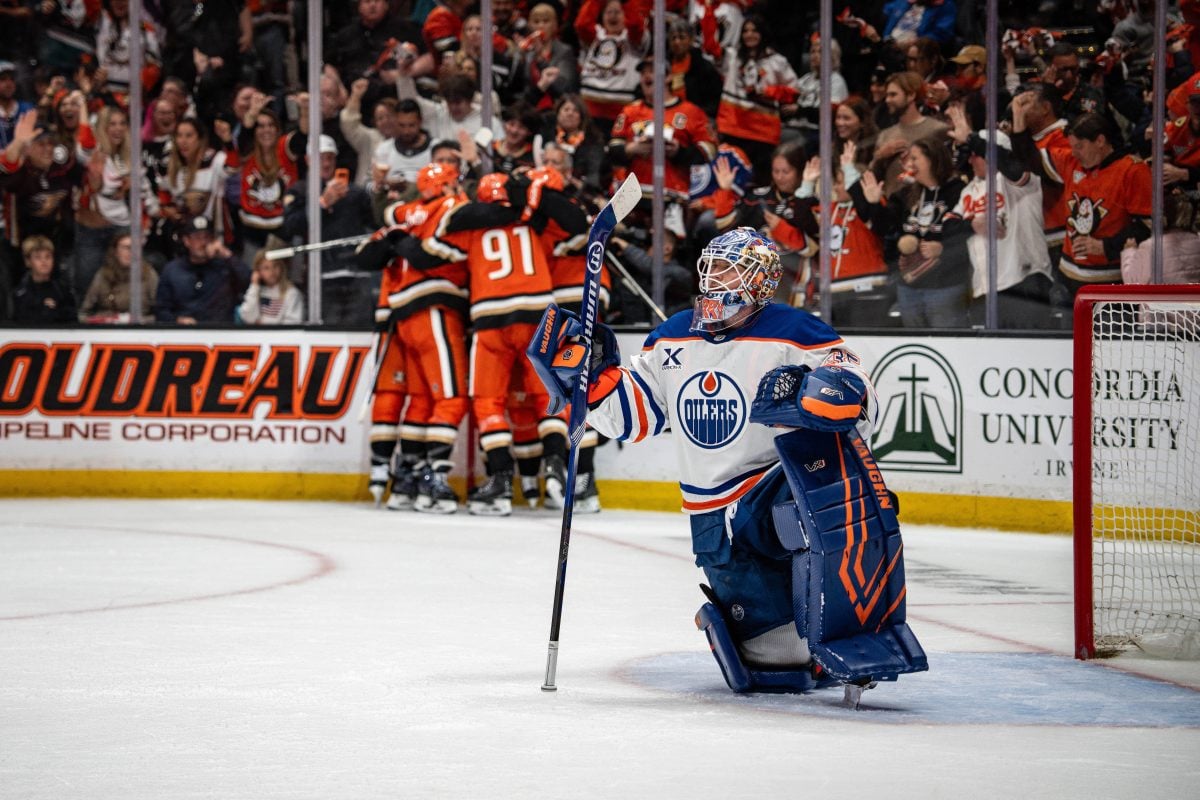
He can’t afford to duplicate last season’s performance with Edmonton. Before the trade, he had a solid .909 SV% with Pittsburgh before things unravelled. So, what changed? He was solid for the Oilers during his first three games, before his injury. But after that, he wasn’t the same. That’s probably the worst thing that can happen after a trade. He was still trying to get to know his new teammates and fit in, and since he couldn’t play, that likely made things more difficult. If he gets hurt while Andersen is still on the shelf, the Oilers would need to call up a netminder from the American Hockey League (AHL), which isn’t ideal. The organization still has a lot of question marks in net.
Best Case Scenario
The best-case scenario is obviously a bounce-back season from the Oilers’ netminder. The Oilers need him to be better and provide quality goaltending. He doesn’t need a .930 SV%, because that’s unrealistic. He holds a career .907 SV%, so if he can hover between .906 and .910, that’s already a major improvement.
Last season, he started only four games with a 900 SV% or higher, which was just 25 percent of his starts. If the Oilers want to win, that number must be much higher. He needs at least 50 percent of his starts to be over .900. The offence can’t outscore their problems all the time. Jarry needs to be a solution, not a problem.
In a perfect world, the Oilers would find a trade partner for Jarry. Unfortunately, teams aren’t lining up to take on his expensive salary, with term, paired with his brutal numbers. His trade value is at an all-time low, even though he got traded for a great package just nine months ago. Bowman got fleeced in that deal, and the organization is still trying to recover.
What should we expect from Jarry this season? Keep following The Hockey Writers as we continue the Oilers’ player preview series in anticipation of this season.
Free Newsletter
Get Edmonton Oilers coverage delivered to your inbox
In-depth analysis, breaking news, and insider takes - free.
Subscribe Free →