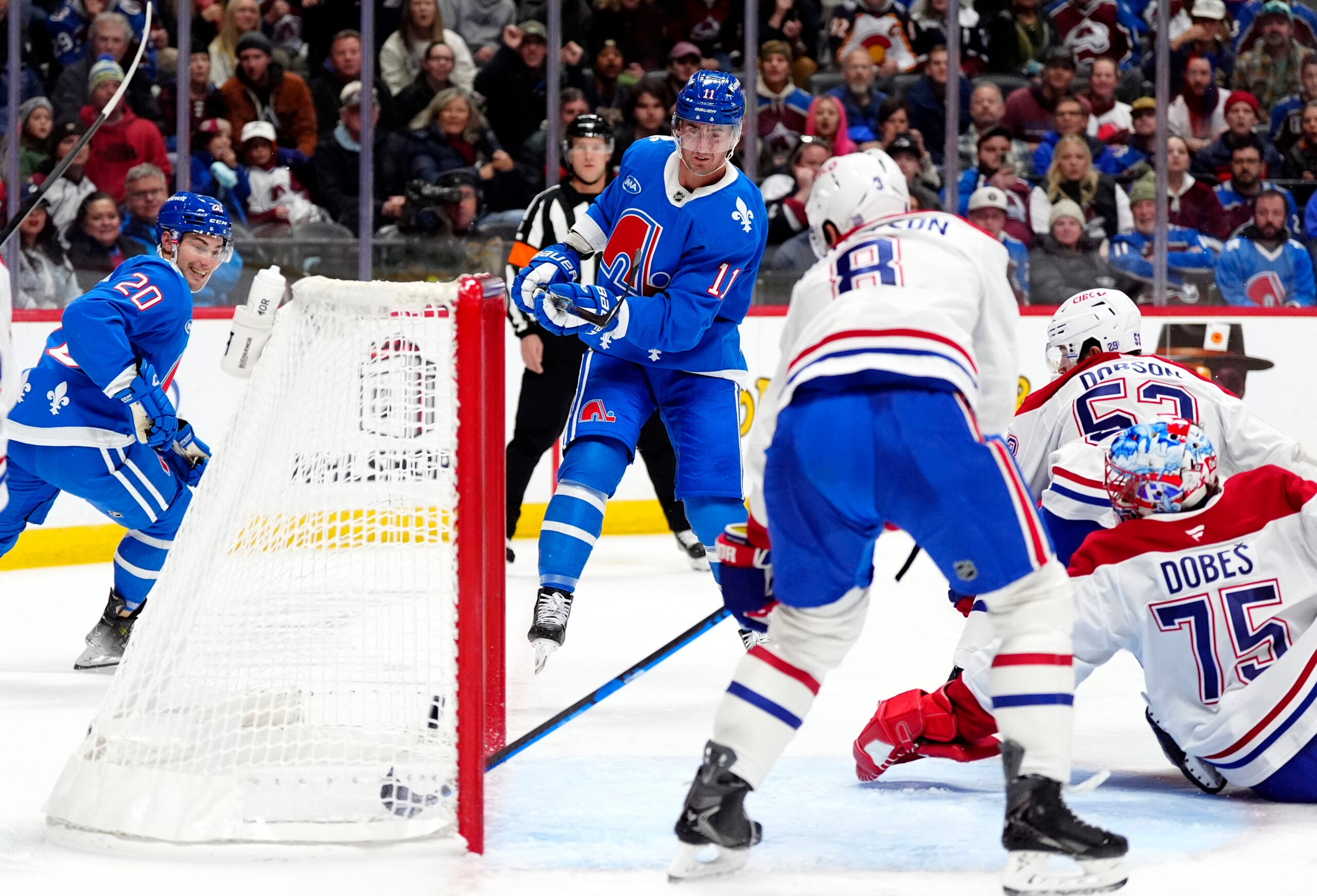
There is an old adage in hockey that goes something like this: your best players have to be your best players. It’s true, of course. Nobody in the NHL wins anything of consequence without elite talent driving the bus.
For the Montreal Canadiens, Nick Suzuki, Cole Caufield, Lane Hutson, and Juraj Slafkovsky are the guys with their hands on the wheel. When they’re rolling, the Bell Centre turns into one of the most electric buildings in sports, and the Canadiens look every bit like a team ready to make serious noise in the Eastern Conference.

But if the first 20 games of this 2026-27 season have taught us anything, it’s that the companion cliché, the one about depth being the true currency of a contender, might actually be underselling what’s happening right now. Sit back and look at the Canadiens’ current record: 12-4-4, sitting right near the top of a brutal Atlantic Division, riding a 9-1-3 heater over their last 13 games. On paper, that looks like the box score of a healthy, humming juggernaut.
Canadiens Look to Their Depth
In reality, it’s the product of a roster that has spent the better part of the fall dodging landmines.
Before the calendar even flipped to mid-November, head coach Martin St. Louis had already watched his captain miss time, seen sophomore sensation Ivan Demidov sidelined with an ankle issue, dealt with early-season scares to Samuel Montembeault and Kaiden Guhle, and watched Mike Matheson miss half of the team’s opening 20 contests.
Then came the latest gut punch: Matheson going back on the shelf for two to three weeks with a lower-body injury, Josh Anderson hitting the sidelines for three to four weeks, and veteran power forward Chris Kreider ruled out for six to eight weeks.
For most teams in this league, losing that kind of experience, size, and heavy-minute capability all at once triggers an immediate slide down the standings. A couple of years ago in Montreal, it would have triggered a full-blown crisis. Instead, the Canadiens just keep banking points. And the reason why is the exact thing general manager Kent Hughes and president of hockey operations Jeff Gorton have spent the last four years obsessing over: organizational depth.
“They’ve got depth everywhere, with the ability to roll four forward lines and three defense pairs, and they have one of the best coaches in the NHL in Martin St. Louis.”
Right now, nobody in that room is blinking, thanks to the NHL ready depth they have been accumulating.
Depth Under Scrutiny
Consider what happens now with Kreider, Anderson, and Demidov all out of the lineup simultaneously. Suddenly, they’re missing top-six scoring touch, net-front chaos, size and physicality along the boards. Instead of panicking and loading up one super line then double-shifting them, a move that inevitably burns out stars by January, St. Louis has leaned on the middle of his roster: Namely the trio of Alexandre Texier, Phillip Danault, and Zachary Bolduc, also known as “the French connection” line.
They aren’t a typical offensive line, or even considered top six at first glance, yet they are making a significant impact at both ends of the ice, reminiscent of the pandemic-era line where Danault centered Brendan Gallagher and Tomas Tatar. According to MoneyPuck, the trio has posted a 61.8% expected goals at five-on-five, making them the Canadiens’ top line in that statistic. They are a top defensive line for Montreal, mostly because they can keep the puck in the offensive zone for long periods, forcing opponents to expend their energy chasing the play, not pushing it into the Canadiens zone.
They’re even ahead of elite lines such as the Edmonton Oilers line led by Connor McDavid (61.6%). Ideally, this line would play as the third line, capable of playing in a matchup roll with a second line so as to keep their possession numbers high, while allowing a Canadiens second line to take advantage of preferential matchups against an opponent’s bottom six.
Yet, due to the injuries, an entire line that could play as a second line are wiped out. Now, players like Kirby Dach, Alex Newhook, and Oliver Kapanen have an opportunity to step into heavier five-on-five matchups, driving play with speed and refusing to let the offense dry up. This leads to a trickle-down issue. What about the fourth line? The depth will be tested now, but it also provides opportunity.
This is where players like Owen Beck can prove their value to the organization. He can add a responsible, high-energy bottom-six capable center alongside Florian Xhekaj and centered by veteran Jake Evans, gives Montreal a line that can actually tilt the ice rather than merely survive a shift.
On the back end, losing a workhorse like Matheson who averages 23:28 per game in all situations, including significant time on the penalty kill, should be a massive problem. Yet having mobile, NHL-ready young defenders like David Reinbacher that can be called up, while also having Adam Engstrom on hand on the NHL roster, who are ready to step onto the third pair alongside a rejuvenated Arber Xhekaj means the Canadiens don’t have to sacrifice their transition game just because a top-four staple is in the trainer’s room. The obvious takeaway is that depth matters.
Banking points in November matters, especially in a division where the Tampa Bay Lightning, Florida Panthers, and Boston Bruins don’t give an inch, because it gives cushion in March and will keep the Canadiens from having to overplay Suzuki and Hutson down the stretch. But if you want to understand why Hughes prioritized this specific kind of depth, you have to fast-forward to April.
Stress Testing Depth
Testing depth now is a key step in the rebuild.
Weathering an early-season injury storm in October and November does more than just protect a team’s spot in the standings; it serves as an invaluable dress rehearsal for the crucible of spring hockey, forcing young call-ups and role players to prove they can handle elevated minutes long before the stakes peak. After all, the Stanley Cup Playoffs are a completely different sport. Space evaporates. Time with the puck gets cut in half. Every single shift turns into a physical war of attrition, and opposing coaches spend entire seven-game series obsessing over one thing: neutralizing their opponents’ best players. Come spring, teams are going to throw their hardest shutdown pairs at Suzuki and Caufield.
They’re going to finish every check on Hutson to try to slow down his breakout passes. When that happens when the top lines cancel each other out in tight-checking, 2-1 game? Series tend to be decided by the players nobody was talking about in October. Look at Newhook’s playoff heroics.
Can the third line win its matchup against the opponent’s bottom six? The Danault line is building that reputation now. When a playoff series stretches to Game 6 or Game 7 and half a team’s blue line is playing through bruised ribs and broken toes, can its seventh and eighth defensemen step onto the ice, on the road without last change, and not get caved in?
By having their depth tested right out of the gate, the Canadiens aren’t just surviving the early-season grind; they are finding out in real time who can answer those exact questions when April arrives. Look at the teams that have hoisted the Cup over the last half-decade. Florida, Tampa Bay, and the Carolina Hurricanes; none of them won simply because their top three forwards were better than everyone else’s. They won because their 10th, 11th, and 12th forwards played with the exact same pace and structure as their first line, and because their sixth defenseman could play 16 reliable minutes in double overtime.
That is the standard the Canadiens are building toward.
Nobody around the Canadiens is handing out trophies in November. There is far too much hockey left to be played, and plenty of adversity still waiting around the corner. But when a team loses a chunk of its core before Thanksgiving and responds by climbing into a tie for first place in the Atlantic, you pay attention. Superstars will always fill the seats at the Bell Centre and win games on any given Tuesday. It’s the depth currently carrying Montreal through the storm that gives them a real shot to still be standing when the weather turns warm.
Free Newsletter
Get Montreal Canadiens coverage delivered to your inbox
In-depth analysis, breaking news, and insider takes - free.
Subscribe Free →