Ex-Montreal Canadiens forward Doug Jarvis knew only championship glory his first four seasons in the league as a member of the team’s 1970s dynasty. That in and of itself isn’t worthy of a ticket to the Hockey Hall of Fame, if only by virtue of the fact Jarvis has yet to be inducted. He’s got much more of a case to earn a call to that effect, though.
Consider how fellow-ex-Canadien Shea Weber just got inducted (and added to the team’s Ring of Honor ahead of their 5-1 win over the Columbus Blue Jackets on Nov. 16) without winning a championship. Especially in this day and age, with so many teams in the league to the point winning it all is extremely difficult, Stanley Cup success isn’t the be all and end all.
Related: Canadiens Well-Represented as Weber Gets Inducted Into Hockey Hall of Fame
Looking at the flipside of the coin, and in defense of the powers that be, when every other teammate of Jarvis’ from those powerhouse Habs teams makes it, there must be a tendency to want to draw the line somewhere. Jarvis was simply the wrong name at which to do that.
Jarvis’ Ironman Streak Flies Under the Radar
As it stands, 10 players from that Canadiens dynasty have been awarded entry to the Hall of Fame: Yvan Cournoyer, Guy Lapointe, Jacques Lemaire, Serge Savard, Ken Dryden, Bob Gainey, Guy Lafleur, Rod Langway, Larry Robinson and Steve Shutt. None stand out as undeserving, and, were Jarvis to eventually join the list, he might to many, but only to those unfamiliar with all he accomplished.
For example, Canadiens captain Nick Suzuki is the team’s resident ironman with the third-longest streak of consecutive games played with 391 among active players (Brent Burns, 859; Ryan Suter, 471). That tends to not get publicized all that much, similar to Jarvis’ streak of 964, which really only consistently made the news a few years ago when Keith Yandle broke the record and Phil Kessel then broke his in short order.
It maybe isn’t the sexiest title someone can own, like a certain scoring record that is making the round these days. However, it is one worth celebrating. That’s a fact, even if only due to how the streak was commemorated as the primary reason Jarvis was named the recipient of the 1987 Bill Masterton Memorial Trophy, after breaking Gary Unger’s record.
Jarvis may not own it anymore. However, that his streak ended in October 1987, literally days after Kessel was even born, and that Yandle only established a new one in January 2022, over 34 years later, is part of the point. Made a healthy scratch for the first time in his career three games into the 1987-88 season, Jarvis never played another (from ‘A Tribute to the NHL’s Ironman – Doug Jarvis,’ Today’s Northumberland, Jan. 25, 2022).
Jarvis Wins Masterton
Ultimately, for a long point in time, Jarvis owned a part of NHL history. He arguably set the standard for endurance, yes, but also commitment. In fact, his name was effectively immortalized for it, as evidenced by the aforementioned trophy, which is awarded to the player who best exemplifies dedication to the game.
Some against his entry into the Hall of Fame may argue a single trophy does not make a career, least of all a Hall of Fame one. However, what the streak represented should: consistency from the point at which he first made the Canadiens as a just-drafted rookie in 1975 (No. 24 overall by the Toronto Maple Leafs only to be traded weeks later for defenseman Greg Hubick) to when he was scratched.
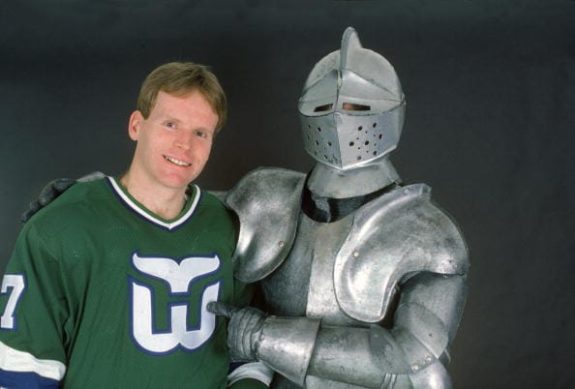
Think about that for a second. Jarvis never played another NHL game again, which means he also technically never missed one either. A member of the Hartford Whalers organization at the time, he finished his career with their American Hockey League affiliate in Binghamton with 24 additional contests as a player-coach, transitioning into his second career behind the bench. After literally decades there, he added two more Stanley Cups as an assistant coach (Dallas Stars, 1999; Boston Bruins, 2011) to his four as a player.
A Key Member of 1970s Canadiens Dynasty
The crux of the argument is, for the longest time even just as a player, nearly 1,000 games, Jarvis was seen as one of the NHL’s top defensive centres. Gainey, his ex-teammate (and linemate alongside Jimmy Roberts/Rick Chartraw), made his bones as one of the top defensive forwards in NHL history, earning the Frank J. Selke Trophy for that reason its first four years in existence. The fact Gainey gained entry into the Hall of Fame despite never being a huge scorer, with a career-best 47 points in 1980-81, shows Jarvis shouldn’t continue to be held back if that’s in fact why entry has eluded him (a career-best 48 in 1981-82 for the record).
By association, Gainey’s accolades actually speak to Jarvis’ ability as his centre, including a renowned one to take faceoffs. That ability not only helped earn him a spot on those star-studded Canadiens teams of the 1970s first as a rookie, which in and of itself is lunacy, but stick in the NHL. And, yes, if there were any doubt, he eventually earned his own Selke too (1984).
So, it’s not just one trophy with Jarvis’ name on it. It’s two… and six Cups in all. It almost seems like his name in the Hall of Fame should be a mere formality. Of course, that’s not how it works. Realistically, based on the length of time that’s passed since Jarvis left the game as a player, that call may never come. Jeremy Roenick, who had been eligible for years, only to be inducted alongside Weber in 2024, provides hope Jarvis eventually may receive it.
If Jarvis does, it certainly won’t be just for the Cups, but his resume as a whole. Mirroring his NHL career, they were just the beginning. Having stuck around the game in varying capacities since, much like during his time as the game’s ironman, there’s no end in sight. Hopefully this specific chapter closes for him one day, though. The way it should.
