The Montreal Canadiens have exceeded expectations in the 2026 Playoffs and deserve to be celebrated for punching above their weight class, using their offensive skill and competitive spirit, to reach the Eastern Conference Final.
But as they now sit on the brink of elimination, down 3-1 in their series against the Carolina Hurricanes heading into Game 5 on Friday, we can afford to take an honest look at what the team still needs to become. Yet, a potential long-term answer has been quietly building his game with the organization’s American Hockey League (AHL) affiliate, Laval Rocket: David Reinbacher.
A Canadiens Blue Line That Has Overperformed
Montreal’s defensive group has been a pleasant surprise this postseason. When Noah Dobson missed most of Round 1, many expected the Canadiens to struggle, but Arber Xhekaj and Jayden Struble stepped up and played some of their best hockey of the season, bringing physicality, energy, and stability that kept the group afloat. That kind of depth is not accidental. It’s the product of deliberate organizational building.
The current blue line features Lane Hutson, Dobson, Alexandre Carrier, Mike Matheson, Kaiden Guhle, Xhekaj, and Struble. They are a disparate group, from puck movers to shutdown defenders to physical presences, who play clearly defined roles. Even better, their contracts are among the best in the league. The core four of Hutson, Dobson, Matheson, and Guhle are locked up until at least 2031, giving the Canadiens rare cost certainty and long-term control that most contenders only dream of.
That said, the Hurricanes have exposed a real weakness. The lack of coherence in Montreal’s defensive structure has been obvious throughout this series, with pairs struggling to drive play and defenders failing to develop meaningful chemistry with one another.
Guhle has been excellent in stretches, with eight points through 16 playoff games, all at five-on-five, while ranking among the top NHL defensemen in advanced metrics this postseason. But he has rotated through multiple partners without establishing lasting chemistry with any of them, and Xhekaj, despite averaging just over eight minutes a night, is tied with Guhle for the most minor penalties among remaining defenders. Those are costly minutes against the Hurricanes.
The bigger issue is structural: Head coach Martin St. Louis has leaned heavily on Hutson and Dobson as his primary puck-movers, a combination that has produced offence but has also given them the toughest deployment in the lineup. The result is a disproportionate burden on his top-two defenders, and a reliable third option who can defend with authority simply doesn’t exist yet. That’s the missing piece.
Montreal’s Defensive Future
Here’s the reassuring part: the defensive core is built along a near-perfect age curve. Dobson, Guhle, Hutson, Xhekaj, and Struble are all under 25, and Reinbacher is only 21, meaning most of this group is either already NHL-ready or will be hitting their prime just as the Canadiens transition into true contention mode.
Once Reinbacher and fellow prospect Adam Engström fully develop, the Canadiens will have nine capable NHL defensemen in the organization, meaning general manager Kent Hughes will be forced to decide who stays, who goes, and how to manage a high-class defensive surplus. That’s the kind of roster management problem championship organizations deal with.
Reinbacher’s fit in all of this is well-defined on paper. In an ideal world, he would eventually slot alongside Hutson on the second pair, with Carrier moving down to the third, a configuration that gives Montreal two right-shot options on the back end and distributes the workload much more evenly. It’s a blueprint that makes tactical sense. The question is when, not if.
Reinbacher’s Development Defined by Adversity
Reinbacher’s 2025–26 season was again disrupted by injury. He broke a bone in his hand during exhibition games and didn’t make his first AHL appearance until late October. It was the latest chapter in a development story marked by significant setbacks, including knee surgery that wiped out most of his 2024–25 campaign.
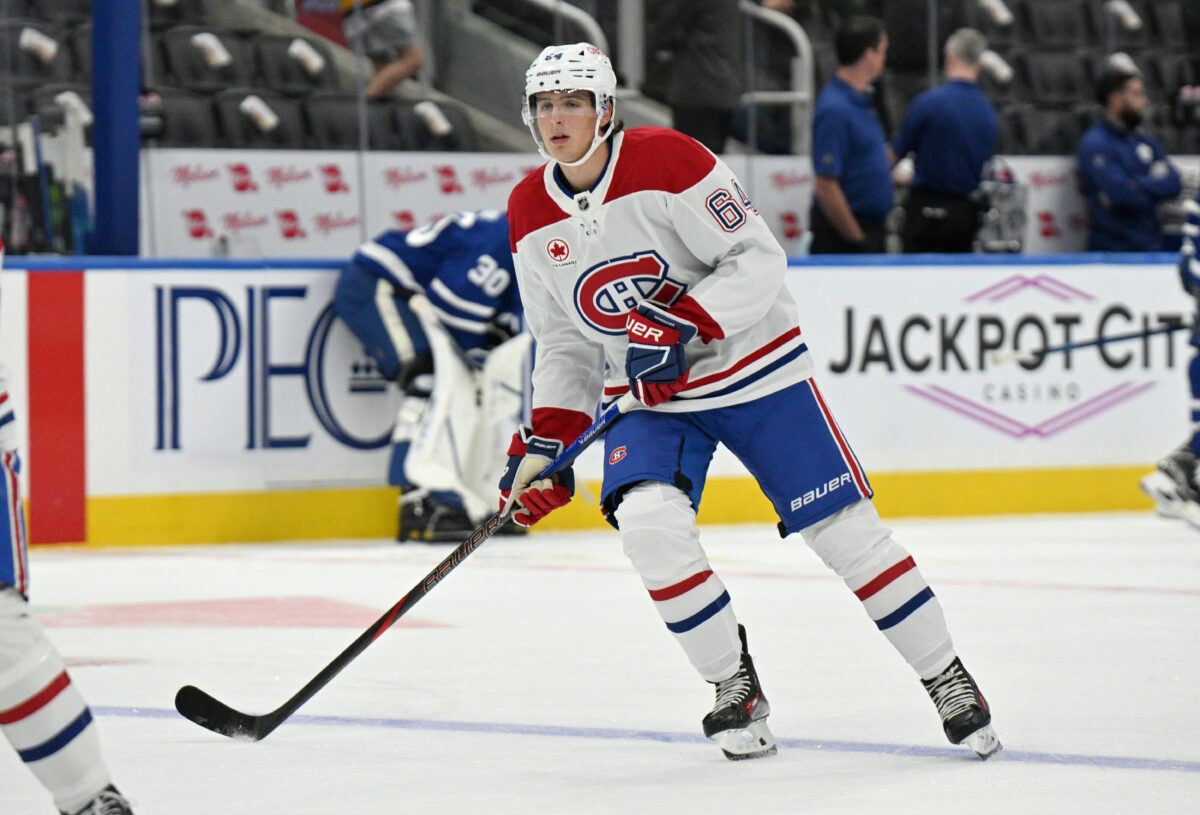
But his progress since returning has been meaningful. Since recovering, Reinbacher has been consistently available and has made tangible strides in his defensive impact, finding ways to compensate for some skating inefficiencies and is primed for an NHL call-up. He finished the regular season with five goals and 24 points in 57 appearances before being recalled by Montreal in April.
Those numbers aren’t flashy, and they aren’t meant to be. Reinbacher was drafted for his defensive awareness, his poise under pressure, and his ability to play reliable, structured minutes against quality competition, the exact qualities the Canadiens are currently missing from their third defensive pairing when the series gets physical and tight.
He has spoken about how meaningful every game is at this stage of his career, describing the AHL playoff environment as a critical proving ground and noting that he feels ready to compete and grow. That self-awareness, for a 21-year-old who has endured two serious injuries in two seasons, is genuinely encouraging.
Canadiens Must Continue to Show Patience
Watching the Canadiens get outworked in their own zone by the Hurricanes’ forecheck makes it tempting to demand an immediate fix. But the organization has been right to exercise restraint with Reinbacher, and that shouldn’t change now. Development is rarely linear for defensemen, and for a player whose game relies on anticipation, structure, and timing rather than raw tools, it will take longer to translate those tools to the professional level.
Another full season in Laval in 2026–27, where he takes on top-pairing minutes, kills penalties, and faces the AHL’s toughest competition, is still the wisest path. The foundation of Montreal’s defensive group is clearly in place, and if the young pieces continue to grow and add consistency, the Habs’ blue line could soon become one of the team’s biggest long-term strengths. Reinbacher is a part of that ceiling, not the floor.
Montreal’s Missing Piece Is Coming
This Eastern Conference Final will leave a mark on this organization, and it should. The Hurricanes have shown the Canadiens exactly what a complete, defensively dominant team looks like, and the gap between the two clubs on the back end is real. But the Canadiens are also closer to closing that gap than the series score suggests.
With the core locked in on long-term deals and a wave of young defensive talent still developing, this is a blue line that could be among the best in the league for years to come, provided the final pieces slot into place at the right time.
Reinbacher is one of those pieces. He is not the finished product. He is the project. If the Canadiens manage his development with the same patience and discipline they’ve shown throughout this rebuild, the player who eventually steps into a regular NHL role could be exactly what tips the scales into becoming a genuine Stanley Cup threat.
Free Newsletter
Get Montreal Canadiens coverage delivered to your inbox
In-depth analysis, breaking news, and insider takes - free.
Subscribe Free →