- The Trade That Closed the Door to the Maple Leafs Drafting Luongo
- The Maple Leafs Goalie Carousel That Followed
- Could Luongo Have Changed Toronto’s Playoff Story?
- In Toronto, Luongo Became a Franchise Icon That Never Was
- The Counterfactual Maple Leafs Questions That Haven’t Been Asked
- The Bigger Lesson for Toronto
In hockey, it’s often the moves you don’t make that come back to haunt you. For the Toronto Maple Leafs, one of those sliding-door moments came at the 1997 NHL Draft. Sitting there at fourth overall was Roberto Luongo—a future Hall-of-Fame, a gold medalist, a workhorse who would go on to play over 1,000 NHL games. But instead of taking him, the Maple Leafs had already traded that pick away.
Related: How the Marner–Babcock Incident Sparked a Culture Shift in Hockey
It’s easy to look back now and imagine how things might have been different. So let’s do it: what if the Maple Leafs had held onto that pick and drafted Luongo?
The Trade That Closed the Door to the Maple Leafs Drafting Luongo
In March 1996, Toronto made a “win-now” move. They sent their 1997 first-round pick, along with Kenny Jonsson, Sean Haggerty, and Darby Hendrickson, to the New York Islanders. Coming back were Wendel Clark, Mathieu Schneider, and D.J. Smith. For fans, Clark’s return was emotional—he was a beloved face of the franchise. But in hindsight, it was a short-term splash that cost the team something much bigger.

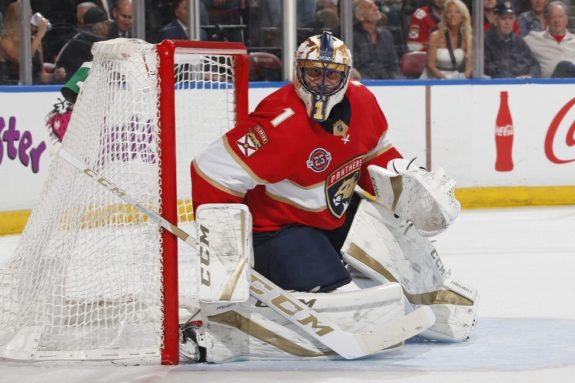
New York used that fourth overall pick to draft Luongo. The Islanders didn’t even keep him long, shipping him to the Florida Panthers after just 24 games. Meanwhile, in Toronto, the long search for a true franchise goalie dragged on.
The Maple Leafs Goalie Carousel That Followed
Think about the Maple Leafs’ crease in the 2000s. After Curtis Joseph left in 2002, it was a revolving door: Ed Belfour, Vesa Toskala, Andrew Raycroft, James Reimer, Jonathan Bernier—you know the list. Each one carried hope for a season or two, but none proved to be the long-term answer.
Related: Maple Leafs Front Office Slammed in Latest NHL Rankings
Now imagine an alternate timeline: Felix Potvin to Joseph to Luongo, spanning nearly two decades. No patchwork solutions. No desperate trades. Just stability in the net. For a franchise that has spent half its modern history searching for “the guy,” that stability alone might have reshaped the team’s postseason story.
Could Luongo Have Changed Toronto’s Playoff Story?
The most tantalizing part is thinking about the playoffs. The 2002 Maple Leafs reached the Eastern Conference Final and came within a step of the Stanley Cup Final. A goalie like Luongo—already stealing games for a weak Florida team—might have been the difference.
And what about the infamous 2013 collapse in Boston? A 4-1 third-period lead vanished in Game 7, one of the lowest points in Maple Leafs history. It’s easy to imagine a veteran Luongo, calm under pressure, shutting the door. Even if one of those turning points had gone differently, it could have shifted the franchise’s entire narrative.
In Toronto, Luongo Became a Franchise Icon That Never Was
Luongo wasn’t just a great goalie. He was durable, charismatic, and respected. Fans in Toronto would’ve embraced his personality—his humour, his leadership—as much as his saves. Instead, they watched him become the face of the Vancouver Canucks and a hero in Florida, while the Maple Leafs kept scrambling for short-term answers.
Related: 3 Way-Too-Early Maple Leafs Predictions for the 2025-26 Season
If he’d been in Toronto, Luongo would’ve been remembered as one of the great Maple Leafs of all time. His jersey might even hang in the rafters at Scotiabank Arena.
The Counterfactual Maple Leafs Questions That Haven’t Been Asked
Of course, it’s never that simple. Would Luongo have developed the same way under the microscope in Toronto? Would weak defensive teams in front of him have worn him down? And even with elite goaltending, could the Maple Leafs’ lack of depth in the 2000s still have held them back? Those are fair questions. Hockey isn’t just about one player.

Still, the fit makes too much sense. The Maple Leafs needed goaltending. Luongo became one of the best of his generation. And that pick was theirs to keep—until it wasn’t.
The Bigger Lesson for Toronto
This isn’t just a fun “what-if.” It says something about how Toronto operated for years: chasing quick fixes instead of building patiently. Trading a first-rounder for the emotional jolt of Wendel Clark was classic Maple Leafs thinking at the time. Later, the same mindset was evident in the Tuukka Rask trade to the Boston Bruins (by the way, the same team where they moved Fraser Minten last season).
Related: How the Dubas vs. Lamoriello Decision Shaped the Maple Leafs
Today, under general manager Brad Treliving, the team faces similar questions about whether to hold onto prospects or swing big on short-term bets. Looking back at Luongo reminds us: sometimes the more brilliant play is to think long-term, even if it means passing on a nostalgic reunion or a flashy headline.
Because in hockey, holding onto tomorrow can be a lot more valuable than chasing yesterday.
[Note: I’d like to thank Brent Bradford (PhD) for his help co-authoring this post. His profile can be found at www.linkedin.com/in/brent-bradford-phd-3a10022a9]

Free Newsletter
Get Toronto Maple Leafs coverage delivered to your inbox
In-depth analysis, breaking news, and insider takes - free.
Subscribe Free →