The Pittsburgh Penguins made a clear statement about their direction by acquiring Yegor Chinakhov from the Columbus Blue Jackets. In exchange, Columbus receives a 2026 second-round pick, a 2027 third-round pick, and forward Danton Heinen.
On the surface, it’s a futures-heavy price for a player who hasn’t yet fully broken out. But for the Penguins, this is about something far more important than raw production: adding controllable skill, speed, and offensive upside to a forward group that has grown increasingly rigid and predictable.
Why Pittsburgh Targeted Chinakhov
Chinakhov is not a finished product, and that’s exactly why Pittsburgh was willing to pay. The 24-year-old winger has already shown flashes of top-six ability in Columbus, combining a dangerous release with a willingness to attack off the rush. He’s a natural shooter, something the Penguins’ lineup has quietly lacked outside of their elite core.
Pittsburgh has leaned heavily on structure, experience, and safe decisions over the past few seasons. That approach has kept them competitive, but it’s also led to diminishing returns at five-on-five. Chinakhov brings a different element — unpredictability. He doesn’t need a perfectly drawn-up play to create offense. He can generate chances through pace, individual skill, and quick-trigger shooting, particularly from the left side.
For a team that too often defaults to perimeter puck movement and low-danger shots, that alone makes him intriguing.
Where Chinakhov Fits in the Penguins’ Lineup
The most natural landing spot for Chinakhov is in the middle six, where Pittsburgh has cycled through veterans without finding a long-term answer. Early on, he could slot alongside Evgeni Malkin, giving the Penguins a winger who can keep up with Malkin’s creativity while providing a shoot-first mentality.
That combination makes sense on multiple levels. Malkin still draws defensive attention, and Chinakhov’s quick release could punish teams that collapse too aggressively. It also allows Pittsburgh to reduce the offensive burden on more defensive-minded wingers who have been asked to play above their ideal roles.
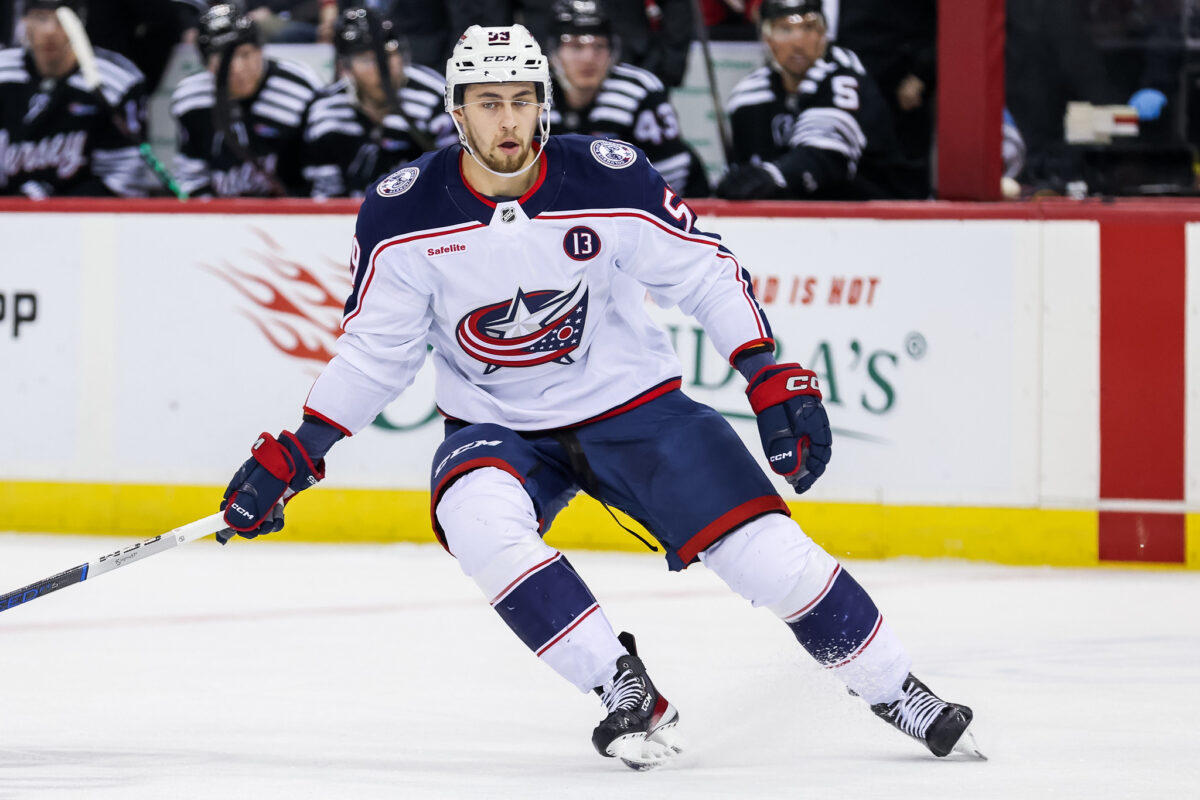
Another possibility is easing Chinakhov into a sheltered third-line role with offensive-zone starts, allowing him to grow without being overwhelmed. That flexibility matters, especially on a roster that includes a mix of aging stars and unproven younger forwards.
What’s clear is that Chinakhov isn’t being acquired to play a purely checking role. Pittsburgh sees him as a potential top-six solution — not immediately guaranteed, but very much in play.
What the Penguins Gave Up — And Why It Makes Sense
From Columbus’ perspective, the return is understandable. A second- and third-round pick gives the Blue Jackets valuable draft capital, while Heinen provides a reliable, defensively responsible forward who can stabilize a lineup.
For Pittsburgh, though, Heinen was expendable. He did exactly what was asked of him, but his ceiling was well-defined. He wasn’t going to meaningfully change the Penguins’ offensive profile, and his role could be replaced internally or through cheaper options.
The draft picks sting more, but this is where Pittsburgh’s current reality matters. With a win-now core built around Sidney Crosby, draft capital has less immediate value than NHL-ready talent with upside. Chinakhov fits that window far better than a future second-rounder who may or may not impact the roster years down the line.
How This Changes the Forward Group
One of the biggest takeaways from this trade is what it signals about the Penguins’ internal evaluations. The organization clearly recognizes that simply reshuffling veterans isn’t enough. They need players who can tilt the ice with speed and skill.
Related: 3 Penguins Players Who Could Be Traded — and What Their Market Looks Like
Chinakhov immediately adds competition to a forward group that includes players like Rickard Rakell, Bryan Rust, and Anthony Mantha. That competition is healthy — and necessary. It creates internal pressure, raises the standard for top-six minutes, and gives the coaching staff more options when lines go cold.
It also allows Pittsburgh to better balance their lines. Instead of loading all offensive creativity onto one unit, Chinakhov’s presence helps spread scoring threats throughout the lineup, making matchups harder for opposing coaches.
Long-Term Implications for the Penguins
This trade does more than just change the lineup; it shows Pittsburgh’s plan to bet on players who will improve with their core group, instead of just getting older with them. Chinakhov is young enough to be part of the Penguins’ change, but he can help the team now.
If he plays well, Pittsburgh could have a cheap forward who can score in a top role. That would be great since they don’t have much money to spend. If he doesn’t become a star, it’s not a huge loss, especially compared to the risk of not making any changes and getting worse on offense.
It also says something to the team. The Penguins aren’t okay with small changes. They will trade draft picks and familiar players to bring some new skills and excitement to the team.
Final Thoughts
This trade isn’t a headline-stealing blockbuster, but it may prove to be one of Pittsburgh’s more important moves in recent seasons. Chinakhov represents a calculated gamble — one rooted in upside, speed, and offensive creativity.
For a Penguins team trying to find solutions outside of its star players, this gamble makes sense. Chinakhov won’t solve all the problems right away, but he gives Pittsburgh a real opportunity to get better on offense without making drastic changes.
And for a franchise still chasing relevance in a fiercely competitive Eastern Conference, that’s a risk worth taking.
