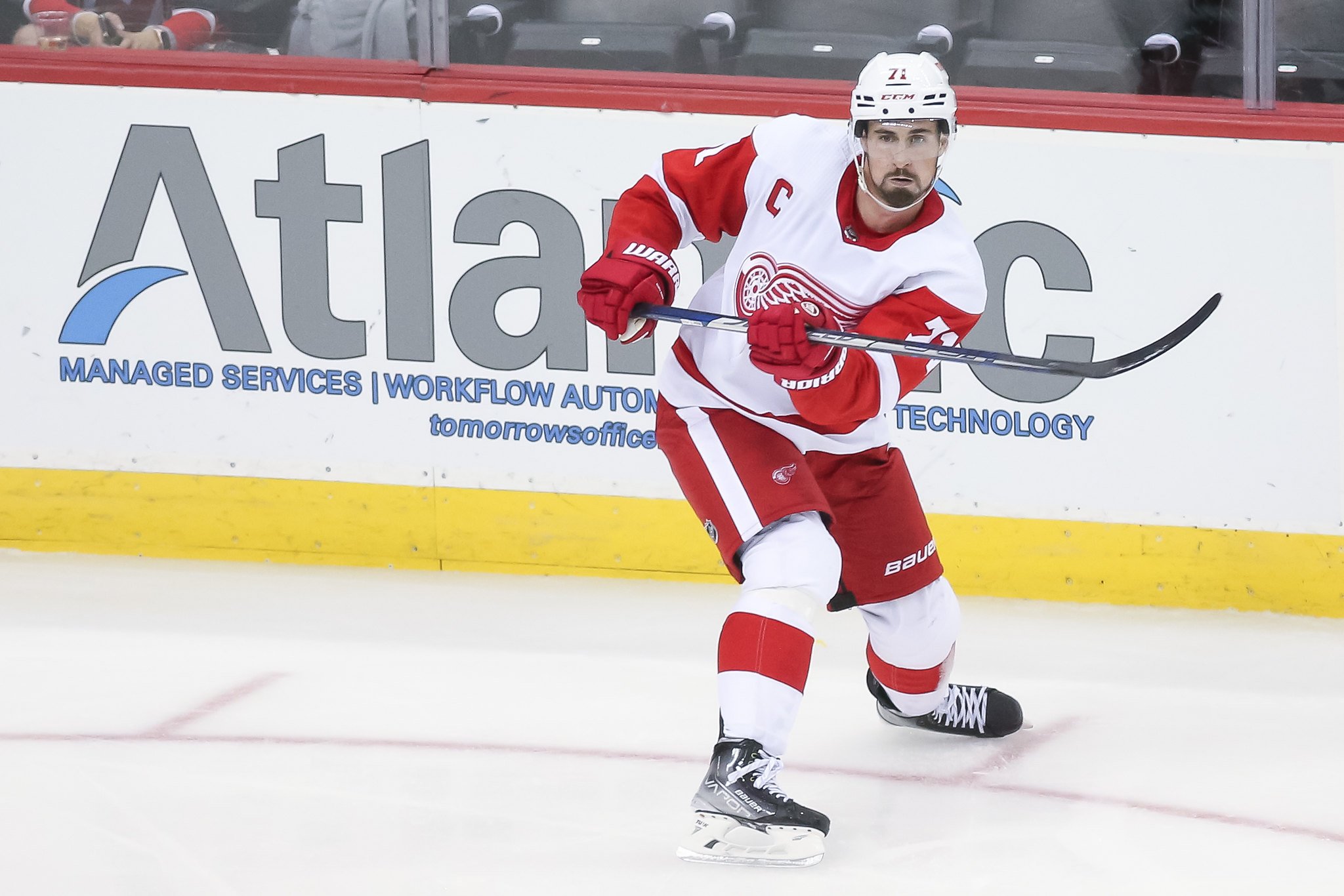
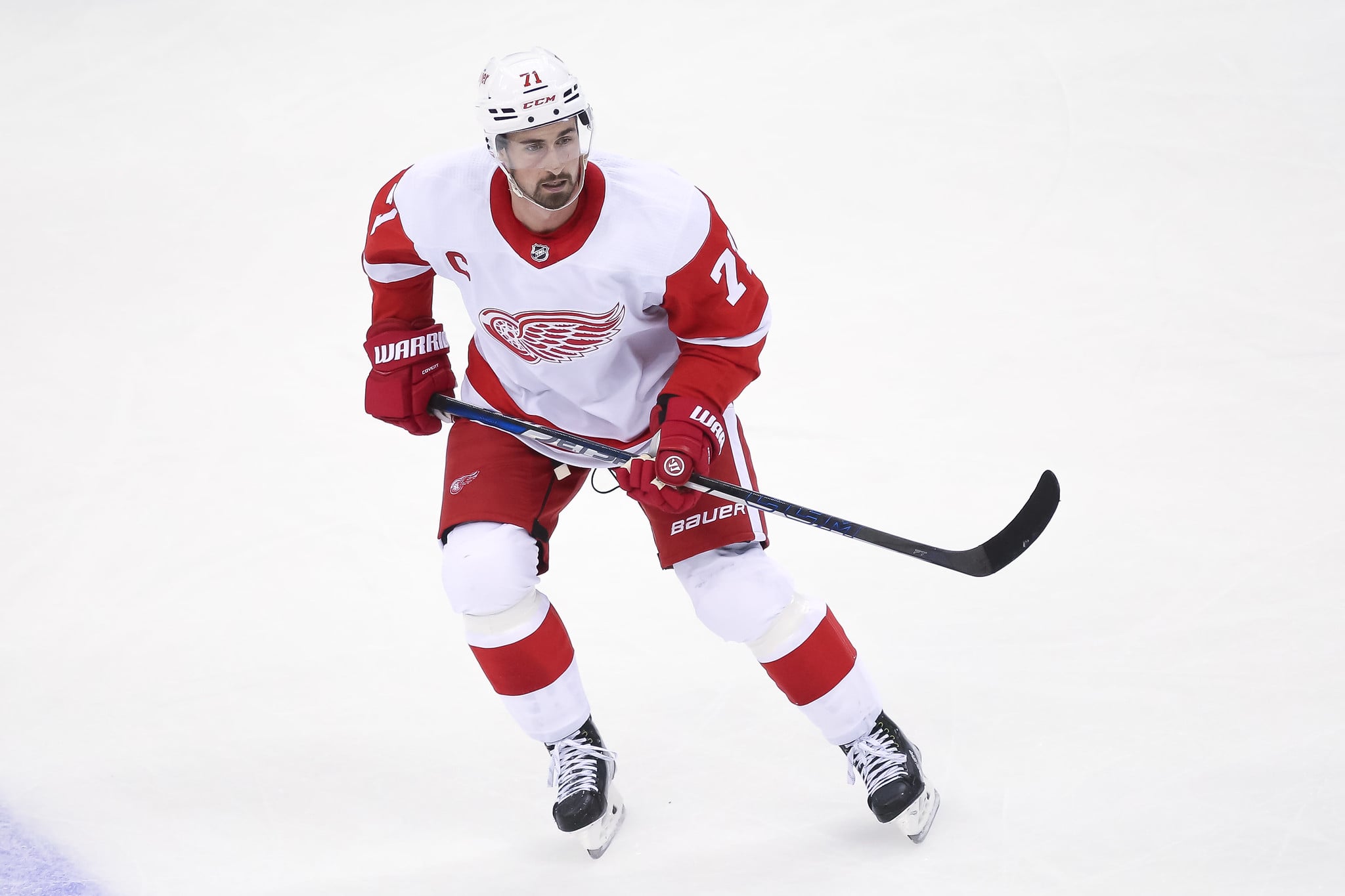
Most of the debate around Dylan Larkin has centered on his trade list, his suspension, and the teams that can’t get to the table. His contract has drawn far less attention, and it may be the strongest advantage the Detroit Red Wings have left.
The most expensive years of Larkin’s contract are already behind him. Detroit has already paid nearly half of the money, and whichever team lands the 30-year-old center will be buying the cheaper end of the deal.
How Dylan Larkin’s Contract Was Built
Steve Yzerman signed Larkin to an 8-year, $69.6 million extension on March 1, 2023. It carries an $8.7 million cap hit, which is simply the average annual value and counts the same against the cap every season. The actual salary, however, was never spread evenly across the term.

According to CapWages, the deal paid Larkin a base salary of $10 million in 2023-24, $11 million in 2024-25, and $10 million in 2025-26. That adds up to $31 million in the first three seasons alone, or nearly 45 percent of the total value.
The numbers drop from there. He is set to earn $8 million in each of the next three seasons, then $7.5 million in 2029-30 and $7.1 million in the final year. Detroit front-loaded the deal while Larkin was still its captain and the face of the rebuild.
What Larkin’s Next Team Would Actually Pay
That structure changes the math for any team on the other end of a trade. Counting all of this season, the remaining salary comes to about $38.6 million over five years. The cap charges over that same stretch add up to $43.5 million.
In other words, an acquiring team would pay roughly $4.9 million less in real money than the cap says it is spending. His actual salary sits below his cap hit in every remaining season, and the gap widens in the final two years.
For clubs that operate on an internal budget, that matters. Ownership groups often look at cash as closely as the cap, and a contract that gets cheaper as it ages is easier to approve than one that peaks late.
It also fits what Detroit wants. Interim general manager Shawn Horcoff has said he prefers NHL-ready players in return, according to MLive’s Ansar Khan (from ‘Red Wings remove Dylan Larkin banner from outside of LCA,’ MLive, Nov. 5, 2026). A buyer getting a proven center on declining salary has less reason to argue that the price is too high.
The Suspension Is Costing Larkin Real Money
The same structure explains what the standoff is costing Larkin. His $8 million salary this season works out to $41,237.11 for every day he is suspended, according to TSN’s Nov. 4 report.
Khan noted that, based on a fan-run tracking site, Larkin had already given up more than $320,000 as of Nov. 5. That figure will keep climbing until a trade is made, and it is the financial side of the leverage we described when we wrote that Detroit has one card left to play.
Not every insider expected the list to hold this long. Sportsnet’s Elliotte Friedman said on the latest 32 Thoughts podcast that “I was a little bit surprised to hear that Larkin hadn’t changed his list.” For now, it hasn’t.
Why the Contract Helps Detroit Hold Its Price
Horcoff hasn’t shown any sign of lowering his demands. “I’m prepared to wait as long as it takes to make sure that the return is something good for the Red Wings,” he said in comments Khan cited. TSN’s Darren Dreger added that the club keeps “looking for the perfect package.”
The contract gives Detroit a fair argument for that patience. Larkin isn’t a player on an inflated deal that a team needs a sweetener to absorb. He produced 67 points, including 34 goals, across 74 games last season, and the cash left on his contract is lower than his cap hit suggests.
That doesn’t mean the Red Wings should treat his salary as an afterthought. Moving it would free money for other priorities, including long-term pieces like Moritz Seider, whose deal carries an $8.55 million cap hit until 2030-31. Detroit can afford to be selective because Larkin’s deal isn’t a burden it needs to shed.
The Limits of Larkin’s Cash Advantage
There is a catch, and it is a big one. The cap doesn’t care how much of the money has already been paid. Every team still has to fit $8.7 million under its ceiling, which is why so few clubs on Larkin’s list can make a deal work without sending salary back, a problem we laid out in our breakdown of his 10-team list and its fits.
Age is the other concern. The deal runs through his age-34 season, and his full no-trade clause runs through 2027-28 before changing to a modified clause for the final three years, according to CapWages. A buyer is betting that he stays a top-six center for most of that stretch.
The protection has already shaped this saga. Larkin started with a short list and moved to 10 teams in October, a change ESPN reported on Oct. 20. Each team that joins it gets access to a center whose most expensive years are already paid for.
What It Means for the Larkin Market
None of this will break the standoff by itself. The list and the cap still decide where Larkin can go. But when Horcoff sits down with any of the clubs he is allowed to talk to, the contract gives him a strong point to make: the hardest part of the bill is already covered. The same pitch would land even harder with teams outside the list, like the Buffalo Sabres, whose push was blocked by the trade list.
The Red Wings paid for the most expensive years of Larkin’s deal in advance. Whoever gets him next will pay less for the years that remain, and Detroit has every reason to make sure that value shows up in the return.
Free Newsletter
Get Detroit Red Wings coverage delivered to your inbox
In-depth analysis, breaking news, and insider takes - free.
Subscribe Free →