In Game 1 of the Western Conference Final, the Dallas Stars looked outmatched against the Edmonton Oilers through two periods. The Oilers held a 3-1 lead with 20 minutes left to play. They were being led by exactly who you would think, Leon Draisaitl, who had a goal and two assists, Connor McDavid, who had two assists and Ryan Nugent-Hopkins, who had a goal and an assist. However, the Stars stormed back and scored five goals in the third period, one being an empty-netter, to close out a Game 1 victory on home ice.
Related: Stars Score 5 Goals in the Third, Defeat Oilers 6-3 in Game 1
This Stars’ third-period comeback can be attributed to something you’ll see talked about at least once on every hockey broadcast, likely more, and at least once per between-period interview with a coach or player. The Stars’ first goal was scored on a breakaway, but after that, the following four goals were all scored with at least one green jersey right on top of Oilers goalie Stuart Skinner, who came into this series having back-to-back shutouts.
Stars Create Havoc in Front of the Oilers’ Net in 3rd Period Comeback
Players, coaches, commentators, or analysts will talk about getting to the front of the net or taking away the goalie’s eyes. There are several different ways it can be said. Still, it is something you hear constantly in every interview, to the point where people crack jokes about hockey players being stale and lacking personality because they all say the same thing repeatedly. But some don’t realize hockey is that simple; you make the game hard on the goalie, and funnel pucks to the net, and it becomes much easier to score.
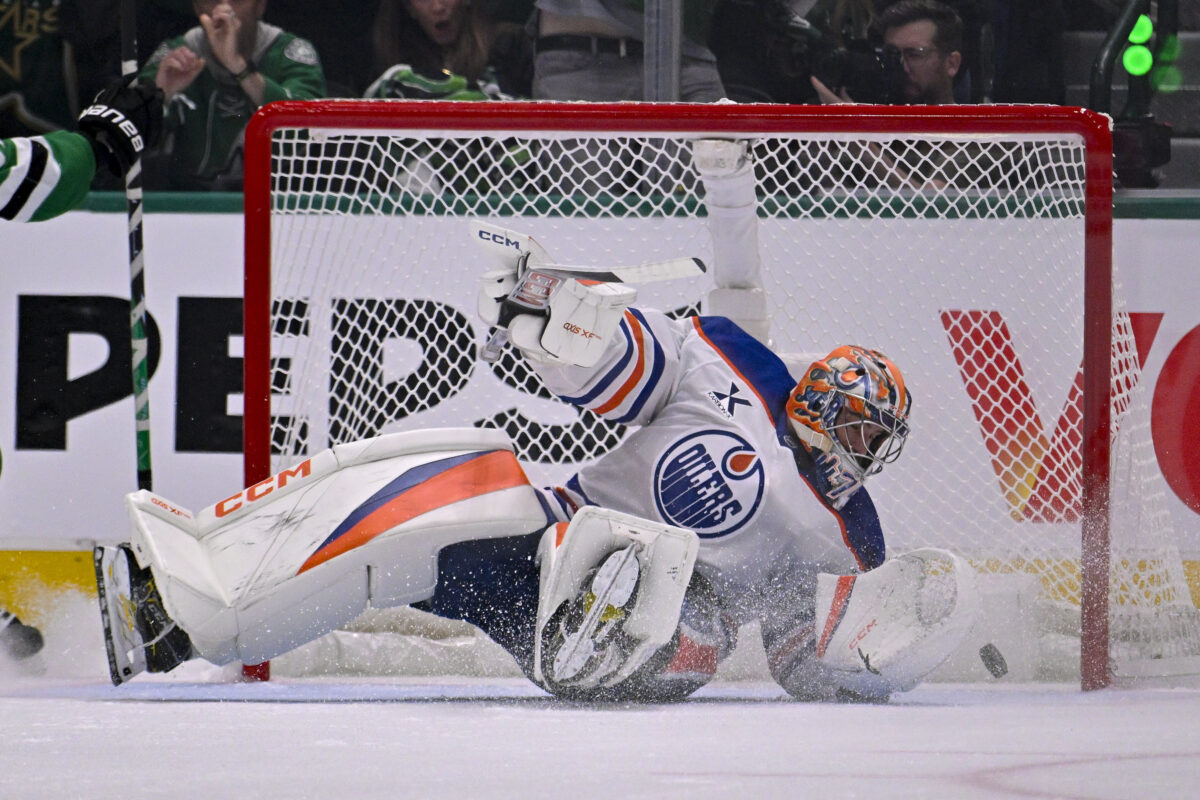
The prime example was the Stars’ second goal, which Miro Heiskanen scored from the point on the power play. It was just a seeing-eye shot that went past numerous bodies, and Skinner did not see it until he pulled it out of his net. While it passed some Oilers on the way to the net, 6-foot-5 Mason Marchment was camped right in front of Skinner, providing most of the screen, forcing Skinner to the middle of the net to open up the left corner that Heiskanen hit.
Another example of this came on the Stars’ third goal, and the timing of Mikael Granlund‘s shot to fully utilize a screen from Jason Robertson. On this goal, Granlund had the puck in the right circle in the Oilers’ zone on the power play. He saw Robertson gliding across the front of the crease creating a flash screen, and as soon as Granlund saw Robertson cross Skinner’s line of sight, he fired a wrist shot, and by the time Skinner could pick up the shot, it was already going up over his shoulder into the top right corner.
As a goalie, being scored on twice in four minutes on shots you didn’t see has to be frustrating, and you saw a little bit of this come out from Skinner when the Stars scored their fourth goal of the game to take the lead.
While this goal did not come off a screen, there was a mad scramble in front of the Oilers’ net after a shot went off the side of the net and popped out on the other side to Matt Duchene after hitting the end wall. As the puck went off the end wall, Troy Stetcher fell in front of the net and knocked Roope Hintz down, just to the left of the crease. That forced Nugent-Hopkins to cut through Skinner’s crease to try and get to Duchene, who ended up getting two whacks at the puck, burying on the second.
You could tell Skinner was tired of dealing with the pressure in front of his net. As soon as the puck went in, Skinner looked back at the refs bargaining for a goalie interference call, even though the only players in the crease were from his team. This was the third goal in a row the Stars scored that Skinner didn’t have a chance of saving, so his frustration was justified, but it just showed that the pressure the Stars were sending to the net was getting to him.
The nail in the coffin came when the Stars took a two-goal lead with four minutes left to play on a different example of how to put pressure on a goalie. It started with Tyler Seguin finding a loose puck in the neutral zone. He handed it off to Sam Steel, and the two got through the neutral zone with speed.
Instead of looking for the perfect one-timer on the two-on-one rush, Seguin went hard to the net, while Steel shovelled a backhand shot on Skinner. Steel put the shot off Skinner’s shoulder, making it nearly impossible for him not to give up a rebound, and as soon as Seguin saw the puck bounce off him, he tipped it home out of mid-air.
Of the five goals the Stars scored on Skinner in Game 1, only two were graded as high-danger chances (via Natural Stat Trick). However, Skinner did not stand a chance of stopping four of the five goals the Stars scored on Wednesday, and that does not include Seguin’s breakaway goal to open the game.
While hockey players and analysts may sound like broken records when discussing the need to create traffic in front of the net, it is one of the biggest keys to the game because it creates goals that should not go in consistently. It is also emphasized even more in the Stanley Cup Playoffs, as players do not have the time and space to consistently make the flashy plays to create traditional high-danger scoring chances. We will see if the Stars can carry this game plan into Game 2 on Friday night or if the Oilers can do a better job clearing the front of the net for their goalie.
