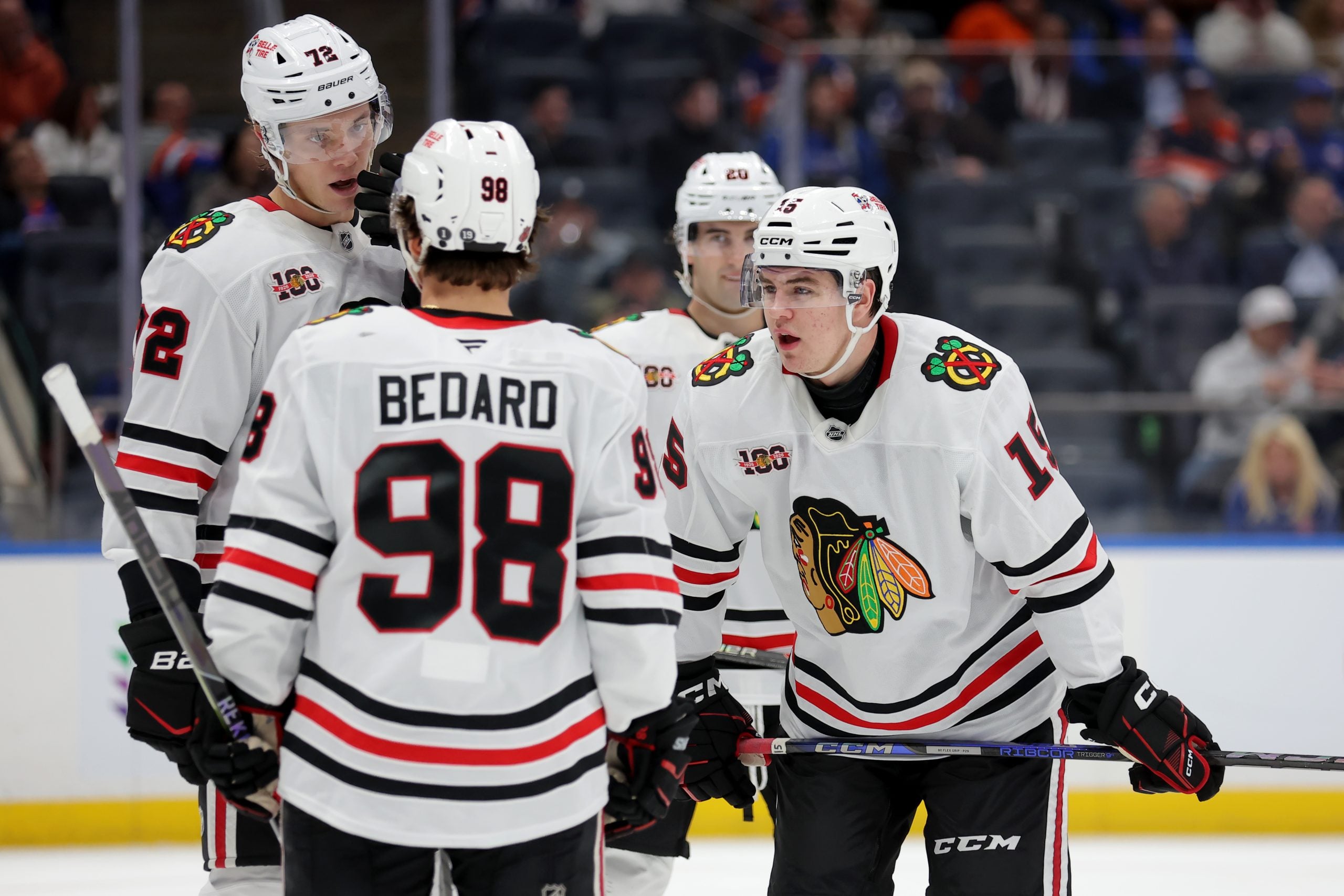
When the Carolina Hurricanes won the 2026 Stanley Cup, goalie Brandon Bussi became just the latest first-year goalie to emerge as a playoff hero and make history in the process. It’s important to make the distinction of “first-year” vs. rookie though, because, at Age 27, Bussi was no longer eligible to win the Calder Memorial Trophy, with players required to be 26 or younger on Sep. 15 of the season in question.
Regardless, Bussi, who had never played an NHL game prior to the preceding regular season and got claimed off waivers at its very start, came through in a big way to relieve No. 1 Frederik Andersen in the Stanley Cup Final against the Vegas Golden Knights. In four appearances, the undrafted goalie went 3-0-1 with a 1.60 goals-against average and .931 save percentage.
While it’s an undeniable great story, it’s hardly unprecedented or entirely unforeseen, as playoff opponents don’t get the chance to to read the whole book on rookie goalies. That’s obviously also true in Bussi’s case, but he proved during the regular season he had what it takes to win consistently, as the fastest goalie in NHL history to reach 10 victories, going 31-6-2 overall with a 2.44 GAA and .895 SV%.
What does he have in store for an encore? Keep in mind, going back to Montreal Canadiens-great Ken Dryden, who actually won the Stanley Cup in 1971 before winning the Calder the next season, five other goalies up to now have notably followed in his footsteps to take the league by storm in the spring before establishing themselves as NHL mainstays. Here they are:
5. Jordan Binnington – St. Louis Blues (2019)
In a way, St. Louis Blues goalie Jordan Binnington is a horrible example, based on how far he’s fallen since he helped lead his team to the 2019 Stanley Cup as a veteran of a single NHL appearance up until that point. The third-round 2011 draft pick got his first career start in early January of that season, when a few days earlier the team had literally been in last place in the league. He proceeded to compile a 30-24-6 record that season with an elite 1.89 goals-against average (GAA) and .927 save percentage (SV%), before going 16-10 with a 2.46 GAA and .914 SV% that postseason.

Binnington’s 12-19-6 record in 2025-26, with a 3.33 GAA and .873 SV% this season, may run counter to his reputation as a big-game goalie. However, his numbers have for all intents and purposes ticked lower and lower with each passing season since that championship-winning campaign. Ironically, the now-35-year-old ex-Blues goalie whose job he “stole,” Jake Allen, who was actually traded to the Canadiens, has enjoyed something of a career resurgence currently with the New Jersey Devils. Decline has hit Binnington, who’s a few years younger, significantly harder, if it’s decline at all.
If it isn’t and Binnington simply rode a wave of beginner’s luck to initial success and subsequent stardom, so be it. That actually makes him more of a textbook example of how any unknown goalie can capture lightning in a bottle to win the Cup.
4. Matt Murray – Pittsburgh Penguins (2016)
One-time Pittsburgh Penguins goalie Matt Murray is the only entry on this list without some connection to the Canadiens. So, Habs fans may not have as much intimate knowledge of him or how he, as a fellow third-round pick (2012), was a hugely hyped prospect once upon a time. So, unlike Binnington, he was projected as having Stanley Cup potential. Few could have predicted he would reach that potential so quickly after first making the NHL, parlaying 13 appearances in 2015-16 into the starter’s job that championship postseason, as he overtook Marc-Andre Fleury as the team’s No. 1.
The two technically split goaltending duties the following season to win a second consecutive Cup. However, it was clear who the “guy” was in management’s eyes, as the Penguins made Fleury available in the ensuing 2017 NHL Expansion Draft before he got claimed by the Vegas Golden Knights.
Again, similar to with Binnington, Murray ironically went on to “enjoy” less success than the man he usurped for the starter’s job, though. He last saw a playoff start in 2020, when he and the Penguins got upset by the Canadiens in the qualifying round after the pandemic-shortened regular season.
That seemed to be the straw that broke the camel’s back. The Penguins soon thereafter traded the restricted free agent to the Ottawa Senators while moving on to Tristan Jarry. He’s been unable to find a lasting home since, bouncing between the NHL and American Hockey League for the last couple of seasons.
Apparently there was a Canadiens connection after all.
3. Antti Niemi – Chicago Blackhawks (2010)
It doesn’t seem that long ago that the Canadiens claimed Antti Niemi off waivers from the Florida Panthers. In reality, it was back in November 2017, when the Habs, fresh off a division win but disappointing first-round upset at the hands of the New York Rangers the previous spring, failed to make the playoffs. It would still be three seasons before then-general manager Marc Bergevin managed to construct a team that would go on to reach the Stanley Cup Final in 2021.
Consistent year-over-year success remained elusive for Bergevin, though. It wasn’t until after he got fired the following season in the throes of an eventual last-place campaign, following nearly 10 years on the job, that the Habs started enjoying semblances of lasting success as a result of a full-scale rebuild.
Oddly enough, Bergevin had initially gotten hired back in 2012 after a stint in the Chicago Blackhawks’ front office. As their director of player personnel, the Hawks won the 2010 Cup, primarily backstopped by none other than Niemi. That regular season, Niemi, who had just three NHL appearances under his belt in what had officially been his rookie season in 2008-09, earned the starting job over ex-Hab Cristobal Huet. Niemi went 26-7-4 with a 2.25 GAA and .912 SV%. In the playoffs, he was just as impressive: 16-6 with a 2.63 GAA and .910 SV%.
Niemi became one of the Blackhawks dynasty’s first cap casualties. His departure that offseason paved the way for Corey Crawford to become their new starter en route to two additional Cups over the next half-decade. For his part, Niemi may not have won it all again, but he played a respectable nine more seasons, with six total teams, the Canadiens representing his last stop in the NHL.
2. Cam Ward – Carolina Hurricanes (2006)
Canadiens fans remember Cam Ward’s postseason debut all too well (and for the worse). The Habs faced the Canes in the first round in 2006 as massive underdogs but took the first two games on the road, with Martin Gerber starting both games. In Game 2, Ward replaced Gerber after the former had allowed three goals in the first period. Ward took the eventual 6-5 overtime loss but won the next four as they reverse-swept the Habs en route to a Cup.
That Cup run was as good as it got for the then-rookie, though. The Canes only made the postseason once more during his tenure, which ended in 2018. He’d play another season with the Blackhawks, with whom he signed as an unrestricted free agent.
Ward’s departure actually coincided with the start of a run of seven straight playoff finishes for Carolina, which persists to this day. Take from that what you will. A first-round pick in 2002, there are legitimate cases that he both had a disappointing career and was nevertheless worth the draft capital based on the bang with which his career started. Wouldn’t you consider drafting a goalie a success if he won even a single Cup?
1. Patrick Roy – Montreal Canadiens (1986)
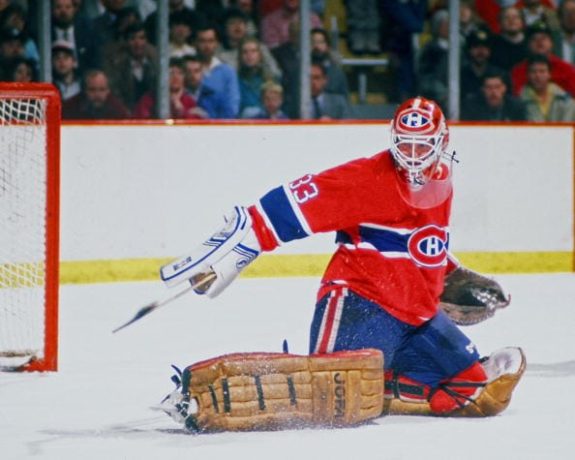
Four-time Cup-champion Patrick Roy makes this list effectively as an exception and for the sake of thoroughness. When he won the Cup as a rookie in 1985-86 (having made a single relief appearance the previous season), he didn’t exactly come out of nowhere. He led all Canadiens goalies in appearances with 47, having effectively established himself as a starter before the postseason.
That fact shouldn’t diminish the accomplishment, but it’s admittedly more in line with Dobes’ career trajectory so far instead of Fowler’s. The takeaway? It shouldn’t matter which Canadiens goalie takes the crease first this postseason. In fact, if this list is anything to go by, several examples on it show it matters more which goalie takes the crease last and, if it comes to having to make a change, the Habs should be comfortable with either, with the former admittedly having built up a stronger resume so far, especially as of late.
It’s all too easy to get caught up in the lore, with Roy’s first career start representing a road win over the Penguins, just like Dryden before him and Carey Price after him. Fowler having accomplished the same feat may make him the sentimental favourite to go the distance this season, but the Canadiens are going to go with the goalie who gives them the best chance.
It’s worth noting the Canadiens are still far from contenders officially speaking. So, this may all be a moot point, but, by the same token, none of the Stanley Cup-winning teams on this list were clear-cut favourites to win it all in the seasons in question. When you’re forced to go with a rookie goalie in the playoffs, it’s not like you’ve necessarily had the chance to shore up your entire roster. So, questions still remain for these Habs like they did for each team above.
“Who will start come the playoffs?” shouldn’t even be a top priority, truth be told. However, the reason is becoming more and more because, whoever it ends up being, the Canadiens shouldn’t need to worry.
Free Newsletter
Get NHL Goaltending coverage delivered to your inbox
In-depth analysis, breaking news, and insider takes - free.
Subscribe Free →