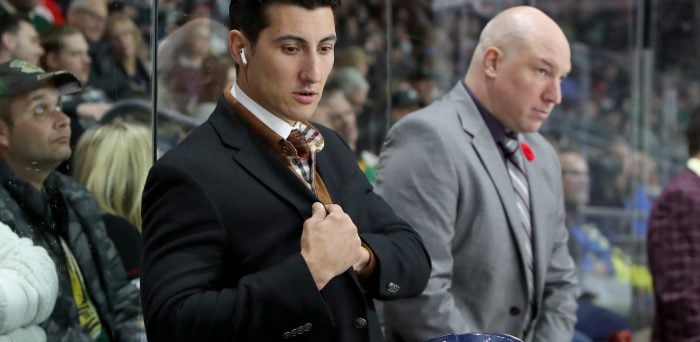
“I look up to Hershey” or “I want this team to be like Hershey” is a common line at the postgame pressers from Lehigh Valley Phantoms head coach Ian Laperriere, not just in this series against the Hershey Bears but since he’s taken over as the head coach. He looks at the Bears and sees a well-coached team and the standard in the American Hockey League (AHL), winning the Calder Cup in back-to-back seasons with Todd Nelson behind the bench. Laperriere is trying to build the Phantoms into that type of team.
It makes this series a defining moment for Laperriere, the Phantoms, and what is being built in Allentown. A young team that is developing into a great one is giving the Bears a tight series, one that can go either way as it heads towards a Game 5 on Sunday night. Yet, the Bears are not only sticking around but proving why they are the team to beat in the AHL.
The series shows a minimal gap between the Bears and Phantoms, with both teams taking two games and winning in multiple ways. The Phantoms have the players to pull off the upset, and it would shock the hockey world, but not those who’ve followed this team in the past month or even the past few weeks.
There is a gap between the two head coaches. It’s the minor details that separate Laperriere, a good AHL coach still looking to make his mark in the league, and Nelson, a great coach who has done just about all there is to do in the AHL, making many wonder why he isn’t in the NHL at this point.
Nelson’s Teams Don’t Take Penalties
A stat that stands out between these two teams is penalty minutes. The Bears were the least-penalized team in the Eastern Conference with only 775 penalty minutes. The Phantoms took 1,046 penalty minutes, the fifth-most in the AHL. The tendencies from the season have carried into the playoffs and this series in particular.
The Phantoms tried setting the tone in Game 1 by making this series one where fights would be common and physical play would stand out. “It’s an emotional time, we have to stay out of those scrums, and the refs said we’re going to start calling guys if this continues,” Nelson mentioned after the first game. Nelson kept his team in check, and it helped them control the game and get off to a hot start in the series.
“I’m done talking about penalties, it’s playoff hockey, let them play,” was Laperriere’s sentiment after Game 4, a contrast from Nelson’s but understandable after his team committed eight penalties. Two of those penalties resulted in goals for the Bears and gave them a 6-4 win. “I don’t expect them to call those at this time of year, but we should know better,” Laperriere added. The Phantoms entered Game 4 hoping things would change from the first game. The Bears knew they wouldn’t, and it allowed them to control the game from start to finish.
Great teams play disciplined hockey and take advantage of the other team’s mistakes. The Bears haven’t capitalized on the Phantoms’ penalties in this series, which explains why they lost Games 2 and 3, yet they’ve been the disciplined team all series. It’s why they have the upper hand when most of the four games could have gone either way.
Laperriere’s Teams Forecheck, Nelson’s Forechecks With Purpose
The Phantoms play a similar style to the Bears, where they are physical and want to set the tone with the forecheck. They’ll chip the puck into the offensive zone and look to create chaos. It prevents the other team from finding its footing and starting up their offense, and was the blueprint for the Phantoms upsetting the Wilkes-Barre/Scranton Penguins in a short two-game series.
Chaos is the key word for the Phantoms, since it’s how they forecheck and skate into the offensive zone. The contrast is the Bears and how they forecheck, as they do so with structure in mind. The Bears aim to create turnovers and immediately set up the offense, which they do. They can collect the puck in the offensive zone and find the open skaters and a quick shot on the net, a masterclass on turning defense into instant offense.
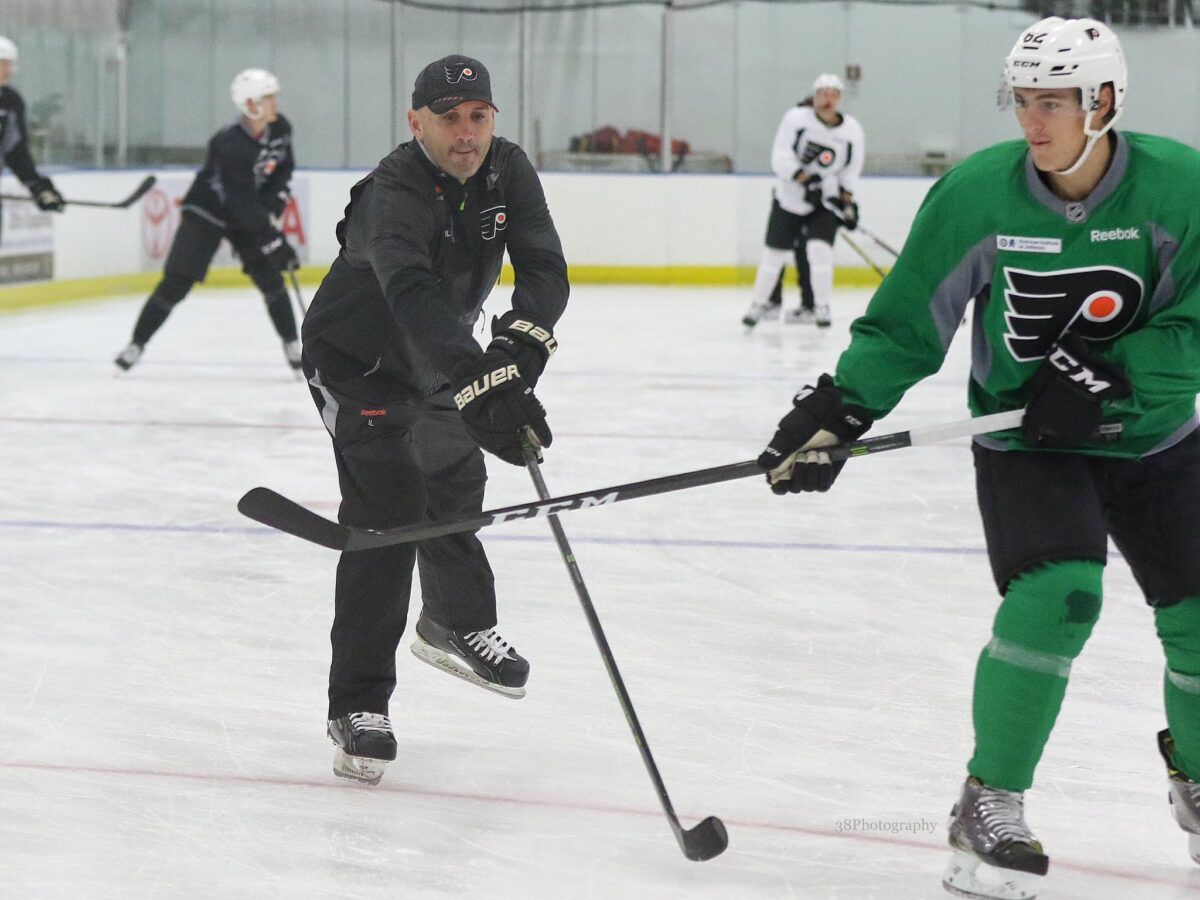
On top of that, the Bears backcheck and keep the puck in the offensive zone. “If you want to score off the rush, that’s fine, but you can’t turn over the puck, and if you turn over the puck, you better be the first one back on defense to help out,” Nelson noted after an April 5 3-2 win over the Hartford Wolf Pack. That game went into overtime, and Alex Limoges scored the game-winner because of the forecheck that provided him with a wide-open look at the net.
The Phantoms have the talent to play that way, where they backcheck and keep the puck in the offensive zone. However, they are often caught out of position and allow the opponents to move the puck up the ice as a result. It doesn’t seem like much, but it goes a long way and separates the good teams from the great ones.
The Pucks to the Net
In the AHL, it’s hard to beat the defense. Oddly enough, it’s easy to beat the goaltender. It’s why shooting the puck and getting shots through traffic is a good idea and a strategy that often pays off. The defense won’t provide much of a shooting lane, yet if the puck gets through, it’s probably going in as well.
The Phantoms get pucks on the net and make great passes. It’s how they’ve scored 19 goals in six playoff games, with eight in the last two games. Their offense stands out, but then the Bears do the same thing with a few additions, and it shows the gap between the two teams.
The Bears generate offense from their blue line, and it helps open things up. Game 4 saw Chase Priskie and Brad Hunt combine for a goal and two assists by firing the puck on the net from the point, knowing there’s a good chance it goes in. The defensemen stepping up helps the forwards in the offensive zone. However, the Bears also have their forwards skate to the high-danger and dirty areas, hoping to deflect the puck or collect a rebound and put it into the goal. It’s how they scored most of their six goals in Game 4.
“It’s hard to score goals, so you’re just trying to get the most pucks on the net,” Perrick Dube noted after the latest victory. He was the beneficiary of the shots from the blue line as he was near the net and finished two scoring chances.
The Bears aren’t a more talented group, especially with the Phantoms coming into form late in the season with a mix of veterans and prospects. They have a group that understands situational hockey better. It’s why they can run up the score even without elite players on their roster.
How Laperriere Can Have a Signature Moment
The Bears have all the momentum and history on their side heading into Game 5. They have the better team and the more established coach. It’s like the 1983 Stanley Cup Final, where the upstart Edmonton Oilers were good but the New York Islanders were there before and always found a way to win (and they did, forcing the Oilers to play at another level the next season to win it all). Laperriere must outcoach Nelson in a big game if the Phantoms hope to win it, which is a tall task.
The big key to doing so is managing the lineup. In big games, it’s always interesting to see who gets the ice time and who doesn’t. Laperriere must lean on the players who have stepped up in this series to win Game 5, whether it’s Anthony Richard or Zayde Wisdom, a 22-year-old forward who has three goals in the last two games. The prospects, notably Alex Bump and Jett Luchanko, are getting much-needed power-play minutes for their development, but they haven’t done much with the opportunities. Laperriere must find skaters who will.
The other big adjustment, or decision, is in the net. Parker Gahagen missed Game 4 and will likely miss Game 5. Cal Peterson filled in and allowed three goals on the first 11 shots, while allowing six goals in the game. It’s easy to turn to the backup after watching that. Nelson pulled his veteran Hunter Shepard for Clay Stevenson in Game 4 with the season on the line, and the move paid off. Laperriere is sticking with Peterson, hoping the opposite strategy pays off. The bet Laperriere is making is that his veteran will bounce back and make the big stops in a must-win game.
This is a big game for the Bears and Phantoms, and it’s a defining moment for Laperriere. The 51-year-old coach still needs a big moment in the AHL, yet he’s coaching in the shadows of Nelson, a coach in his division who has done it all. A win in Game 5 will put him and the Phantoms on the map, or it will remind everyone why the Bears are still the standard in this league.
Free Newsletter
Get AHL coverage delivered to your inbox
In-depth analysis, breaking news, and insider takes - free.
Subscribe Free →