- Who Is Ville Koivunen, Beyond the Boxscore?
- Built In Oulu: What Liiga Taught Him
- Translation Test In Wilkes-Barre/Scranton
- The NHL Tease: From Top Line To IR
- Why the Penguins Can Wait
- What the Tape Says at NHL Pace
- What Koivunen’s Story Says About the Finnish Pipeline
- Questions That Decide Whether Koivunen Stays
The Pittsburgh Penguins have seen flashes of what Ville Koivunen can become. One week, he is ripping apart the American Hockey League (AHL) before playing on Sidney Crosby’s wing in the NHL. Next, he’s fighting for fourth-line scraps, then he’s watching from the press box. Now, he is in a tracksuit, this time on injured reserve with a lower-body injury after the Global Series trip to Sweden.
It’s been an up-and-down campaign for the 22-year-old from Oulu. One month, he tallied seven assists in eight NHL games and was referred to as a future fixture. Next, he had two assists in eleven games, lost his first-line audition when Bryan Rust returned, and was then bumped down to the AHL while Sam Poulin was recalled.
The stat line is jarring in its split. Koivunen put up 56 points in 59 Liiga games for Kärpät in 2023-24, then 56 points in 63 AHL games as a rookie for the Wilkes-Barre/Scranton Penguins the following season, earning an AHL All-Rookie Team nod. This season, he started with 11 points in six AHL games, then just two points in 11 NHL games before he was injured.
Which version is real? The AHL top out or the NHL up-and-comer, and how much patience can a cap-strapped Penguins team afford with a slow-burning Finnish playmaker?
Who Is Ville Koivunen, Beyond the Boxscore?
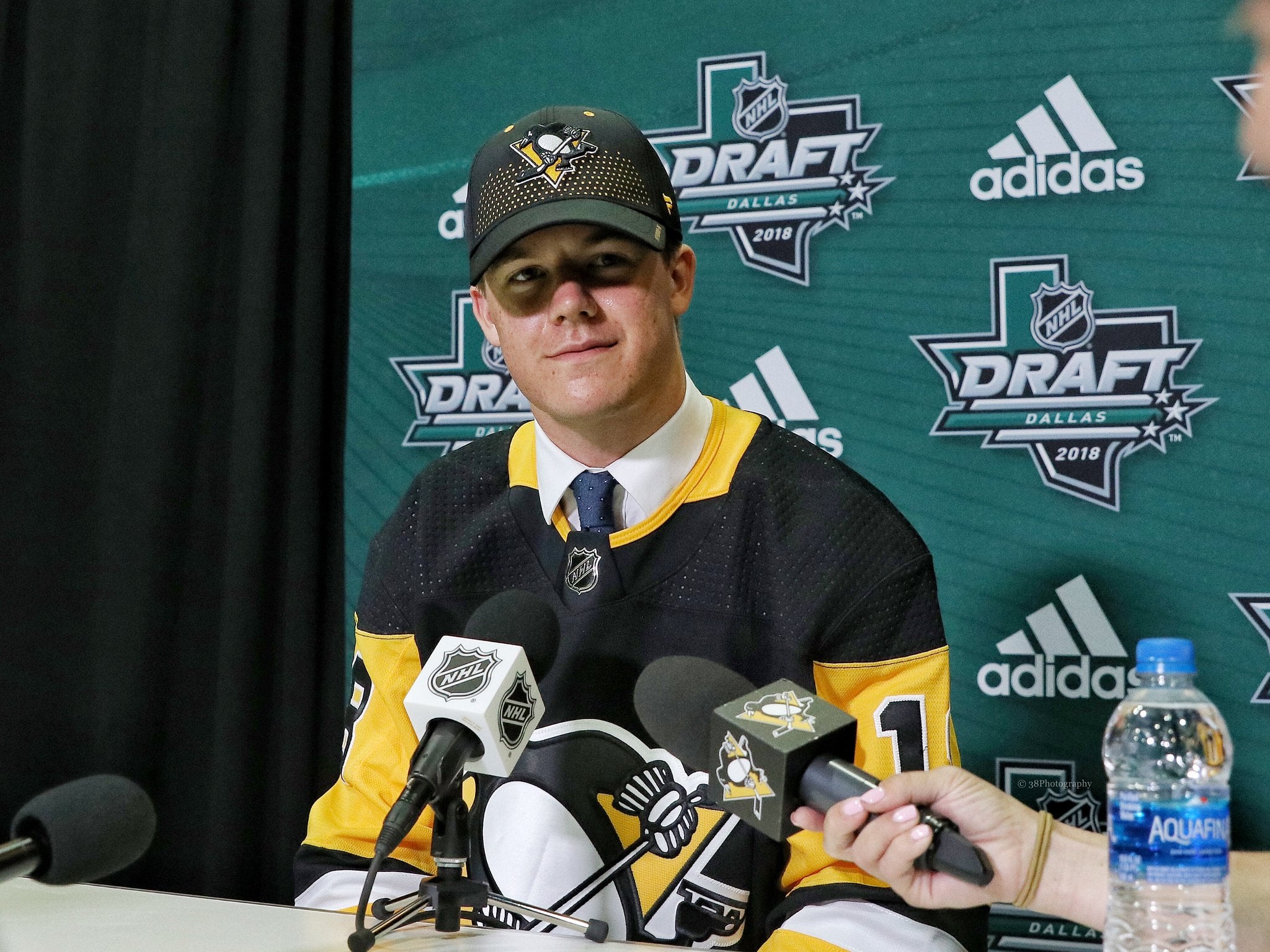
Koivunen is not a mystery man in prospect circles. The Carolina Hurricanes grabbed him 51st overall in 2021 after he torched Finland’s U20 league for 49 points in 38 games and won Rookie of the Year honors.
He signed his NHL deal that summer, stayed home, and climbed Kärpät’s system, eventually becoming one of Liiga’s most creative young forwards. In March 2024, he moved to Pittsburgh as part of the Jake Guentzel trade that also sent Michael Bunting and Vasily Ponomarev to the Penguins.

At 6-feet and 170 pounds, he is not the straight-line power winger that used to dominate Pittsburgh’s depth chart. Pensburgh’s Top 25 Under 25 series slotted him at number two this summer and described a patient playmaker with deceptive edges and strong power-play vision. Dobber Prospects referred to him as a dual-threat winger who makes his linemates better, more than a line driver in his own right.
Built In Oulu: What Liiga Taught Him
Kärpät had Koivunen working in almost every offensive situation. He finished 2023-24 with 22 goals and 34 assists in 59 games, then added 13 points in 12 playoff contests as Kärpät leaned on him in the lineup.
The tape from that season shows a Finnish-type winger. He attacks with his head up, uses little delays at the blue line to force defenders to plant their feet, and loves to arrive late on the weak side rather than sprinting through the middle. When the puck goes low, he does not just cycle for the sake of it. He is probing for soft ice above the dots or a seam through the box.
Liiga’s structure matters. The league rewards patience and pattern recognition. Coaches trust forwards who support underneath and reset plays rather than ramming pucks into shin pads from bad angles. That is exactly the environment where Koivunen’s strengths in deception, timing, and short-area passing could flourish. It’s also what head coach Mike Sullivan is looking for when the Penguins are at their best – five connected pieces and constant support under the puck.
Translation Test In Wilkes-Barre/Scranton
If Liiga was finishing school, Wilkes-Barre/Scranton was the entrance exam for North America, and Koivunen passed with distinction. As a 21-year-old rookie in 2024-25, he posted 21 goals and 35 assists in 63 games, led the Wilkes-Barre Pens in scoring, and earned a spot on the AHL All-Rookie Team.
The adjustment was not just about numbers. On smaller ice, his delays had to be sharper and his routes shorter. Early reports from Wilkes-Barre/Stranton staff highlighted how quickly he started to manipulate defenders by changing pace and using the inside of the ice, not just the boards.
Penguins beat pieces noted his four-goal game against the Hershey Bears and a stretch where he looked like one of the best players on the ice every night, even without highlight-reel speed. Stat sites that track chance creation backed that up. Across all situations, his assist rates and primary involvement in scoring chances sat near the top of rookie forwards, which is exactly what you want from a winger advertised as a brain and touch player more than a burner.
The NHL Tease: From Top Line To IR
The Penguins hinted this fall that they saw Koivunen as more than a depth call-up. He broke camp on the opening-night roster and even got a turn on Crosby’s wing when injuries gutted the top six. Local coverage floated his name as a Calder dark horse if the fit stuck.
Then reality intervened. After two quiet NHL games, when Bryan Rust returned from injured reserve, Pittsburgh used Koivunen’s waiver-exempt status and sent him back to Wilkes-Barre. He did what good prospects are supposed to do. He ripped off 11 points in his first six AHL games and climbed near the top of the league scoring table again.
The second act of the tease arrived in Stockholm. Koivunen was recalled after Rickard Rakell’s hand surgery and played the first game of the NHL Global Series, logging over 13 minutes in a tight overtime loss. By game two against the Nashville Predators, he was out of the lineup and listed as day-to-day with a lower-body injury.
A few days later, the Penguins formally placed him on injured reserve and called up Poulin, describing Koivunen’s status as week-to-week. He finished this latest NHL stint with two assists in 11 games. On paper, that’s underwhelming. In context, it is still a tiny, noisy sample wedged between strong AHL stretches and a growing list of forward injuries around him.
Why the Penguins Can Wait
The easy reaction is frustration. The Penguins are built around aging stars; they need cheap upside, and here is a skilled Finn who cannot quite grab his chair. That tension is real. It is also why Koivunen might be exactly the type of player they cannot afford to rush or dump.
His contract gives them flexibility. He carries an entry-level cap hit just above $800,000 through at least 2025-26, and he does not need to clear waivers yet, which makes him the cleanest shuttle piece between Pittsburgh and Wilkes-Barre/Scranton. In a cap world where Guentzel needed a rich extension somewhere else, the only way to keep skill on Crosby’s wings is to develop it internally.
Depth chart context helps. When everyone is healthy, the Penguins still have Rakell, Rust, Michael Bunting, and other veterans slotted on the wings, with blue-chip forward Rutger McGroarty pushing from below. That is a crowded field for a finesse winger who thrives alongside finishers and given power-play touches. Koivunen is unlikely to succeed on a crash line with pure checkers.
The better question is not whether he can carry his own unit right now. It is whether he can be the connective tissue that keeps a Crosby line humming at five-on-five without needing a big cap number.
What the Tape Says at NHL Pace
Even in this choppy early NHL run, the habits that made Koivunen stand out in Oulu and Wilkes-Barre/Scranton are visible. He rarely skates himself into blind alleys. Instead, he rides defenders, cuts back toward the middle, and waits for lanes to open. That little hesitation at the wall is straight out of Liiga. It shows up now as he draws a second defender and then slips a pass into the slot.
Away from the puck, he hunts soft ice. He fades high in the zone to offer a release valve, then quietly slides down the weak side when the play turns toward the net. That pattern is tailor-made for a center like Crosby or McGroarty, who drives the middle and needs a late passing option more than another player calling for one-timers from the circle.
Defensively, he will never look like a classic Penguins forechecker. His best work comes from reading routes, keeping his stick in lanes, and cutting off exits rather than blowing up bodies on the end boards. That makes him more of an anticipator than a disrupter, closer to a Sebastian Aho-type of defensive profile than a Brandon Tanev, which is fine if the coaching staff leans into it.
What Koivunen’s Story Says About the Finnish Pipeline
Koivunen’s arc is also a snapshot of how Finnish development fits a team like Pittsburgh. Liiga did what it usually does with its better forwards. It taught him to play within structure, manage the puck, and work both special teams, then handed him big playoff minutes when he earned them.
That background is a gift for a roster built around stars who dominate touches. The Penguins do not need their next Finnish winger to be a soloist. They need someone who can complement high-usage players and keep the puck moving when the big names are swarmed. Koivunen has already shown in Liiga and the AHL that he can boost the lines he lands on without demanding the whole stage.
The risk is not that his game fails to translate. It is that organizational impatience or roster crunches shove him into roles that do not match his strengths, then fans declare him a bust far earlier than his development curve would suggest. For a club that cashed out Guentzel to acquire him, that would be an ugly outcome and a self-inflicted one.
Questions That Decide Whether Koivunen Stays
Koivunen’s injury will heal. When it does, the test starts again. Still, there are a few lingering questions. Will the Penguins give him a proper middle-six run with at least one proven finisher, or will he return to a shuttle role and seven minutes a night?

Can he add just enough pace and strength to survive defensive zone shifts without the puck, so Sullivan trusts him when the game tilts against Pittsburgh? Do the front office and fan base see two assists in 11 games as a warning sign, or as the sort of noisy first impression most playmakers fight through before everything slows down?
Most of all, if you believe his Liiga and AHL samples, is this the kind of player you risk moving in a quick-fix trade, or the type you ride with until the slow burn finally catches? That answer might decide whether Finland’s latest gift becomes another “what if” or a real part of Crosby’s twilight story.
Free Newsletter
Get Pittsburgh Penguins coverage delivered to your inbox
In-depth analysis, breaking news, and insider takes - free.
Subscribe Free →