After being swept in the first round by the Carolina Hurricanes, it may seem as though the Ottawa Senators are nothing special. That they’re good enough to make the playoffs in 2026-27, but going on a real run—much less hoisting the Stanley Cup—is a long shot.
But the Senators’ foundation is a lot stronger than they’re being given credit for. In fact, it’s similar to the Hurricanes’. With a smart offseason, Ottawa could be a dark-horse Stanley Cup contender.
Senators’ Deep Forward Corps
My early takeaway from this year’s Stanley Cup Final, won by Carolina in six games, was that Ottawa is uniquely capable of being a similar team. It may not seem like it on paper, but the Senators’ foundation is in a perfect spot. Their roster, top to bottom, is remarkably sound.
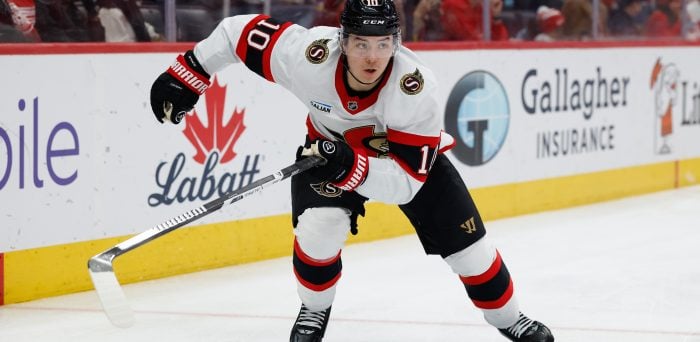
Let’s start with their offence. The two big-name forwards on the roster, Tim Stützle and Brady Tkachuk, carried their weight. The former recorded 34 goals and 49 assists in 80 games, while the latter put up 22 goals and added 37 assists in 60 contests. However, it’s their 5-on-5 play that sets them apart from other stars.
According to PuckIQ, Stützle and Tkachuk’s deployment wasn’t too intense, but they both finished the campaign with a 5-on-5 goal share just above 52%. While that’s solid on its own for star players, the Senators had the third-worst team save percentage at five-a-side hockey this past season (which is likely unsustainable). Despite the setback, Ottawa’s stars were net positives in the goal differential department.
In particular, Tkachuk, who should still have plenty of prime years left, was quietly fantastic in the injury-riddled season. Per 60 minutes among skaters with 200 or more minutes of 5-on-5 ice time, he was one of six players with at least 3.25 points in all situations, and relative shot attempt and expected goal plus/minus ratings of at least 5.00 and 0.35 at 5-on-5, respectively. To expand, those last two metrics basically measure play-driving.
He joined a group of Cole Caufield, Jack Hughes, Connor McDavid, Jason Robertson, and Matthew Tkachuk. Mind you, in that group, Brady ranks fifth, first, and first in each statistic—he’s not hanging on by a thread. He drove play and put up points at a superstar level.
The Hurricanes are defined by players who impact the game beyond the score sheet. Tkachuk fits that narrative to a tee, even following the early-season injury.
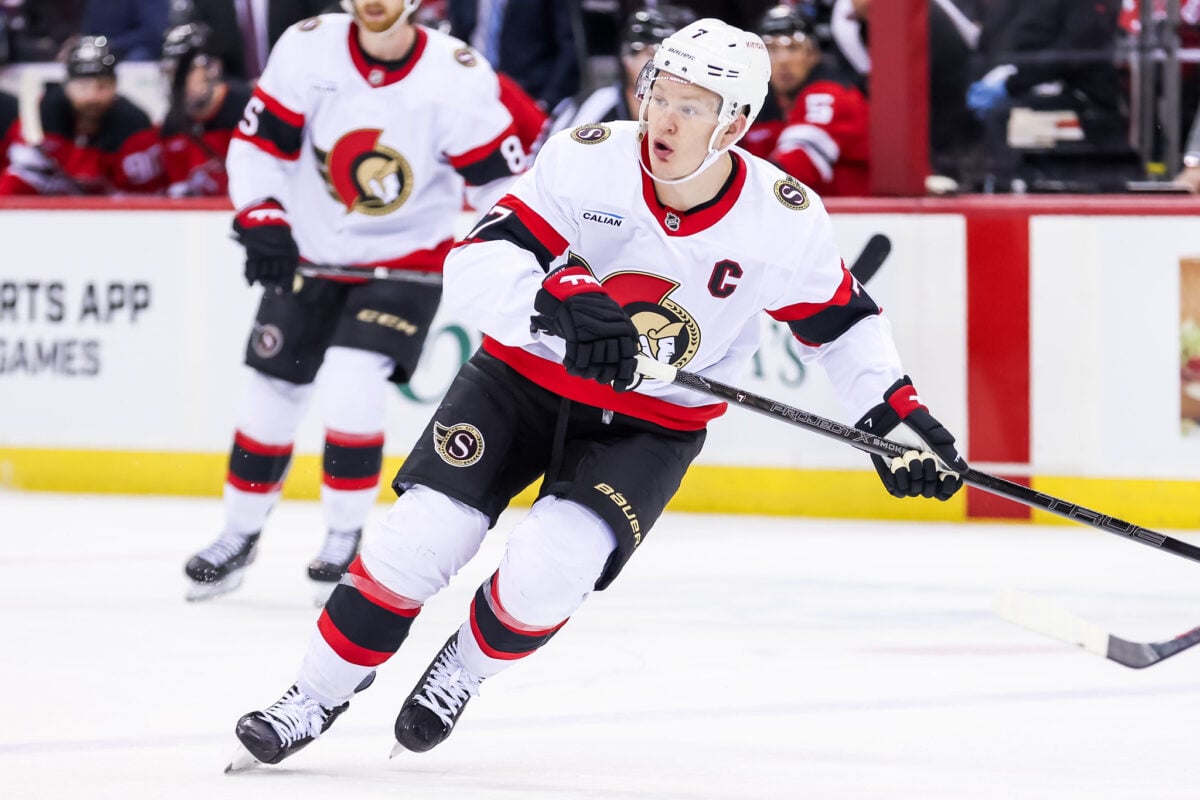
Shifting gears, Drake Batherson and Dylan Cozens were a good source of offence. Batherson had 33 goals and 71 points, while Cozens recorded 28 goals and 59 points. At 5-on-5, they had expected goal shares of 56.2% and 61.5%, to boot.
Batherson’s goal share took a hit from the goaltending bug, sitting at 48.4%, but his ability to produce and simultaneously have majorly positive impacts at 5-on-5 is great to see. Cozens, as the team’s second-line centre, took things to the next level. He, like Tkachuk, found himself in an elite group of play-drivers. His point, relative shot attempt, and expected goal metrics were similar to those of established star Mathew Barzal and emerging star Zach Benson.
Even a 38-year-old Claude Giroux, who is an unrestricted free agent but will presumably re-sign in Ottawa, was sixth in total points (49) and ninth in 5-on-5 expected goal share (56.1%) among Senators skaters who recorded at least 200 minutes.
Finally, in Hurricanes-esque fashion, Michael Amadio and Shane Pinto ate the team’s tough minutes but excelled in the process. They had goal shares above 51% and expected goal shares above 54%—pretty incredible, given their deployment. Plus, they combined for 38 goals and 43 assists. This led to moderate Selke Trophy consideration for both.
Now, Ottawa could use some more offensive talent, which is something I’ll get into later. But the foundation here is in an enviable spot. Very few teams across the league are this complete.
Senators’ Defence: Best in the NHL?
Shifting to defence, the Senators might have the best in the NHL. Well, so long as nothing comes from those Jordan Spence trade rumours (from ‘Ottawa Senators checking trade market for RFA blueliner Jordan Spence,’ Ottawa Citizen, June 15, 2026).
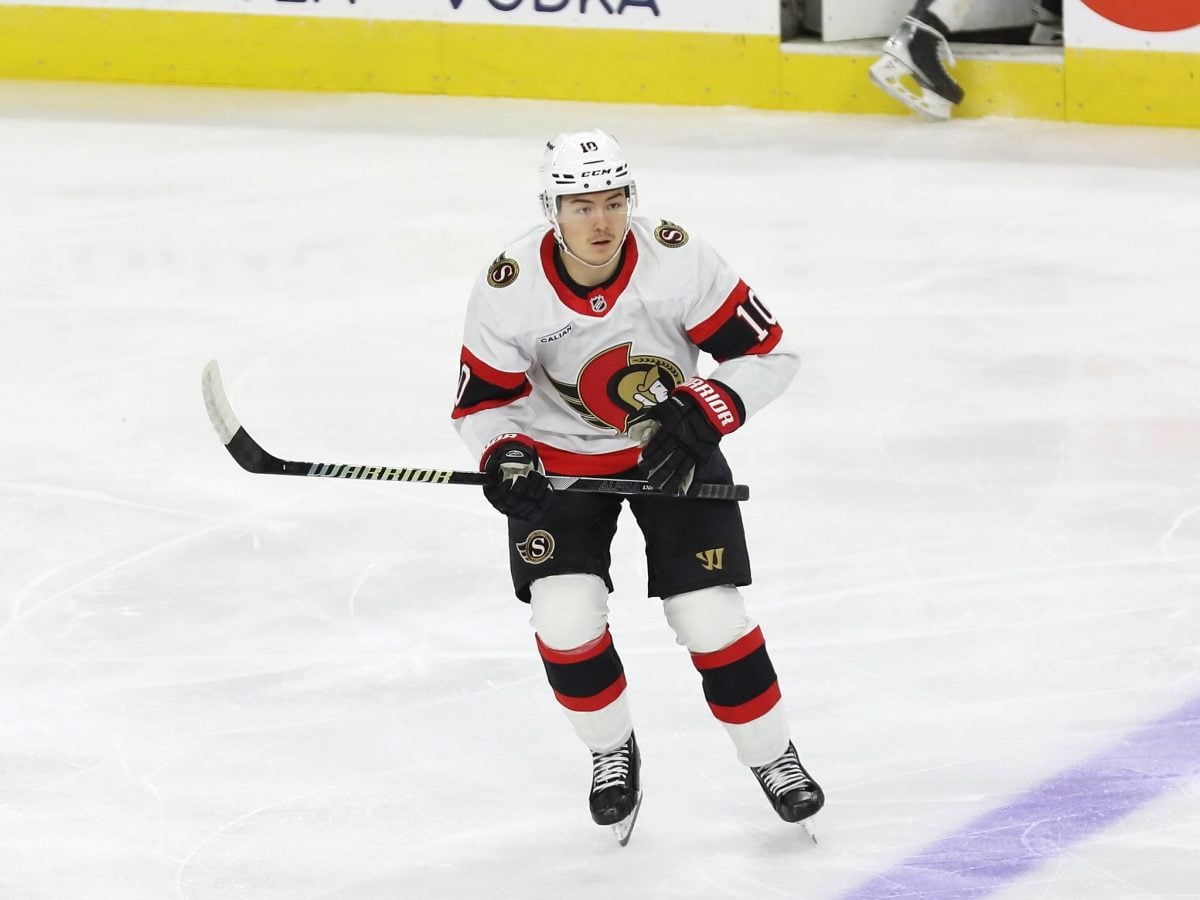
At the top, Jake Sanderson has become one of the best defencemen in the game. He eats tons of minutes, can skate with the best of them, and has a high two-way ceiling. This past season, he recorded 54 points in 67 games on 24:50 of average ice time. His goal and expected goal shares at 5-on-5 were both above 56%, too.
Thomas Chabot had some injury troubles, but he had a respectable 31 points in 57 games with goal and expected goal shares above 52%. Artem Zub put up similar numbers in a healthier campaign.
Perhaps the most intriguing player on this blue line, though, is Spence. The 24-year-old put up elite results in a sheltered role with the Los Angeles Kings in 2024-25, and the same was true when he got to Ottawa until around mid-March. Then, with Chabot and Sanderson missing time, he put up elite results while playing the most minutes on the team.
Picture this: only four defencemen averaged at least 18 minutes of ice time, had an expected goal share of at least 52%, and had a relative expected goal plus/minus of at least 0.50. That list consisted of Adam Fox, Lane Hutson, Moritz Seider, and Spence.
That’s not to say Spence is a top-10 defenceman in the league. But he’s proven to be capable in a top-pairing role. The Senators should give him a long-term contract.
Rounding everything out is Carter Yakemchuk, whose two-assist performance in Game 4 against the Hurricanes in 19:34 was his magnum opus in a short stint with the Senators. Time will tell if he’s capable of being a full-timer in the NHL next season, but the upside is immense. Ottawa’s defence corps is top-heavy yet deep.
Who the Senators Should Target This Summer
The Senators aren’t a finished product yet. They could use another high-skill forward and a goalie to help out Linus Ullmark. With Leevi Meriläinen finishing the season with a league-worst minus-3.15 Wins Above Replacement (WAR) grade, adding an elite backup could ascend this team. Meanwhile, another forward could do the same.
According to PuckPedia, the team has just under $17 million in cap space this summer with 19 of 23 roster players signed. Their key free agents are Giroux and Spence, while everyone else is just depth. So, some money is at play here. Who should Ottawa target?
Player One: Jordan Kyrou, St. Louis Blues
Jordan Kyrou, whose name has been everywhere, would be the perfect snag for the Senators. After averaging 71 points over the past four seasons, he had just 18 goals and 28 assists in 72 games. But his 5-on-5 impacts relative to his teammates were up there with Ottawa’s best forwards. He’d be a great addition to the top six.
With a new general manager, it’s unclear what the St. Louis Blues’ direction is. But they seem to want to maintain a semi-competitive roster, even if they’re selling. As outlined in the linked piece at the start of this section, a trade like Fabian Zetterlund, Logan Hensler, and two first-round picks could make sense. That’s a bit rich for my taste, but the foundation is agreeable.
Player Two: A High-End Backup Goalie
There’s no backup in particular that I’d target, but the Senators should splurge on the position if money permits it. Having a reliable guy back there could raise this team’s ceiling substantially and help Ullmark in the process.
The average hockey fan will probably look at the Senators and not think anything much. After all, they lost in the first round in each of the past two seasons and haven’t advanced any further since 2017. But should they have a good summer, people ought to start paying attention.
Stats courtesy of Evolving-Hockey and Hockey Stats
Free Newsletter
Get Ottawa Senators coverage delivered to your inbox
In-depth analysis, breaking news, and insider takes - free.
Subscribe Free →