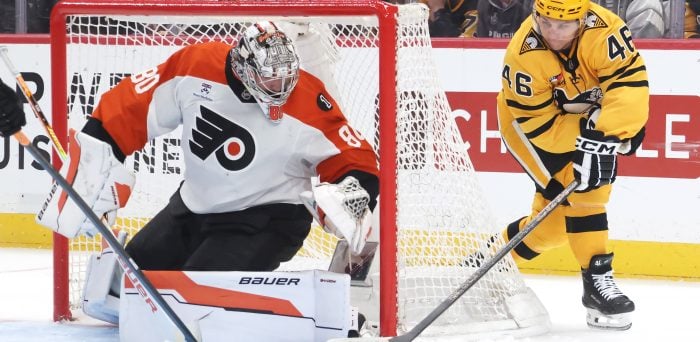
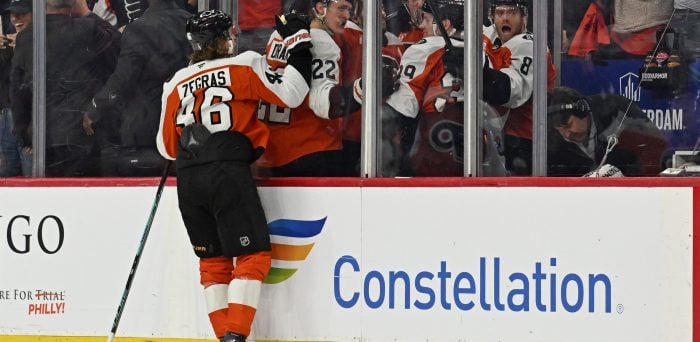
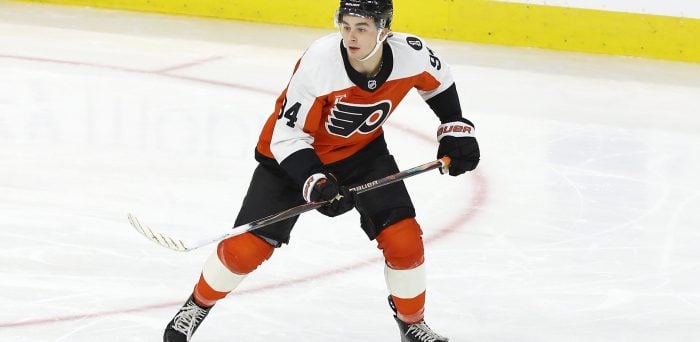
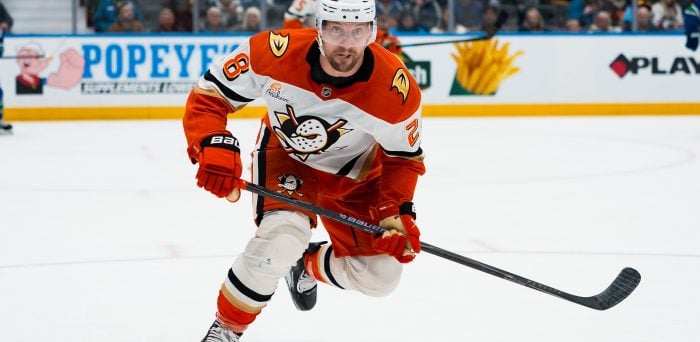
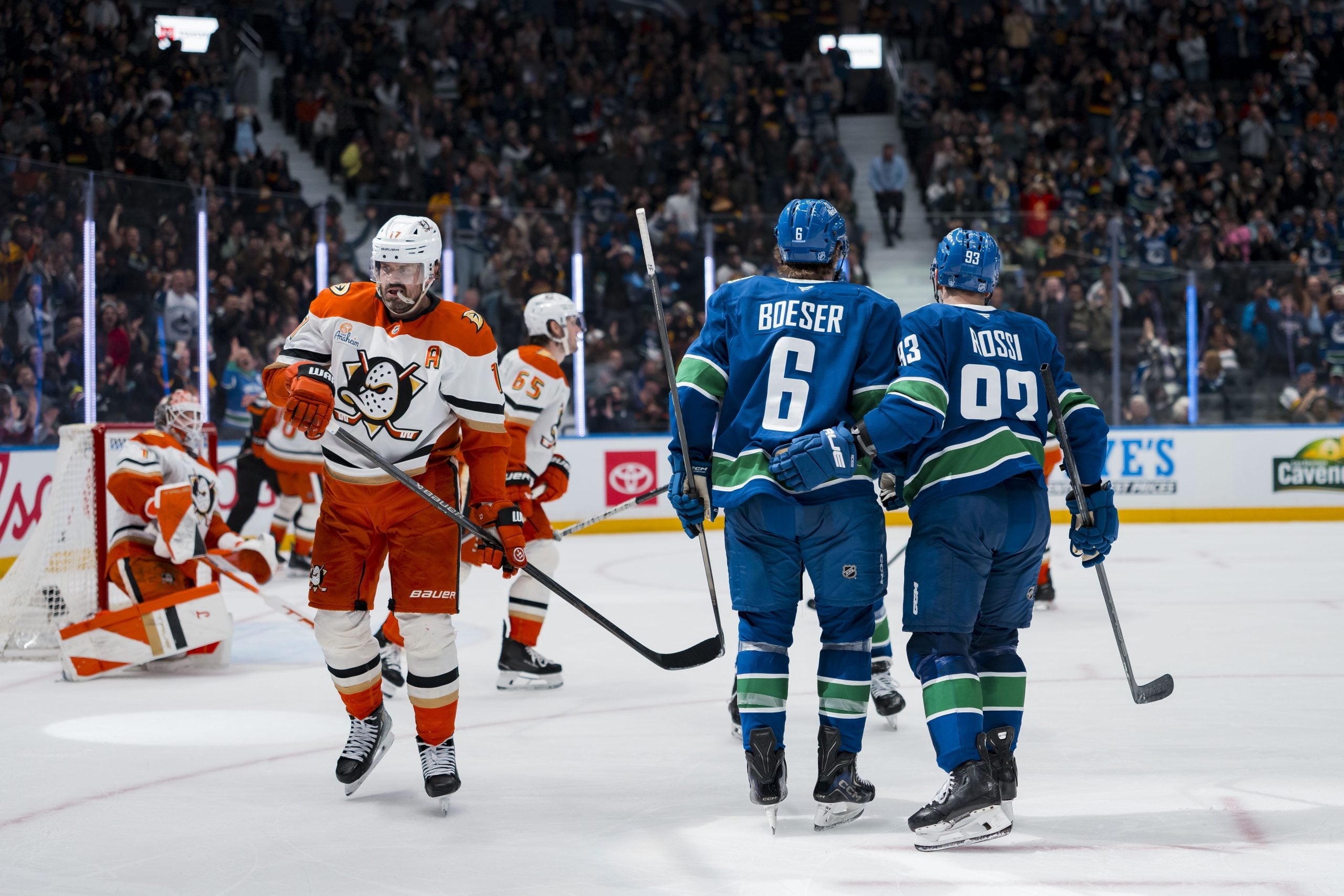
There was a lot to take in at Xfinity Mobile Arena on Tuesday night when the Philadelphia Flyers hosted the Anaheim Ducks. There was the unwelcome presence of Cutter Gauthier, which drew groans after he opened the scoring early in the first period, but then raucous jeers when the game’s tenor changed. There was a dynamite game from Trevor Zegras, who stepped in to replace what was lost when Gauthier was dealt. But amid the animosity, there was a brief moment of cordiality when Ryan Poehling received a short tribute in his return to Philadelphia.
Yet, the biggest piece of Flyers news didn’t illicit much of a reaction – the standard treatment for anything other than the most seismic contract extensions, which Christian Dvorak’s five-year, $25.75 million extension isn’t. However, it is very significant, marking one of Daniel Brière’s biggest risks as he nears his third anniversary as general manager.
One game doesn’t make or break a deal, especially one that doesn’t start for another nine months, when Dvorak will be 30 years old. However, in his first contest after inking the biggest contract of his career, he showcased the reasons why the Flyers are comfortable with him on the books despite the concerns surrounding the numbers.
Dvorak Delights in the Details
Though he’s enjoying a career season offensively, Dvorak has never been known as a major scoring threat. His best work is often done in the shadows, making subtle plays in the dirty areas to free up his teammates. That was evident on the Flyers’ first goal, one of two Zegras scored in the opening frame.
A Travis Konecny drop pass skipped off the mark and appeared to be on its way out of the offensive zone. However, Dvorak hustled into the play as the third forward and held the line. He then proceeded to walk around Gauthier to reach a dangerous scoring area, only to quickly slip the puck backdoor, where Zegras was lurking for one of the most electrifying moments of his first season as a Flyer.
“He really wanted the third one, we’ll say. We tried to get it for him,” Dvorak said of his frequent linemate’s hat-trick bid in the team’s 5-2 win over the Ducks. “He had a couple okay looks, I guess. But yeah, maybe next time.”
Later in the game, Dvorak showed that hustle off at the other end of the ice. With the Flyers employing a fairly conservative cycle on a late power play protecting a two-goal lead, the Ducks managed a quick shorthanded burst. A big rebound off the pad of Dan Vladar looked like it might produce a goal to cut the deficit to one, but Dvorak again won the race to ensure Anaheim wouldn’t be able to shrink the gap.
He has been much more prominent offensively than defensively in Philadelphia. He’s third on the team in expected goals for per 60 minutes but last in expected goals against per 60 minutes, per Natural Stat Trick. His partnership with Zegras has changed his role; he’s basically the team’s first-line center now, averaging nearly a minute more of 5-on-5 time than any other point in his career.
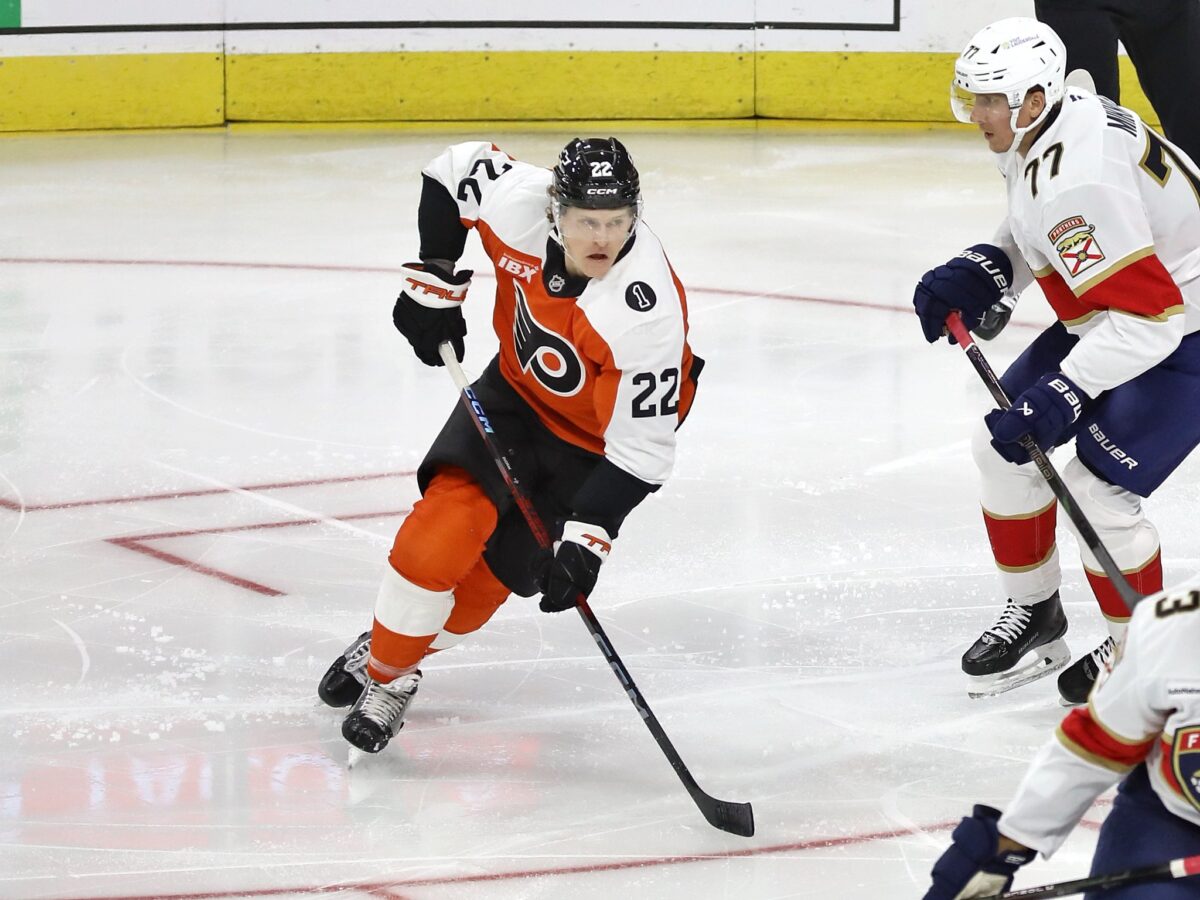
“I believe that I had more in my game offensively, and that’s kind of why I took the one-year deal this summer,” Dvorak said on Tuesday morning.” I kind of bet on myself, and I thought I had a good opportunity here, and playing with the linemates that I’ve played with this year, I mean, it’s, it’s been a lot of fun, and they’re very easy players to play with, and I got to thank them too.”
While the numbers haven’t been kind to Dvorak’s defensive game, he has consistently performed well in the face-off circle. His 54.2% rate this season is in line with his career average of 53.2%, and he’s won at least 52% of his draws every season since 2018-19, his third in the league. The Flyers dominated a lot of areas on Tuesday, and the faceoff dot was one of them; Dvorak’s 65.2% success rate contributed to a team-wide 63.2% mark, their third-best mark of the campaign.
Dvorak Opted for Term
The brunt of the sticker shock for Dvorak’s deal isn’t the cap hit (he actually took a slight decrease from his 2025-26 average annual value) or trade protection (full no-trade years one and two, 20-team no-trade list year three, five-team trade list year four, no protection year five). It’s the term, taking Dvorak to 35 years old, when most players are in decline.
“It was pretty, pretty smooth process, I would say, overall came together somewhat quickly. I think term was, you know, one of the main things I was looking for,” Dvorak confirmed. “So, you know, we’re really happy to work something out, and I’m just very excited and happy it got done.
I’m turning 30 soon, but there’s still a little bit more that I have in my game that I can be that kind of player [who plays with more high-end scorers] going forward, maybe from versus what I have been in the past.”
While the Flyers have other defensive options down the middle, like Sean Couturier and Noah Cates, to allow Dvorak to shift to more of a scoring role, Philadelphia needs more from him (and everyone) on the penalty kill. Since Dec. 1, the PK is operating at a 73.1% success rate, sixth-worst in the NHL. That’s one area where his poor underlying numbers can’t be blamed on a shifting role.
Dvorak has also performed better both defensively and overall by xG rate when separated from Zegras. Comparing with and without numbers isn’t an end-all, be-all because they omit important situational context. But despite their close friendship, there is evidence that maybe the two would be better served by dividing and conquering.
| TOI | xGA/60 | xGF% | GF% | |
| Zegras w/ Dvorak | 432:01 | 2.92 | 49.65% | 54.17% |
| Zegras w/o Dvorak | 171:55 | 1.97 | 54.46% | 50% |
| Dvorak w/o Zegras | 115:52 | 2.47 | 52.92% | 55.56% |
Which Flyers Stay and Who Goes?
While there’s not much urgency for the Flyers to move any of their current forwards, that could change as soon as the start of next season. Tyson Foerster and Porter Martone both project to be part of the 2026-27 opening-night lineup, and neither of them nor anyone in the top nine is really a fit for the fourth line. Maybe Cates could do that, but he’d be an awfully expensive fourth-liner.
Among the team’s many forwards, Sean Couturier and Travis Konecny both have no-movement clauses. Matvei Michkov, Zegras, and Martone aren’t going anywhere, and it’s difficult to see Denver Barkey being moved if he continues to impress. Foerster would likely only be available in a blockbuster trade, and it’s rare for a young player to be moved after suffering a serious injury as he has without getting any time to rebuild his value.
Related: Flyers’ Trevor Zegras Embracing Team Amid New Belief
The two most obvious trade candidates for the future are Owen Tippett and Bobby Brink. At this point, it’s safe to assume Tippett won’t be able to fully harness his high-end tools to become a difference-maker on a nightly basis. Brink has always been seen as a bit of a tweener, and while he’s already one goal away from tying his career-high, it’s not like he’s a high-end scorer that the team can’t live without.
“You never know which [prospects] and when they’re going to be ready,” said Brière on Tuesday night. “Everybody has their own pace… Denver Barkey last year, we thought he’d be in the minors for two, three years, and now he’s with us. You just don’t know. We’re not going to rush anybody. But when a player is ready, we’ll find a way to make him room.
That’s what we’re doing with Denver at the moment. When they’re ready, we’ll find room for good players. It’s exciting to see what’s going on. We’re going to try to help the team if we can, but it’s something that’s going to make sense. It doesn’t change the vision. It doesn’t change what we’re trying to do. It’s still about the future.”
The big difference between those two is their contract status. Tippett is signed at $6.25 million through 2030. Meanwhile, Brink will be due for a modest raise from his $1.5 million cap hit as a restricted free agent with arbitration rights this summer. The ease of his negotiation could determine which winger is more likely to be on the outs.

Free Newsletter
Get Philadelphia Flyers coverage delivered to your inbox
In-depth analysis, breaking news, and insider takes - free.
Subscribe Free →