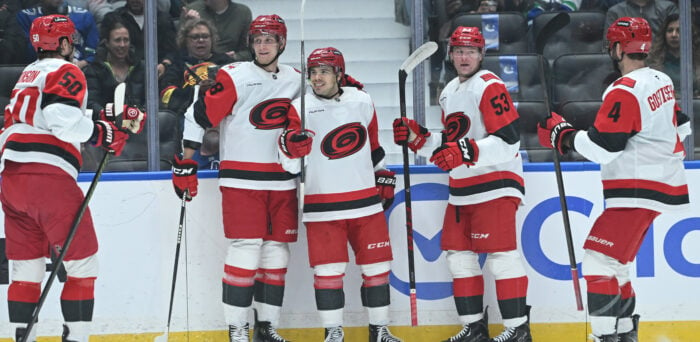
The Carolina Hurricanes are currently the reigning Stanley Cup Champions. With one of the most aggressive front offices in the NHL, they are constantly looking for ways to improve the roster. On the recent 32 Thoughts Podcast, Sportsnet insider Elliotte Friedman noted that the Hurricanes were among a few teams considering using the normally taboo offer sheet method in a unique way we haven’t really seen across the NHL, a way so aggressive it really depended on the Hurricanes to get it done.
They were looking to tender offer sheets to players they could flip to teams that lacked the assets to use the offer sheet method. This is due to a relative quirk in the offer sheet rules. When a player signs an offer sheet, the team that holds his RFA rights gets a week to decide if they’re going to match the contract the player signed or let him walk for draft pick compensation. If they match, the player cannot be traded for a year. This poison pill is difficult to swallow for some teams, whether against the cap or with a player walking to unrestricted free agency, à la Barrett Hayton with the New Jersey Devils. That rule doesn’t apply to teams tendering the offer sheet.
Carolina’s Aggression
On the July 1st iteration of 32 Thoughts, Friedman suggested that the Hurricanes were lacking the assets to go after their primary choice of goaltender: Connor Hellebuyck. If a team like the Winnipeg Jets doesn’t want to venture into the depths of a rebuild, then things like picks and prospects aren’t going to hold much value to them. That’s a logical conversation that happens frequently, and it usually ends with the team with the player keeping the player, or the team that wants the player upping their offer.
Carolina is uniquely positioned to do something different. If Winnipeg doesn’t want to bottom out but also doesn’t want to risk their picks, the Hurricanes can tender offer sheets to RFAs the Jets hold interest in and flip them to the Jets in the initial package for the player they were after. It’s extremely creative given the typical way we’ve seen teams trade in the past, or how we hear conversations for players die at the inquiry stage.

This isn’t the only situation that makes sense to use the offer sheet and flip the player. Carolina could have a conversation with a team like the Florida Panthers. Florida doesn’t have a first-round pick until the death of mankind, or 2030, whichever you prefer. They don’t have the prerequisites for a big offer sheet. Carolina does. Carolina could make the offer sheet, then work out a trade for different assets. This example is a little smudged because Florida doesn’t have a ton of high-end assets to trade anymore; they turned them all into roster pieces, but I hope you get the idea.
The Risk
The risk here is that many franchises are unsure of what the future holds. If they barely made the playoffs last season and there is no certainty they will make the playoffs this upcoming season, they will want to be more risk-averse because draft-pick compensation is unprotected. Then there are the contenders who are punting any draft pick they can to improve their roster. They may lack the assets to pull off an offer sheet.
Carolina’s unique position as a perennial contender, combined with holding every draft pick of their own, minus the 2027 seventh-round pick, and almost exclusive certainty that they will not only make the postseason, but make it out of the first round, creates this perfect storm for the Hurricanes. Because the Hurricanes are not a team reliant on top talent, they can trust their organisational depth to carry them through tough times during the season. It’s the same way Carolina won the Stanley Cup. Wave after wave of pressure, no matter the personnel. It’s the system that kills you, not the players. It means they should never be at risk of bottoming out because of injuries.
While the quality of the Metropolitan Division is improving with many teams re-emerging from retools or rebuilds, the Hurricanes should still stand alone atop the division for the next couple of seasons at least, which gives them about as much security as you can get in the NHL. They’re in a position where they can continue to dominate in the division, make deep playoff runs, and use the threat of an offer sheet for leverage in deals for guys they want.
It’s unlikely we see anything come of this at this point in the summer. Many eligible players have filed for arbitration, which prevents teams from tendering them an offer sheet. It’s not impossible, but the list of eligible offer sheet candidates in the already unique list of prerequisites of being on a team that may not match an offer sheet right away is declining with every passing signing. It’s an aggressive approach, but will the Hurricanes get to execute it? We’ll have to find out.
Free Newsletter
Get Carolina Hurricanes coverage delivered to your inbox
In-depth analysis, breaking news, and insider takes - free.
Subscribe Free →