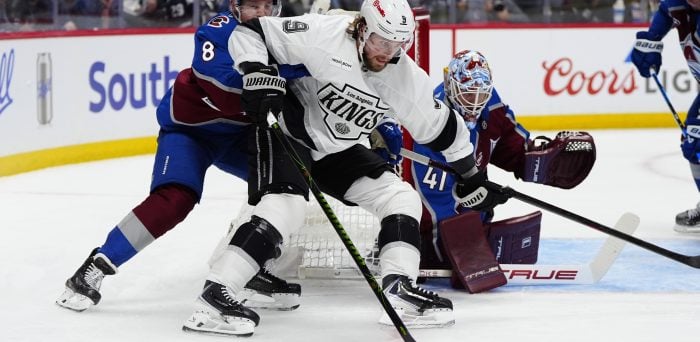
Stop me if you have heard this one before. The Los Angeles Kings score fewer than two goals and ultimately lose another game in overtime. It was the Kings’ league-leading 13th overtime loss of the season, and fourth overtime loss in seven games.
“I don’t know that I have an answer to that to be honest, because if I did, I don’t think we would keep being in the same situation every game,” Warren Foegele said when asked what’s missing right now. “At the end of the day, we didn’t get the job done, we didn’t get the two points, and it’s just not good enough.”
It’s an already difficult pill to swallow for a Kings team that can’t figure out a way to score goals, win games in regulation, or win games in overtime, and it’s an even bigger pill to swallow when you drop back-to-back games against your bitter rivals who are chasing you in the standings.
Before Friday’s game against the Anaheim Ducks, the Kings had a two-point lead with an opportunity to make that a six-point gap. Instead, both teams are now tied with 51 points each, and the separation has disintegrated.
Same Story, Different Night
It doesn’t seem to matter how the game plays out; the result seems to be the exact same. Whether the Kings play well enough to win by multiple goals, or are chasing the entire game and manage to pull through to extra time, you can almost guarantee an overtime appearance and more often than not, an overtime loss.
“We’re used to it. It’s almost part of the evening for us these days,” Kings coach Jim Hiller said. “We’re ready for it, we just haven’t been able to execute well enough.”
The Kings dominated a majority of Friday’s color-rush contest against the Ducks. A game in which they could have easily been up by three goals at the end of the first period had they been able to capitalize on the opportunities they did create.
There was a level of creativity throughout the offense that popped out at you with how rare it’s been to see the Kings operate like that. It was all for nothing, though. All it took was 7-8 minutes in the second period for the Ducks to erase what took the Kings almost two periods to generate.
On Saturday, despite the Ducks being the better team, possessing more of the puck, and generating more high-danger chances, the Kings had multiple opportunities to step on their throats and run away with it, but once again failed to capitalize. The Kings had six power-play opportunities, five of which came in a row in the second period.
The power play has been horrific all season, and nothing was different last night in Anaheim as the Kings went 1-for-6 and only managed to score on the one two-man advantage they were given.
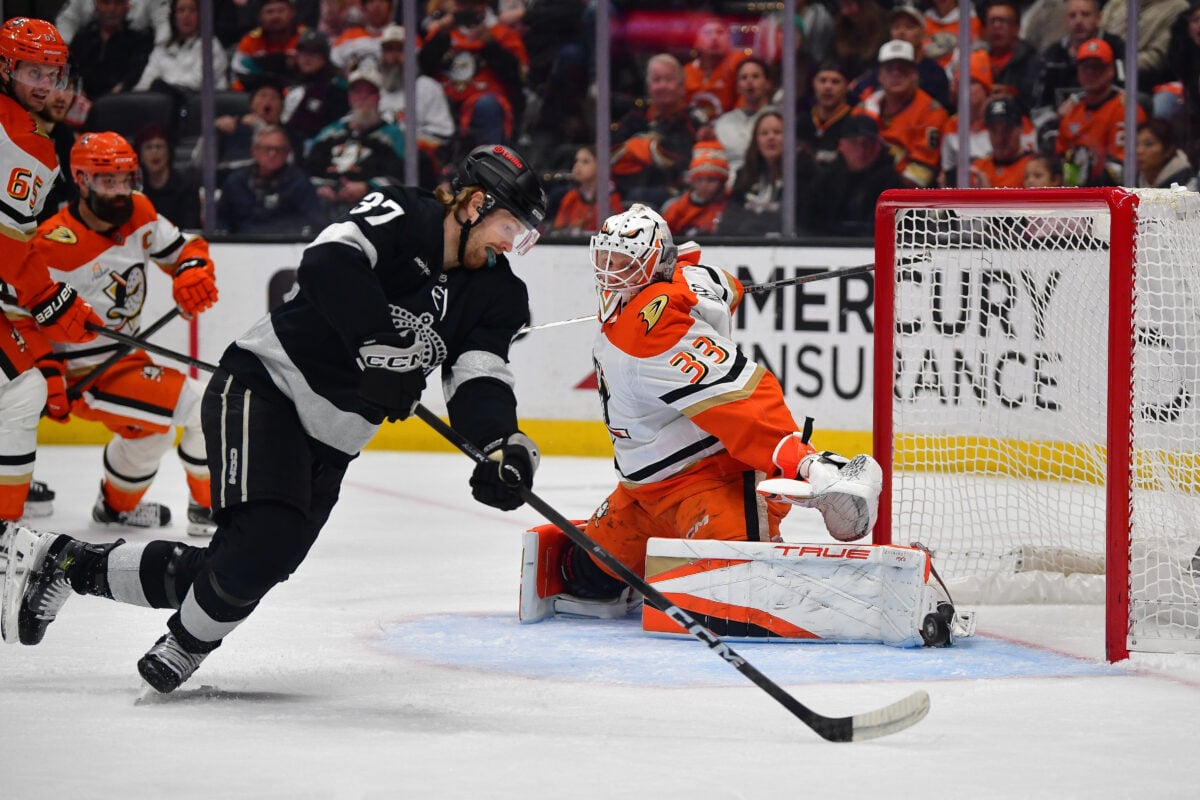
“I don’t think we were as fluid as we wanted to be in that situation. They kept taking penalties and kept giving us another chance to redeem ourselves, and we just didn’t seem fluid, didn’t seem like we were getting pucks to the net, and that’s unfortunate,” a visibly agitated Brandt Clarke said.
The Kings managed just eight shots throughout the six power plays they had, and it was their usual, predictable perimeter play, along with a low effort to get pucks toward the net, that stopped them from running away with a game the Ducks practically begged them to.
“I didn’t think we executed well at all…outside of that (5-on-3 goal) I didn’t think we executed, we didn’t generate enough rubber at the net…we didn’t attack inside enough, and so if there was a chance for us to win the game, that would have been it, and we didn’t execute there,” Hiller said.
Even when the Kings are handed prime chances to win games and run up the score, it’s a very rare occurrence that they take advantage of them. The magic word for the Kings right now is capitalizing. The inability to do so in whatever situation presents itself is the main reason they are struggling to win games.
“I think we’re all happy with the efforts we are putting forward. It’s just capitalization is first and foremost on the priority list right now, and it’s not working out for us as we want to,” Clarke said. “We’re there in every single game, and we want to win so bad. That’s all our entire bench is thinking about.”
The Kings were presented with a stretch of games against divisional opponents over the past two weeks, as well as an opportunity to pick up huge points in a tight race, and they came out of it 1-2-4, picking up six of a possible 14 points, averaging a measly 1.86 goals per game.
The effort remains there, the execution doesn’t, and even though it may feel as if the Kings are putting their best foot forward on most nights, Hiller recognizes it simply isn’t good enough.
Hiller: “What we’re doing isn’t enough”#GoKingsGo pic.twitter.com/Fy8eMlnvsZ
— Raz Devraj (@razdevraj) January 18, 2026
Scoring remains a major concern, and no matter how good the Kings’ defensive game is, it hasn’t been enough to win games. The NHL is filled with talent that will find ways to score, no matter how structured or tight a system a team plays. The Kings have been met with enough evidence of that over the course of this season, as well as their four straight playoff series losses to the Edmonton Oilers.
The way the Kings play doesn’t help in fixing their offensive struggles. The Kings historically haven’t been a team that relies on a heavy offensive output to win games, but sacrificing an aggressive forecheck, sitting back and trapping, and not taking risks to try and force turnovers or push the pace only works if a team can be opportunistic and capitalize, two things this season’s Kings are struggling with mightily.
Repeated mistakes don’t help either, and deployment has raised some questions. A team desperate to pick up two points should theoretically start their best offensive defenseman in overtime to give them the best chance of pushing the pace and controlling play in the offensive zone right off the bat, right?
Drew Doughty, despite having a goals-for percentage of 47.13, while Clarke’s sits at 63.01, continues to start in overtime. That’s just one stat, but Clarke leads all Kings defensemen in offensive metrics. No one is saying that Doughty starting in overtime is the reason for the losses. There have been some egregious turnovers that have killed the Kings, but it would be criminal not to realize the offensive capabilities of Clarke and recognize that he is the best option when it comes to needing a goal to win a game.
Related: ‘It’s Extremely Frustrating’: Lack of Results Beginning to Agitate Kings
Hiller mentioned before Saturday’s contest that his group hasn’t “hit their high” yet. If you’re 46 games into the season and haven’t hit your high yet, how can you be sure that there even is a high to be reached?
How much longer can the Kings continue dropping one-goal games? Feeling like they are playing well, but obviously not playing well enough to pick up wins? How much longer till management is willing to imprint their mark and switch something up? At what point do they have to realize that this could very well be the ceiling of the current group?
TSN insider Pierre Lebrun reported that Kings general manager Ken Holland doesn’t plan on making a coaching change as long as the Kings stay in the race. Continuing to collect loser points should keep them “in the race” in a division like the Pacific. With just seven wins in their last 23 games, the Kings are tied in points with both the San Jose Sharks (second wildcard spot) and the Seattle Kraken (third in the Pacific).
It’s both a good and bad thing for the Kings. On one hand, it minimizes the damage their struggles have on fighting for a playoff spot. They are still very much in the mix despite not deserving it. On the other hand, it blocks any significant change that the team could benefit from because they are still “in the race”.
Are the Kings content with continuing on like this while hoping enough teams don’t go on a run for the loser points to be enough to sneak into the playoffs? Something tells me that’s not the case, and a few more losses like this should cause some sort of shakeup; otherwise, this season is going to slip away from the Kings fast.

Free Newsletter
Get Los Angeles Kings coverage delivered to your inbox
In-depth analysis, breaking news, and insider takes - free.
Subscribe Free →